Department of Infectious Diseases, Beijing Children's Hospital, Capital Medical University, National Center for Children's Health, Nalishi Road 56#, Xicheng, Beijing, 100045, China.
Department of Infection, Hebei Children's Hospital, Shijiazhuang, China.
BMC Infect Dis. 2021 Nov 15;21(1):1156. doi: 10.1186/s12879-021-06860-8.
Streptococcus pneumoniae (S. pneumoniae) is a major cause of bacterial meningitis, septicemia and pneumonia in children. Inappropriate choice of antibiotic can have important adverse consequences for both the individual and the community. Here, we focused on penicillin/cefotaxime non-susceptibility of S. pneumoniae and evaluated appropriateness of targeted antibiotic therapy for children with IPD (invasive pneumococcal diseases) in China.
A multicenter retrospective study was conducted in 14 hospitals from 13 provinces in China. Antibiotics prescription, clinical features and resistance patterns of IPD cases from January 2012 to December 2017 were collected. Appropriateness of targeted antibiotics therapy was assessed.
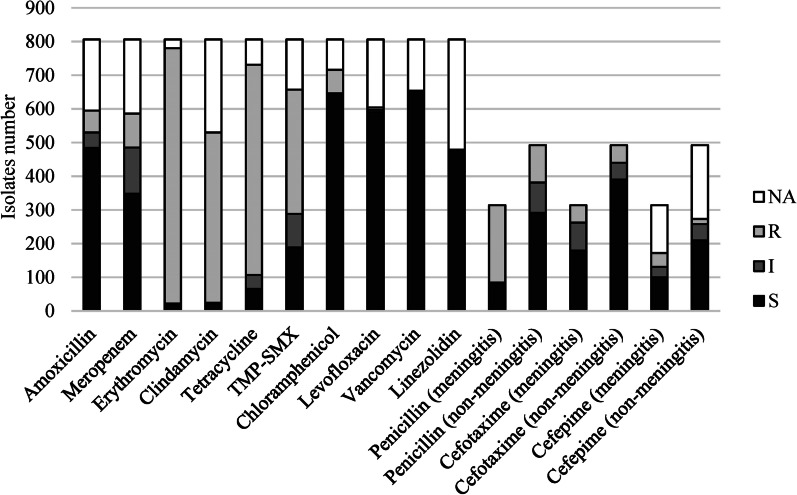
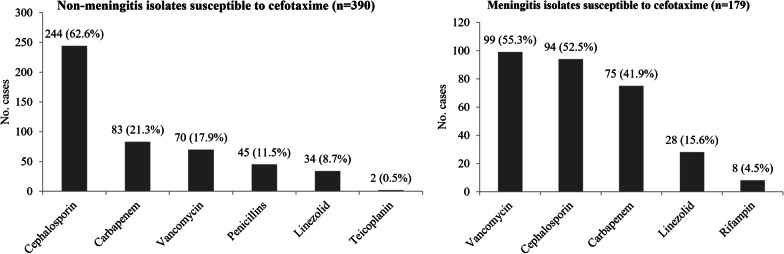
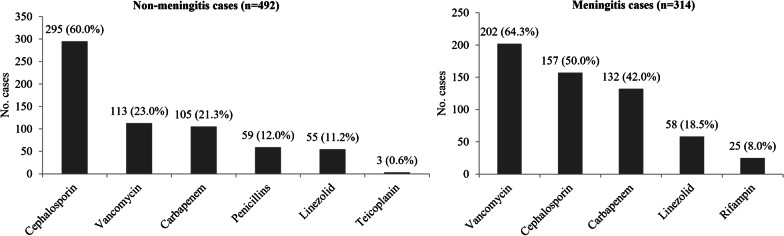
806 IPD cases were collected. The non-susceptibility rates of S. pneumoniae to penicillin and cefotaxime were 40.9% and 20.7% respectively in 492 non-meningitis cases, whereas those were 73.2% and 43.0% respectively in 314 meningitis cases. Carbapenems were used in 21.3% of non-meningitis cases and 42.0% of meningitis cases for targeted therapy. For 390 non-meningitis cases with isolates susceptible to cefotaxime, vancomycin and linezolid were used in 17.9% and 8.7% of cases respectively for targeted therapy. For 179 meningitis cases with isolates susceptible to cefotaxime, vancomycin and linezolid were prescribed in 55.3% and 15.6% of cases respectively. Overall, inappropriate targeted therapies were identified in 361 (44.8%) of 806 IPD cases, including 232 (28.8%) cases with inappropriate use of carbapenems, 169 (21.0%) cases with inappropriate use of vancomycin and 62 (7.7%) cases with inappropriate use of linezolid.
Antibiotic regimens for IPD definite therapy were often excessive with extensive prescription of carbapenems, vancomycin or linezolid in China. Antimicrobial stewardship programs should be implemented to improve antimicrobial use.
肺炎链球菌(S. pneumoniae)是导致儿童细菌性脑膜炎、败血症和肺炎的主要原因。抗生素选择不当会对个体和社区产生重要的不良后果。在这里,我们重点关注肺炎链球菌对青霉素/头孢噻肟的不敏感性,并评估中国儿童侵袭性肺炎球菌病(IPD)的靶向抗生素治疗的适宜性。
我们在中国 13 个省的 14 家医院进行了一项多中心回顾性研究。收集了 2012 年 1 月至 2017 年 12 月期间 IPD 病例的抗生素处方、临床特征和耐药模式。评估了靶向抗生素治疗的适宜性。
共收集了 806 例 IPD 病例。在 492 例非脑膜炎病例中,肺炎链球菌对青霉素和头孢噻肟的不敏感性率分别为 40.9%和 20.7%,而在 314 例脑膜炎病例中,这两种药物的不敏感性率分别为 73.2%和 43.0%。碳青霉烯类药物在 21.3%的非脑膜炎病例和 42.0%的脑膜炎病例中被用于靶向治疗。对于 390 例对头孢噻肟敏感的非脑膜炎分离株,万古霉素和利奈唑胺分别在 17.9%和 8.7%的病例中被用于靶向治疗。对于 179 例对头孢噻肟敏感的脑膜炎分离株,万古霉素和利奈唑胺分别在 55.3%和 15.6%的病例中被处方。总体而言,在 806 例 IPD 病例中,有 361 例(44.8%)的靶向治疗方案不合适,其中 232 例(28.8%)碳青霉烯类药物使用不当,169 例(21.0%)万古霉素使用不当,62 例(7.7%)利奈唑胺使用不当。
在中国,治疗 IPD 的抗生素方案通常过于广泛,广泛使用碳青霉烯类、万古霉素或利奈唑胺。应实施抗菌药物管理计划以改善抗菌药物的使用。