Stem Cell Research Laboratory, Medical Genetics Institute, Shaare Zedek Medical Center, Jerusalem, Israel.
Hebrew University Medical School, Jerusalem, Israel.
Eur J Hum Genet. 2022 Aug;30(8):980-983. doi: 10.1038/s41431-021-00999-3. Epub 2021 Nov 15.
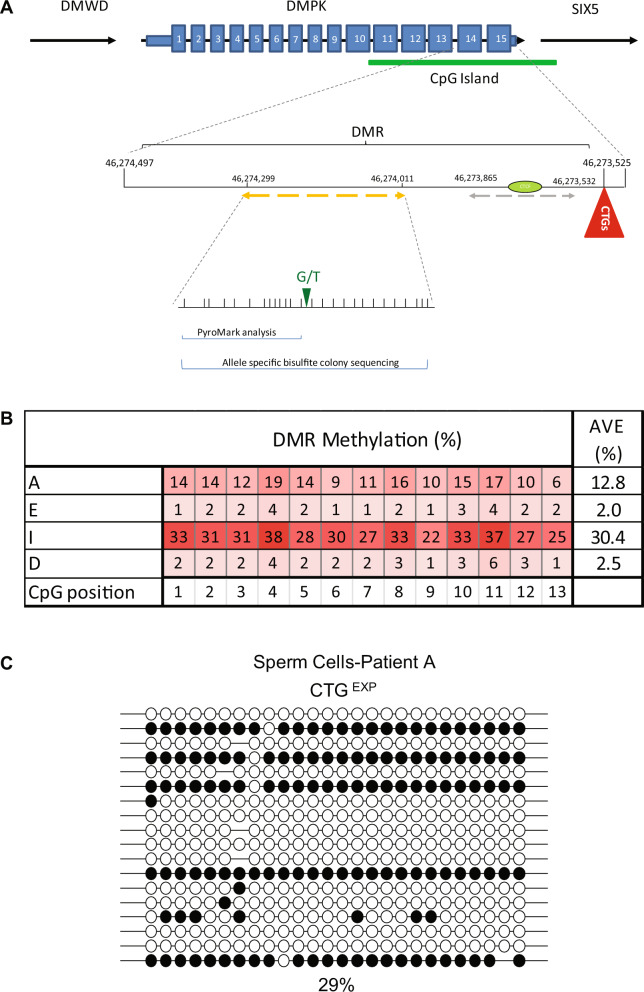
Myotonic dystrophy type 1 (DM1) is an autosomal dominant muscular dystrophy that results from a CTG expansion (50-4000 copies) in the 3' UTR of the DMPK gene. The disease is classified into four or five somewhat overlapping forms, which incompletely correlate with expansion size in somatic cells of patients. With rare exception, it is affected mothers who transmit the congenital (CDM1) and most severe form of the disease. Why CDM1 is hardly ever transmitted by fathers remains unknown. One model to explain the almost exclusive transmission of CDM1 by affected mothers suggests a selection against hypermethylated large expansions in the germline of male patients. By assessing DNA methylation upstream to the CTG expansion in motile sperm cells of four DM1 patients, together with availability of human embryonic stem cell (hESCs) lines with paternally inherited hypermethylated expansions, we exclude the possibility that DMPK hypermethylation leads to selection against viable sperm cells (as indicated by motility) in DM1 patients.
肌强直性营养不良 1 型(DM1)是一种常染色体显性肌营养不良症,由 DMPK 基因 3'UTR 中的 CTG 扩展(50-4000 个拷贝)引起。该疾病分为四个或五个略有重叠的形式,与患者体细胞中的扩展大小不完全相关。除了极少数例外,患有先天性肌强直性营养不良症(CDM1)和最严重形式疾病的都是患病母亲在传递疾病。为什么 CDM1 很少由父亲传递仍然未知。一个解释为什么几乎只由患病母亲传递 CDM1 的模型表明,在男性患者的生殖系中存在对高度甲基化的大扩展的选择。通过评估四个 DM1 患者游动精子细胞中 CTG 扩展上游的 DNA 甲基化情况,以及具有父系遗传高度甲基化扩展的人类胚胎干细胞(hESC)系的可用性,我们排除了 DMPK 高甲基化导致 DM1 患者有活力的精子细胞(如运动性)选择的可能性。