Wood Andrea J, Carroll Amber R, Shinn Ann K, Ongur Dost, Lewandowski Kathryn E
Schizophrenia and Bipolar Disorder Research Program, McLean Hospital, Belmont, MA, United States.
Department of Psychiatry, Harvard Medical School, Boston, MA, United States.
Front Psychiatry. 2021 Oct 28;12:734272. doi: 10.3389/fpsyt.2021.734272. eCollection 2021.
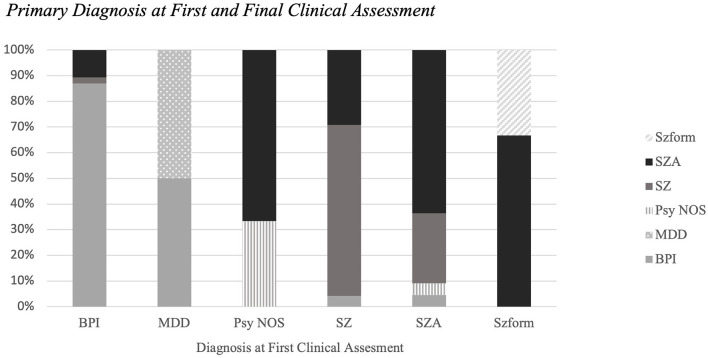
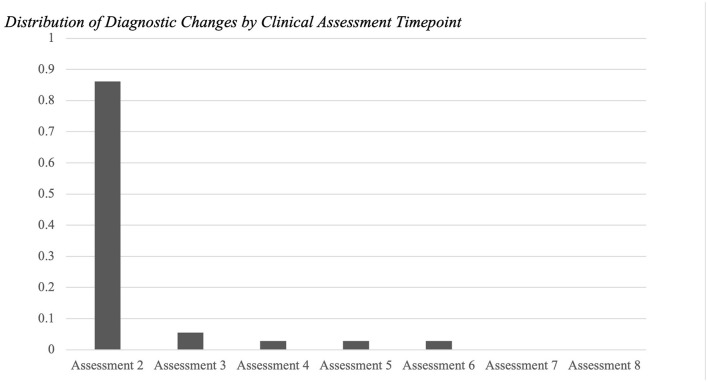
Psychiatric diagnosis is often treated as a stable construct both clinically and in research; however, some evidence suggests that diagnostic change may be common, which may impact research validity and clinical care. In the present study we examined diagnostic stability in individuals with psychosis over time. Participants with a diagnosis of any psychotic disorder ( = 142) were assessed at two timepoints using the Structured Clinical Interview for Diagnostic and Statistical Manual of Mental Disorders. We found a 25.4% diagnostic change rate across the total sample. People with an initial diagnosis of psychosis not otherwise specified and schizophreniform disorder had the highest rates of change, followed by those with schizophrenia and schizoaffective disorder; people with bipolar disorder had the lowest change rate. Most participants with an unstable initial diagnosis of schizophrenia, schizophreniform disorder, bipolar disorder, or psychosis not otherwise specified converted to a final diagnosis of schizoaffective disorder. Participants with an unstable initial diagnosis of schizoaffective disorder most frequently converted to a diagnosis of schizophrenia. Our findings suggest that diagnostic change is relatively common, occurring in approximately a quarter of patients. People with an initial diagnosis of schizophrenia-spectrum disorder were more likely to have a diagnostic change, suggesting a natural stability of some diagnoses more so than others.
在临床和研究中,精神科诊断通常被视为一个稳定的概念;然而,一些证据表明诊断变化可能很常见,这可能会影响研究效度和临床护理。在本研究中,我们考察了精神病患者诊断随时间的稳定性。对142名诊断为任何精神障碍的参与者在两个时间点使用《精神障碍诊断与统计手册》的结构化临床访谈进行评估。我们发现整个样本的诊断变化率为25.4%。最初诊断为未特定的精神障碍和精神分裂症样障碍的患者变化率最高,其次是精神分裂症和分裂情感性障碍患者;双相情感障碍患者的变化率最低。大多数最初诊断不稳定的精神分裂症、精神分裂症样障碍、双相情感障碍或未特定的精神障碍患者最终被诊断为分裂情感性障碍。最初诊断不稳定的分裂情感性障碍患者最常转变为精神分裂症诊断。我们的研究结果表明诊断变化相对常见,约四分之一的患者会出现这种情况。最初诊断为精神分裂症谱系障碍的患者更有可能发生诊断变化,这表明某些诊断比其他诊断具有更强的自然稳定性。