Department of Pharmacy, Ruijin Hospital, Shanghai Jiao Tong University School of Medicine, Shanghai, China.
Department of Pharmacy, Xi'an Children's Hospital, Xi'an, China.
Oxid Med Cell Longev. 2021 Oct 21;2021:4190098. doi: 10.1155/2021/4190098. eCollection 2021.
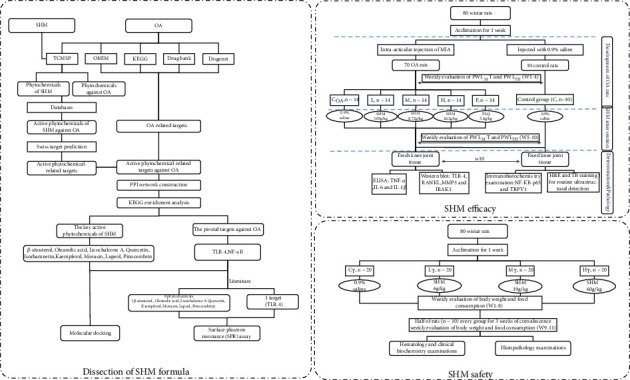
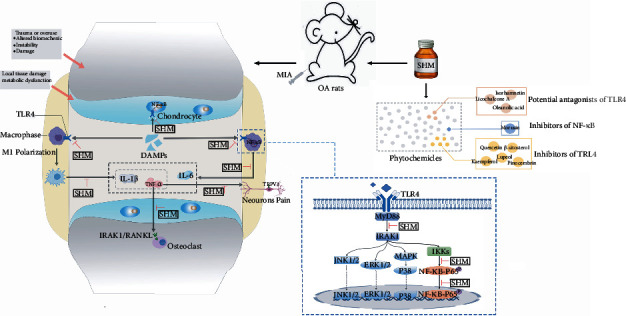
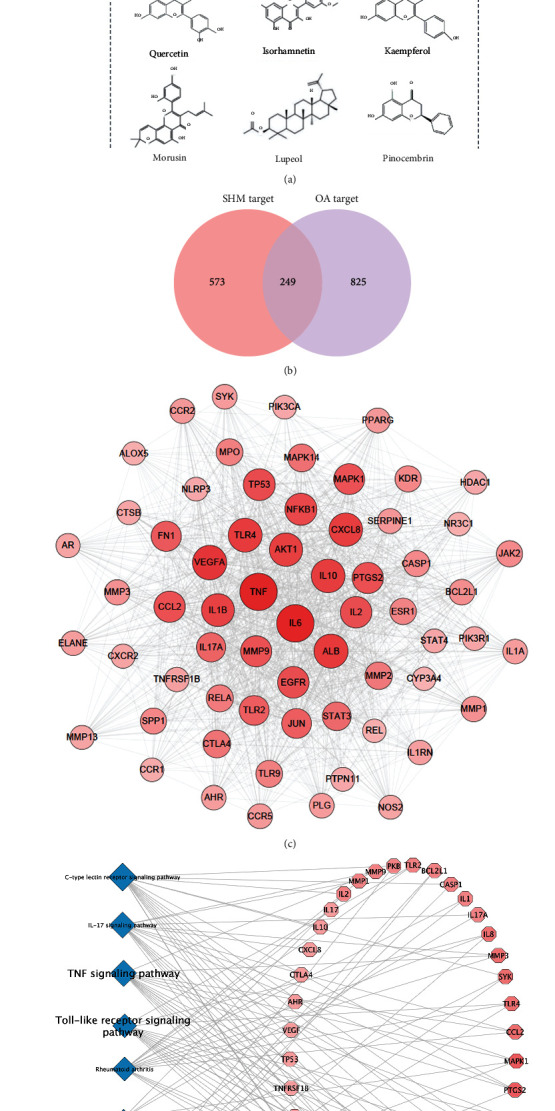
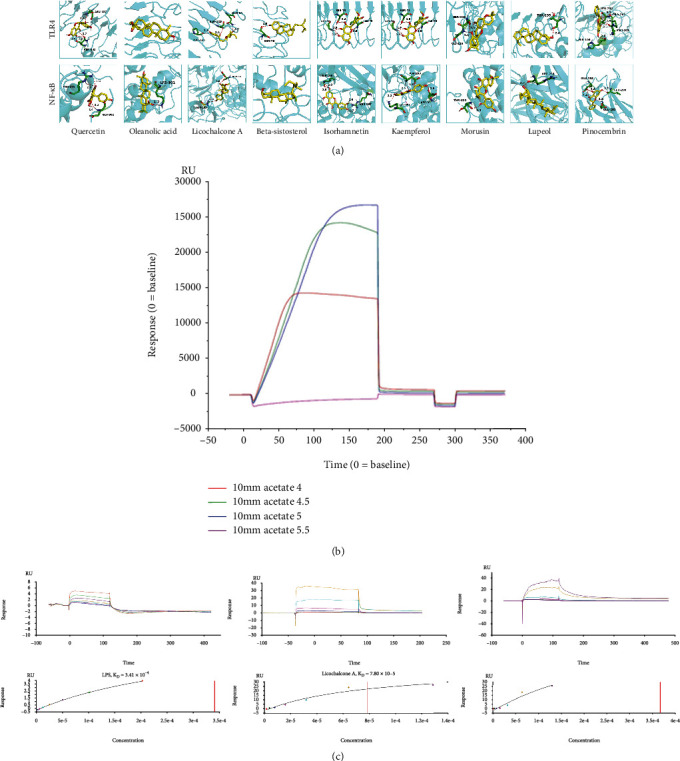
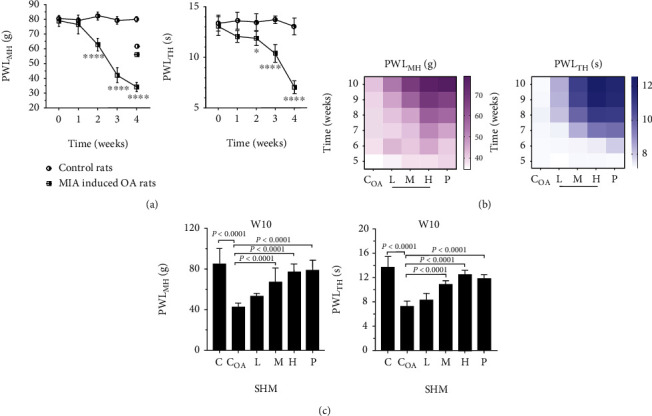
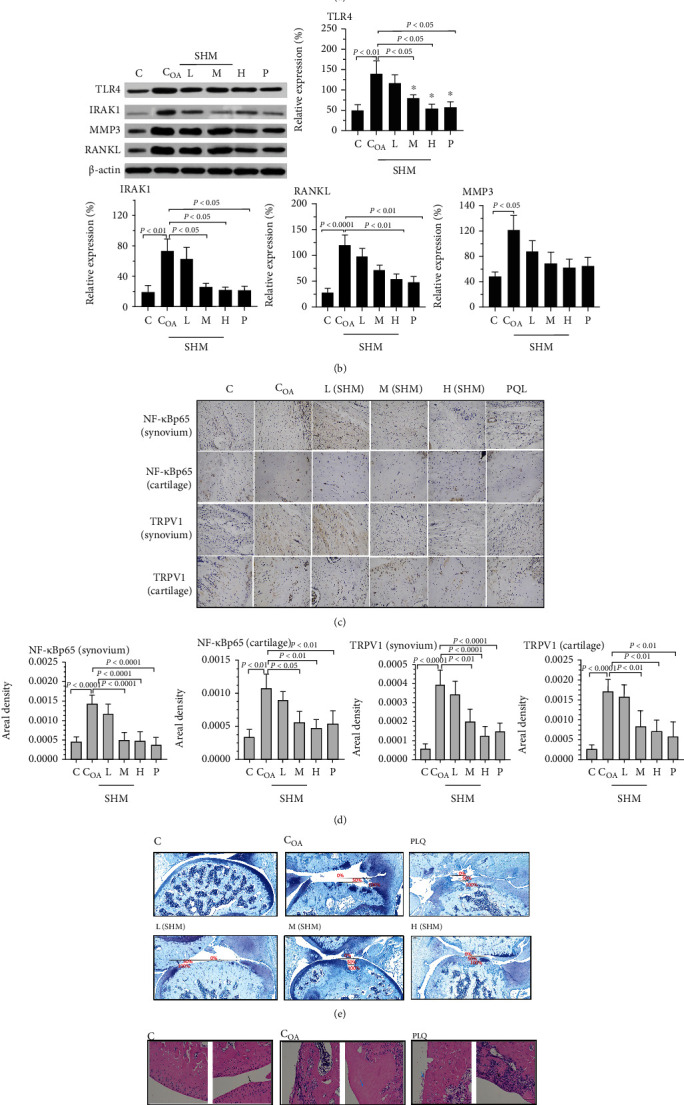
Osteoarthritis (OA), a highly prevalent chronic joint disease, involves a complex network of inflammatory mediators that not only triggers pain and cartilage degeneration but also accelerates disease progression. Traditional Chinese medicinal shenjinhuoxue mixture (SHM) shows anti-inflammatory and analgesic effects against OA with remarkable clinical efficacy. This study explored the mechanism underlying anti-OA properties of SHM and evaluated its efficacy and safety via in vivo experiments. Through network pharmacology and published literature, we identified the key active phytochemicals in SHM, including -sitosterol, oleanolic acid, licochalcone A, quercetin, isorhamnetin, kaempferol, morusin, lupeol, and pinocembrin; the pivotal targets of which are TLR-4 and NF-B, eliciting anti-OA activity. These phytochemicals can enter the active pockets of TLR-4 and NF-B with docking score ≤ -3.86 kcal/mol, as shown in molecular docking models. By using surface plasmon resonance assay, licochalcone A and oleanolic acid were found to have good TLR-4-binding affinity. In OA rats, oral SHM at mid and high doses (8.72 g/kg and 26.2 g/kg) over 6 weeks significantly alleviated mechanical and thermal hyperalgesia ( < 0.0001). Accordingly, the expression of inflammatory mediators (TLR-4, interleukin (IL-) 1 receptor-associated kinase 1 (IRAK1), NF-B-p65, tumor necrosis factor (TNF-) , IL-6, and IL-1), receptor activator of the NF-B ligand (RANKL), and transient receptor potential vanilloid 1 (TRPV1) in the synovial and cartilage tissue of OA rats was significantly decreased ( < 0.05). Moreover, pathological observation illustrated amelioration of cartilage degeneration and joint injury. In chronic toxicity experiment of rats, SHM at 60 mg/kg demonstrated the safety. SHM had an anti-inflammatory effect through a synergistic combination of active phytochemicals to attenuate pain and cartilage degeneration by inhibiting TLR-4 and NF-B activation. This study provided the experimental foundation for the development of SHM into a more effective dosage form or new drugs for OA treatment.
骨关节炎(OA)是一种高发的慢性关节疾病,涉及到复杂的炎症介质网络,不仅引发疼痛和软骨退化,还加速了疾病的进展。中药补肾活血合剂(SHM)具有抗炎和镇痛作用,对 OA 具有显著的临床疗效。本研究通过体内实验探讨了 SHM 的抗 OA 作用机制,并评估了其疗效和安全性。通过网络药理学和已发表的文献,我们确定了 SHM 中的关键活性植物化学物质,包括β-谷甾醇、齐墩果酸、甘草查尔酮 A、槲皮素、异鼠李素、山奈酚、桑辛素、羽扇豆醇、和 pinocembrin;其关键靶点是 TLR-4 和 NF-B,从而发挥抗 OA 活性。这些植物化学物质可以通过分子对接模型进入 TLR-4 和 NF-B 的活性口袋,对接评分≤-3.86 kcal/mol。通过表面等离子体共振测定法,发现甘草查尔酮 A 和齐墩果酸与 TLR-4 具有良好的结合亲和力。在 OA 大鼠中,口服 SHM 中、高剂量(8.72 g/kg 和 26.2 g/kg)6 周后,显著缓解机械性和热痛觉过敏(<0.0001)。相应地,OA 大鼠滑膜和软骨组织中炎症介质(TLR-4、白细胞介素(IL-)1 受体相关激酶 1(IRAK1)、NF-B-p65、肿瘤坏死因子(TNF-)、IL-6 和 IL-1)、核因子-κB 配体(RANKL)和瞬时受体电位香草酸 1(TRPV1)的表达显著降低(<0.05)。此外,病理观察表明软骨退化和关节损伤得到改善。在大鼠慢性毒性实验中,SHM 剂量为 60mg/kg 时表现出安全性。SHM 通过活性植物化学物质的协同组合发挥抗炎作用,通过抑制 TLR-4 和 NF-B 的激活来减轻疼痛和软骨退化。本研究为 SHM 开发成更有效的剂型或治疗 OA 的新药提供了实验基础。