Li Jing, Gao Na, Gao Zhengfan, Liu Wei, Pang Bairen, Dong Xingli, Li Yong, Fan Tianli
Department of Pharmacology, School of Basic Medical Science, Zhengzhou University, Zhengzhou, China.
St George Hospital, St George and Sutherland Clinical School, Faculty of Medicine, UNSW Sydney, Kensington, NSW, Australia.
Front Cell Dev Biol. 2021 Oct 28;9:737962. doi: 10.3389/fcell.2021.737962. eCollection 2021.
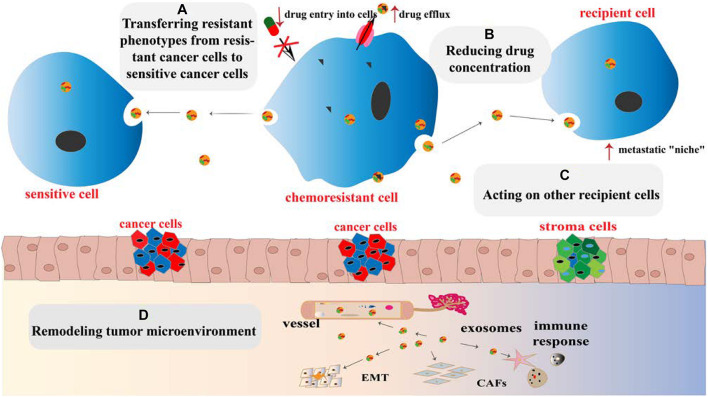
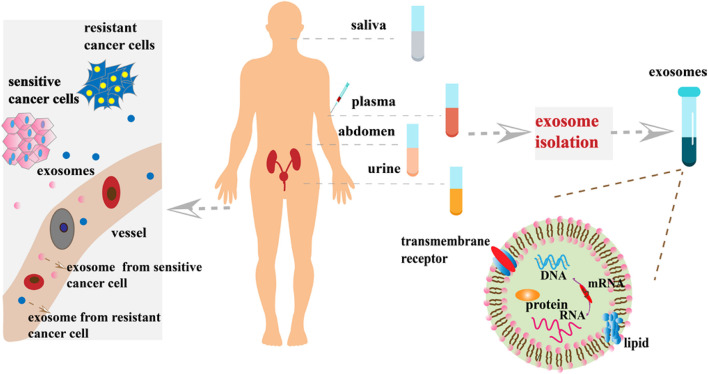
Chemoresistance is an impending challenge in cancer treatment. In recent years, exosomes, a subtype of extracellular vesicles with a diameter of 40-150 nm in bloodstream and other bio-fluids, have attracted increasing interest. Exosomes contain proteins, nucleic acids, and lipids, which act as important signaling molecules. Many reports indicate that exosomes play critical roles in chemoresistance through intercellular interactions, including drug removal from cells, transfer of drug resistance phenotypes to other cancer cells, and the increase in plastic stem cell subsets. Exosomes can reflect the physiological and pathological state of parent cells. Owing to their elevated stability, specificity, and sensitivity, exosomes are served as biomarkers in liquid biopsies to monitor cancer chemoresistance, progression, and recurrence. This review summarizes the exosome-mediated mechanisms of cancer chemoresistance, as well as its role in reversing and monitoring chemoresistance. The scientific and technological challenges and future applications of exosomes are also explored.
化疗耐药是癌症治疗中一个迫在眉睫的挑战。近年来,外泌体作为细胞外囊泡的一种亚型,在血液和其他生物流体中的直径为40-150纳米,已引起越来越多的关注。外泌体含有蛋白质、核酸和脂质,它们作为重要的信号分子发挥作用。许多报告表明,外泌体通过细胞间相互作用在化疗耐药中发挥关键作用,包括从细胞中清除药物、将耐药表型转移到其他癌细胞以及增加可塑性干细胞亚群。外泌体可以反映亲本细胞的生理和病理状态。由于其稳定性、特异性和敏感性的提高,外泌体在液体活检中作为生物标志物用于监测癌症的化疗耐药性、进展和复发。本综述总结了外泌体介导的癌症化疗耐药机制,以及其在逆转和监测化疗耐药中的作用。还探讨了外泌体的科学技术挑战和未来应用。