Ding Lili, Zhang Wanwan, Zhang Fengling, Huang Chaoqun, Yang Ming, Tang Zhouping, Li Yongwu, Mi Jun, Zhong Weimin
The Fifth Hospital of Xiamen, Xiamen, China.
Affiliated Union Hospital Pingtan Branch, Fujian Medical University, Fuzhou, China.
Front Med (Lausanne). 2021 Oct 27;8:733274. doi: 10.3389/fmed.2021.733274. eCollection 2021.
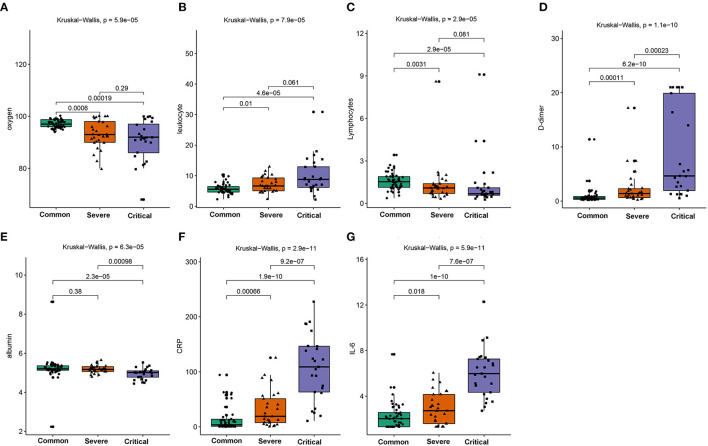
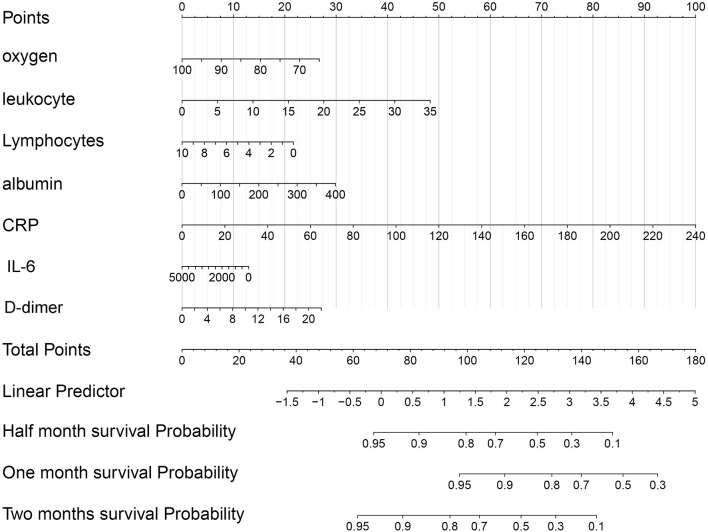
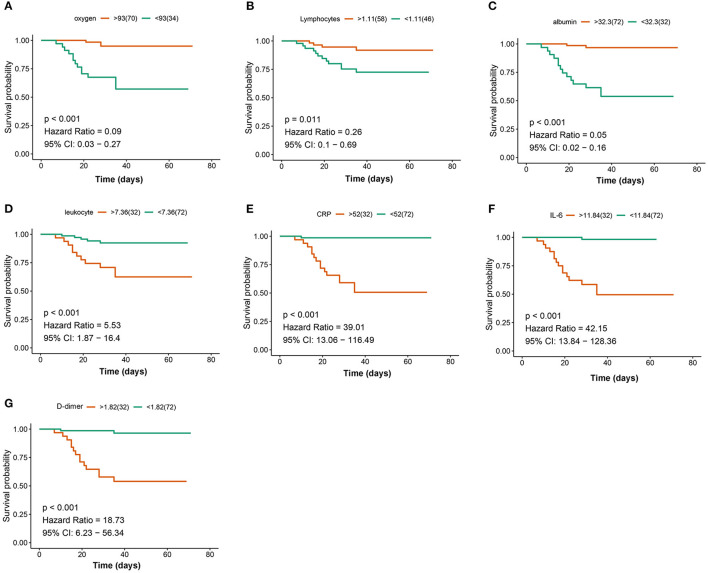
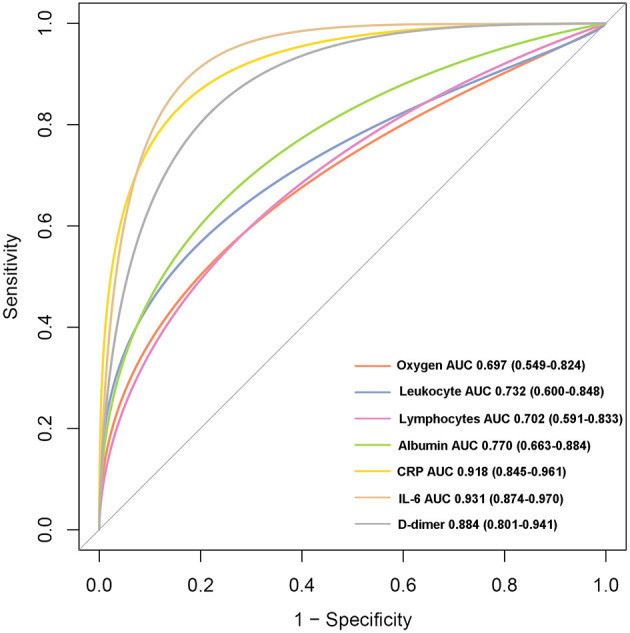
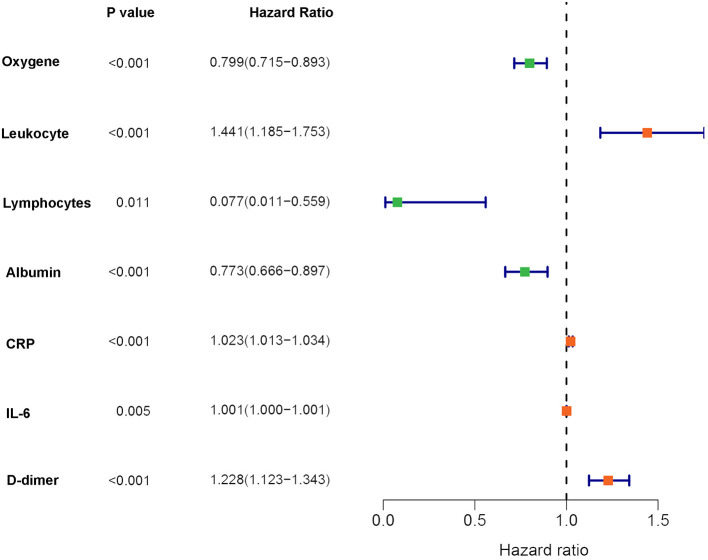
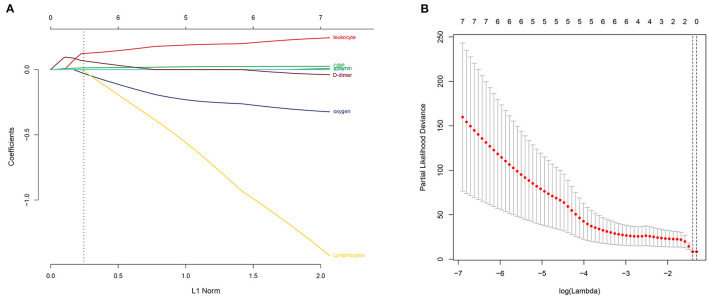
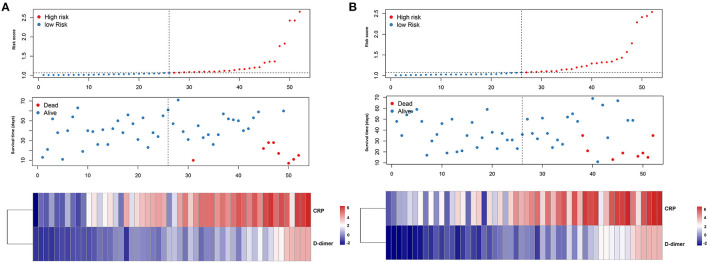
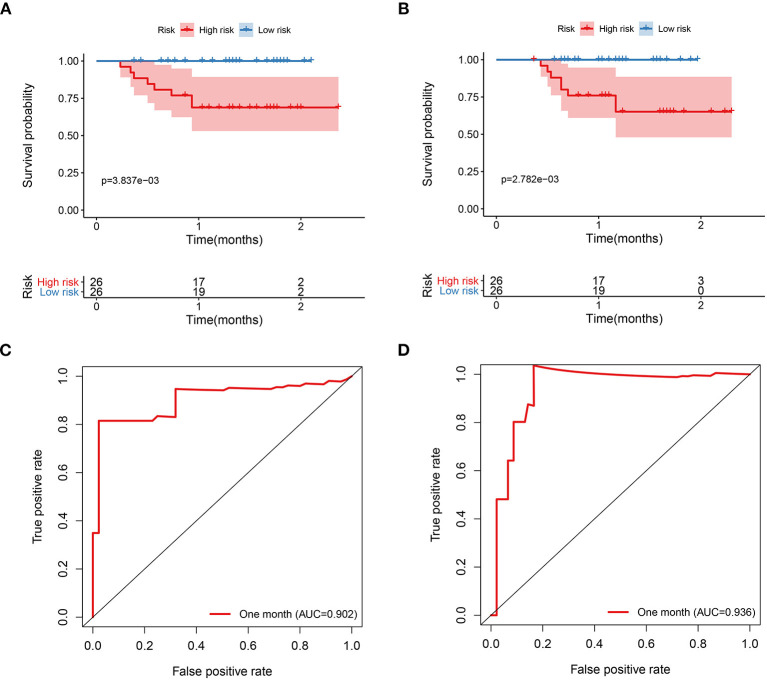
The prognostic role and diagnostic ability of coronavirus disease 2019 (COVID-19) disease indicators are not elucidated, thus, the current study aimed to investigate the prognostic role and diagnostic ability of several COVID-19 disease indicators including the levels of oxygen saturation, leukocytes, lymphocytes, albumin, C-reactive protein (CRP), interleukin-6 (IL-6), and D-dimer in patients with COVID-19. The levels of oxygen saturation, lymphocytes, and albumin were significantly higher in the common and severe clinical type patients compared with those in critical type patients. However, levels of leukocytes, CRP, IL-6, and D-dimer were significantly lower in the common and severe type patients compared with those in critical type patients ( < 0.001). Moreover, the current study demonstrated that the seven indicators have good diagnostic and prognostic powers in patients with COVID-19. Furthermore, a two-indicator (CRP and D-dimer) prognostic signature in training and testing datasets was constructed and validated to better understand the prognostic role of the indicators in COVID-19 patients. The patients were classified into high-risk and low-risk groups based on the median-risk scores. The findings of the Kaplan-Meier curve analysis indicated a significant divergence between the high-risk and low-risk groups. The findings of the receiver operating curve (ROC) analysis indicated the good performance of the signature in the prognosis prediction of COVID-19. In addition, a nomogram was constructed to assist clinicians in developing clinical decision-making for COVID-19 patients. In conclusion, the findings of the current study demonstrated that the seven indicators are potential diagnostic markers for COVID-19 and a two-indicator prognostic signature identification may improve clinical management for COVID-19 patients.
2019冠状病毒病(COVID-19)疾病指标的预后作用和诊断能力尚未阐明,因此,本研究旨在调查包括血氧饱和度、白细胞、淋巴细胞、白蛋白、C反应蛋白(CRP)、白细胞介素-6(IL-6)和D-二聚体水平在内的几种COVID-19疾病指标在COVID-19患者中的预后作用和诊断能力。普通型和重型临床类型患者的血氧饱和度、淋巴细胞和白蛋白水平显著高于危重型患者。然而,普通型和重型患者的白细胞、CRP、IL-6和D-二聚体水平显著低于危重型患者(<0.001)。此外,本研究表明这七个指标在COVID-19患者中具有良好的诊断和预后能力。此外,构建并验证了训练和测试数据集中的双指标(CRP和D-二聚体)预后特征,以更好地了解这些指标在COVID-19患者中的预后作用。根据中位风险评分将患者分为高风险和低风险组。Kaplan-Meier曲线分析结果表明高风险组和低风险组之间存在显著差异。受试者工作特征曲线(ROC)分析结果表明该特征在COVID-19预后预测中表现良好。此外,构建了一个列线图,以协助临床医生为COVID-19患者制定临床决策。总之,本研究结果表明这七个指标是COVID-19的潜在诊断标志物,双指标预后特征识别可能改善COVID-19患者的临床管理。