Department of Critical Care Medicine, Jiangsu Provincial Key Laboratory of Critical Care Medicine, Zhongda Hospital, School of Medicine, Southeast University, Nanjing, 210009, China.
Department of Clinical Sciences, Liverpool School of Tropical Medicine, L3 5QA, Liverpool, UK.
BMC Infect Dis. 2020 Aug 6;20(1):584. doi: 10.1186/s12879-020-05314-x.
Coronavirus Disease-2019 (COVID-19) pandemic has become a major health event that endangers people health throughout China and the world. Understanding the factors associated with COVID-19 disease severity could support the early identification of patients with high risk for disease progression, inform prevention and control activities, and potentially reduce mortality. This study aims to describe the characteristics of patients with COVID-19 and factors associated with severe or critically ill presentation in Jiangsu province, China.
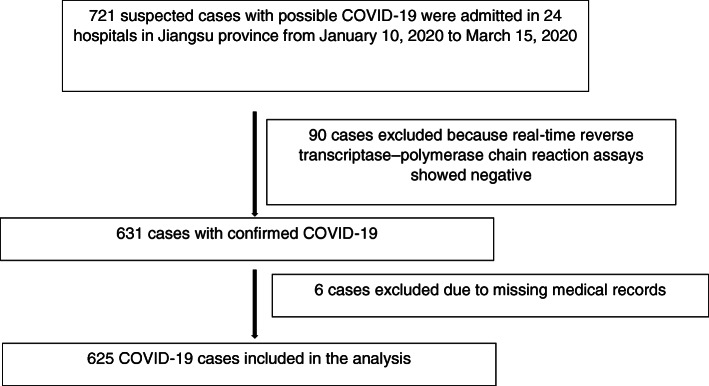
Multicentre retrospective cohort study of all individuals with confirmed Severe Acute Respiratory Syndrome Coronavirus-2 (SARS-CoV-2) infections diagnosed at 24 COVID-19-designated hospitals in Jiangsu province between the 10th January and 15th March 2020. Demographic, clinical, laboratory, and radiological data were collected at hospital admission and data on disease severity were collected during follow-up. Patients were categorised as asymptomatic/mild/moderate, and severe/critically ill according to the worst level of COVID-19 recorded during hospitalisation.
A total of 625 patients, 64 (10.2%) were severe/critically ill and 561 (89.8%) were asymptomatic/mild/moderate. All patients were discharged and no patients died. Patients with severe/critically ill COVID-19 were more likely to be older, to be single onset (i.e. not belong to a cluster of cases in a family/community, etc.), to have a medical history of hypertension and diabetes; had higher temperature, faster respiratory rates, lower peripheral capillary oxygen saturation (SpO), and higher computer tomography (CT) image quadrant scores and pulmonary opacity percentage; had increased C-reactive protein, fibrinogen, and D-dimer on admission; and had lower white blood cells, lymphocyte, and platelet counts and albumin on admission than asymptomatic/mild/moderate cases. Multivariable regression showed that odds of being a severe/critically ill case were associated with age (year) (OR 1.06, 95%CI 1.03-1.09), lymphocyte count (10/L) (OR 0.25, 95%CI 0.08-0.74), and pulmonary opacity in CT (per 5%) on admission (OR 1.31, 95%CI 1.15-1.51).
Severe or critically ill patients with COVID-19 is about one-tenths of patients in Jiangsu. Age, lymphocyte count, and pulmonary opacity in CT on admission were associated with risk of severe or critically ill COVID-19.
新型冠状病毒肺炎(COVID-19)疫情已成为危害全中国和全世界人民健康的重大卫生事件。了解与 COVID-19 疾病严重程度相关的因素可以帮助早期识别疾病进展风险较高的患者,为预防和控制活动提供信息,并可能降低死亡率。本研究旨在描述江苏省 COVID-19 患者的特征以及与严重或危重症表现相关的因素。
这是一项多中心回顾性队列研究,纳入 2020 年 1 月 10 日至 3 月 15 日期间江苏省 24 家 COVID-19 指定医院确诊的所有严重急性呼吸综合征冠状病毒-2(SARS-CoV-2)感染患者。收集入院时的人口统计学、临床、实验室和影像学数据,并在随访期间收集疾病严重程度数据。根据住院期间记录的 COVID-19 最严重程度,患者被分为无症状/轻症/中度和重症/危重症。
共纳入 625 例患者,64 例(10.2%)为重症/危重症,561 例(89.8%)为无症状/轻症/中度。所有患者均已出院,无患者死亡。重症/危重症 COVID-19 患者更可能年龄较大、为单发病例(即不属于家庭/社区等聚集性病例)、有高血压和糖尿病病史;体温较高、呼吸频率较快、外周毛细血管血氧饱和度(SpO)较低、计算机断层扫描(CT)图像象限评分和肺不透明度百分比较高;入院时 C 反应蛋白、纤维蛋白原和 D-二聚体升高,白细胞、淋巴细胞和血小板计数以及白蛋白降低。多变量回归显示,年龄(岁)(OR 1.06,95%CI 1.03-1.09)、淋巴细胞计数(10/L)(OR 0.25,95%CI 0.08-0.74)和入院时 CT 肺不透明度(每 5%)(OR 1.31,95%CI 1.15-1.51)与重症/危重症病例的发生有关。
江苏省 COVID-19 重症或危重症患者约占患者总数的十分之一。年龄、淋巴细胞计数和入院时 CT 肺不透明度与 COVID-19 重症或危重症的风险相关。