Helmholtz International Laboratory for Anti-Infectives, Shandong University-Helmholtz Institute of Biotechnology, State Key Laboratory of Microbial Technology, Shandong University, Qingdao, China.
Institute of Agricultural Resources and Environment, Shandong Academy of Agricultural Sciences, Jinan, China.
J Sci Food Agric. 2022 May;102(7):3038-3046. doi: 10.1002/jsfa.11645. Epub 2021 Nov 26.
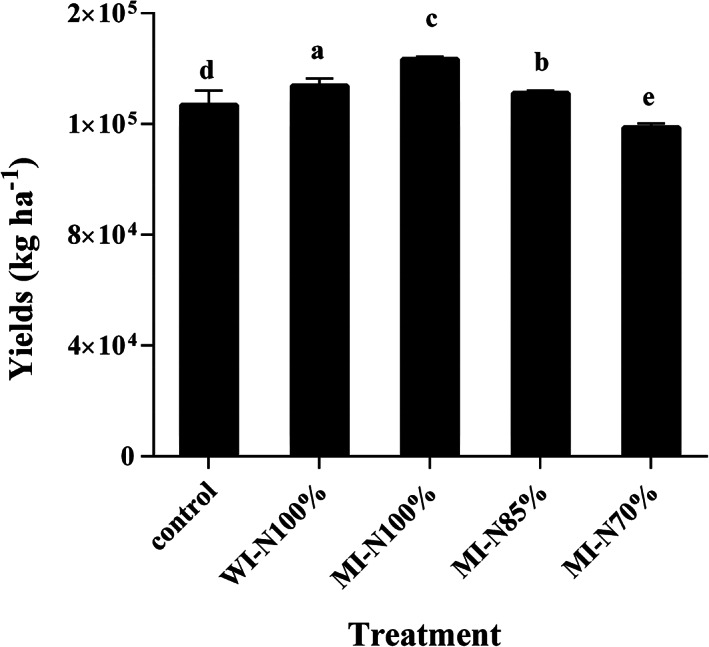
Excessive nitrogen (N) fertilization in glasshouse fields greatly increases N loss and fossil-fuel energy consumption resulting in serious environmental risks. Microbial inoculants are strongly emerging as potential alternatives to agrochemicals and offer an eco-friendly fertilization strategy to reduce our dependence on synthetic chemical fertilizers. Effects of a N-fixing strain Pseudomonas protegens CHA0-ΔretS-nif on ginger plant growth, yield, and nutrient uptake, and on earthworm biomass and the microbial community were investigated in glasshouse fields in Shandong Province, northern China.
Application of CHA0-ΔretS-nif could promote ginger plant development, and significantly increased rhizome yields, by 12.93% and 7.09%, respectively, when compared to uninoculated plants and plants treated with the wild-type bacterial strain. Inoculation of CHA0-ΔretS-nif had little impact on plant phosphorus (P) acquisition, whereas it was associated with enhanced N and potassium (K) acquisition by ginger plants. Moreover, inoculation of CHA0-ΔretS-nif had positive effects on the bacteria population size and the number of earthworms in the rhizosphere. Similar enhanced performances were also found in CHA0-ΔretS-nif-inoculated ginger plants even when the N-fertilizer application rate was reduced by 15%. A chemical N input of 573.8 kg ha with a ginger rhizome yield of 1.31 × 10 kg ha was feasible.
The combined application of CHA0-ΔretS-nif and a reduced level of N-fertilizers can be employed in glasshouse ginger production for the purpose of achieving high yields while at the same time reducing the inorganic-N pollution from traditional farming practices. © 2021 The Authors. Journal of The Science of Food and Agriculture published by John Wiley & Sons Ltd on behalf of Society of Chemical Industry.
温室田过度施氮肥会导致大量氮素流失和化石燃料能源消耗,从而带来严重的环境风险。微生物接种剂作为农用化学品的替代品,具有很大的发展潜力,为减少对合成化肥的依赖提供了一种环保的施肥策略。本研究在中国山东省的温室田,调查了固氮菌 Pseudomonas protegens CHA0-ΔretS-nif 对生姜植株生长、产量和养分吸收以及蚯蚓生物量和微生物群落的影响。
与未接种植物和野生型细菌处理的植物相比,应用 CHA0-ΔretS-nif 可促进生姜植株发育,分别使根茎产量显著增加 12.93%和 7.09%。接种 CHA0-ΔretS-nif 对植物磷(P)吸收影响不大,但与生姜植物对氮(N)和钾(K)的吸收增强有关。此外,接种 CHA0-ΔretS-nif 对根际细菌种群大小和蚯蚓数量有积极影响。即使减少 15%的氮肥施用量,在接种 CHA0-ΔretS-nif 的生姜植株中也发现了类似的增强表现。在化学 N 投入 573.8 kg/公顷、生姜根茎产量 1.31×10 公斤/公顷的情况下是可行的。
在温室生姜生产中,可将 CHA0-ΔretS-nif 与减少的氮肥水平联合应用,以实现高产,同时减少传统农业实践带来的无机-N 污染。© 2021 作者。《食品科学杂志》由 John Wiley & Sons Ltd 代表化学工业协会出版。