Daviet Florence, Guilloux Philippe, Hraiech Sami, Tonon David, Velly Lionel, Bourenne Jeremy, Porto Alizée, Gragueb-Chatti Inès, Bobot Mickael, Baumstarck Karine, Papazian Laurent, Collart Frédéric, Forel Jean-Marie, Guervilly Christophe
Medecine Intensive Réanimation, Centre hospitalier Universitaire L'Hôpital Nord, Assistance Publique hôpitaux de Marseille, chemin des Bourrely, 13015, Marseille, France.
Faculté de Médecine Centre d'Études et de Recherches sur les Services de Santé et qualité de vie EA 3279, Aix-Marseille Université, 13005, Marseille, France.
Ann Intensive Care. 2021 Nov 15;11(1):157. doi: 10.1186/s13613-021-00943-0.
Since March 2020, health care systems were importantly affected by severe acute respiratory syndrome coronavirus 2 (SARS-CoV-2) outbreak, with some patients presenting severe acute respiratory distress syndrome (ARDS), requiring extra-corporeal membrane oxygenation (ECMO). We designed an ambispective observational cohort study including all consecutive adult patients admitted to 5 different ICUs from a university hospital. The main objective was to identify the risk factors of severe COVID-19 ARDS patients supported by ECMO associated with 90-day survival.
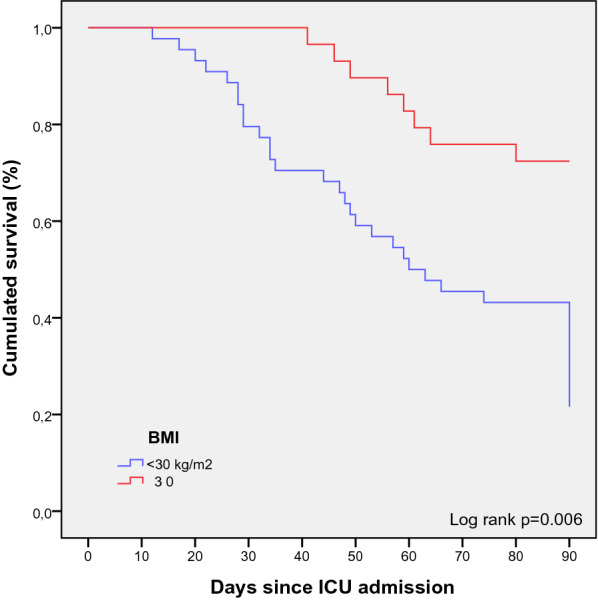
Between March 1st and November 30th 2020, 76 patients with severe COVID-19 ARDS were supported by ECMO. Median (interquartile range IQR) duration of mechanical ventilation (MV) prior to ECMO was of 6 (3-10) days. At ECMO initiation, patients had a median PaO:FiO of 71 mmHg (IQR 62-81), median PaCO of 58 mmHg (IQR 51-66) and a median arterial pH of 7.33 (IQR 7.25-7.38). Forty-five patients (59%) were weaned from ECMO. Twenty-eight day, 60-day and 90-day survival rates were, respectively, 92, 62 and 51%. In multivariate logistic regression analysis, with 2 models, one with the RESP score and one with the PRESERVE score, we found that higher BMI was associated with higher 90-day survival [odds ratio (OR): 0.775 (0.644-0.934), p = 0.007) and 0.631 (0.462-0.862), respectively]. Younger age was also associated with 90-day survival in both models [OR: 1.1354 (1.004-1.285), p = 0.044 and 1.187 (1.035-1.362), p = 0.014 respectively]. Obese patients were ventilated with higher PEEP than non-obese patients and presented slightly higher respiratory system compliance.
In this ambispective observational cohort of COVID-19 severe ARDS supported by ECMO, obesity was an independent factor associated with improved survival at 90-day.
自2020年3月以来,医疗系统受到严重急性呼吸综合征冠状病毒2(SARS-CoV-2)疫情的重大影响,一些患者出现严重急性呼吸窘迫综合征(ARDS),需要体外膜肺氧合(ECMO)。我们设计了一项回顾性观察队列研究,纳入了一家大学医院5个不同重症监护病房收治的所有连续成年患者。主要目的是确定接受ECMO支持的重症COVID-19 ARDS患者90天生存的危险因素。
2020年3月1日至11月30日期间,76例重症COVID-19 ARDS患者接受了ECMO支持。ECMO前机械通气(MV)的中位(四分位间距IQR)持续时间为6(3-10)天。开始ECMO时,患者的中位PaO:FiO为71 mmHg(IQR 62-81),中位PaCO为58 mmHg(IQR 51-66),中位动脉pH为7.33(IQR 7.25-7.38)。45例患者(59%)成功撤离ECMO。28天、60天和90天生存率分别为92%、62%和51%。在多因素逻辑回归分析中,使用两个模型,一个包含RESP评分,另一个包含PRESERVE评分,我们发现较高的BMI与较高的90天生存率相关[比值比(OR)分别为0.775(0.644-0.934),p = 0.007)和0.631(0.462-0.862)]。在两个模型中,较年轻的年龄也与90天生存率相关[OR分别为1.1354(1.004-1.285),p = 0.044和1.187(1.),p = 0.014]。肥胖患者通气时的呼气末正压(PEEP)高于非肥胖患者,呼吸系统顺应性略高。
在这个接受ECMO支持的COVID-19重症ARDS回顾性观察队列中,肥胖是与90天生存率提高相关的独立因素。