
美国类风湿关节炎患者中贫血、恶性肿瘤、静脉血栓栓塞、主要不良心血管事件及感染的发病率、患病率及相关费用与治疗史的关系
The Incidence, Prevalence, and Associated Costs of Anemia, Malignancy, Venous Thromboembolism, Major Adverse Cardiovascular Events, and Infections in Rheumatoid Arthritis Patients by Treatment History in the United States.
作者信息
Dore Robin K, Antonova Jenya N, Burudpakdee Chakkarin, Chang Lawrence, Gorritz Magdaliz, Genovese Mark C
机构信息
Private practice, Tustin, California.
Gilead Sciences, Foster City, California.
出版信息
ACR Open Rheumatol. 2022 Jun;4(6):473-482. doi: 10.1002/acr2.11376. Epub 2021 Nov 18.
OBJECTIVE
Comorbidities in rheumatoid arthritis (RA) can influence treatment selection, impact treatment persistency, and increase health care costs. This study assessed the magnitude of comorbidity burden via epidemiology (incidence and prevalence) and associated costs of select comorbidities in RA patients: anemia, malignancy, venous thromboembolism (VTE), major adverse cardiovascular events (MACE), and infections, stratified by history of disease-modifying antirheumatic drug (DMARD) exposure.
METHODS
From the IQVIA PharMetrics® Plus database, we selected adult patients with RA (2 or more RA diagnostic codes at least 30 days apart) at initiation of a new DMARD (DMARD-naïve), after the first conventional synthetic DMARD (csDMARD) or after the first biologic DMARD (bDMARD). We assessed pre-index prevalence (percentage) and on-treatment incidence (per 100 patient-years [P100PY]) of the aforementioned comorbidities. For patients with versus without incident conditions, we compared total all-cause health care costs as unadjusted and adjusted for baseline characteristics and health care costs.
RESULTS
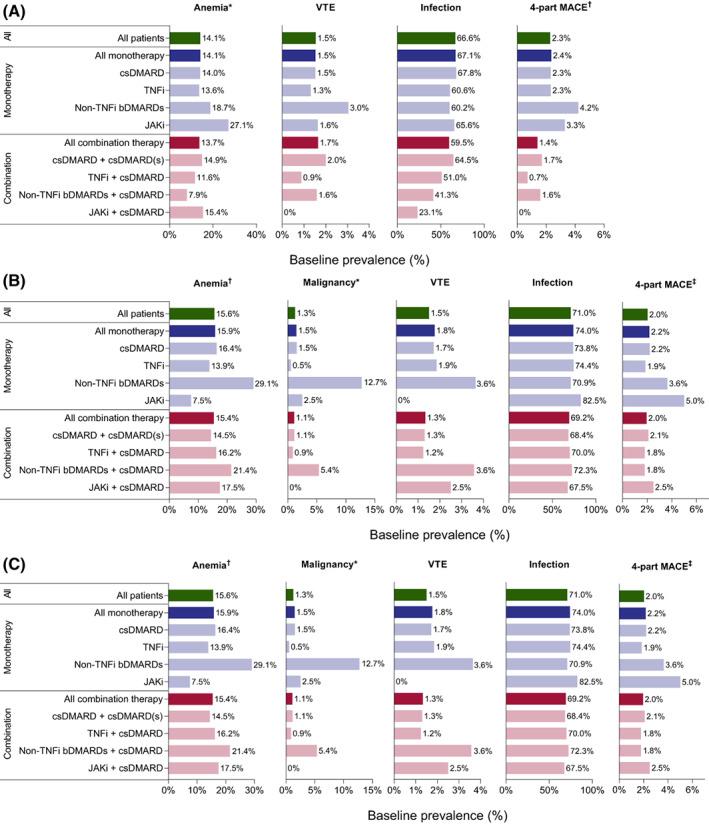
Prior to initiating a new treatment, among DMARD-naïve patients (N = 28,201), csDMARD switchers (N = 7,816), or bDMARD switchers (N = 4,656), the overall prevalence ranged from 14.1% to 16.2% (anemia), from 1.3% to 5.2% (malignancy, evaluated in csDMARD and bDMARD switchers), from 1.5% to 2.1% (VTE), from 1.8% to 2.9% (MACE), and from 66.6% to 76.1% (infections). Once on index treatment, overall incidence (P100PY) among the cohorts ranged from 6.9 to 8.9 (anemia), from 2.0 to 2.3 (malignancy), from 0.7 to 0.9 (VTE), from 1.6 to 2.0 (MACE), and from 77.4 to 87.7 (infections). The incident comorbidities (except herpes zoster) were associated with increased adjusted health care costs.
CONCLUSION
Anemia, malignancy, VTE, MACE, and infections affect patients with RA at all stages of their treatment journey and are associated with increased health care costs.
目的
类风湿关节炎(RA)的合并症会影响治疗方案的选择、影响治疗依从性并增加医疗成本。本研究通过流行病学(发病率和患病率)评估了RA患者特定合并症的合并症负担程度以及相关成本,这些合并症包括贫血、恶性肿瘤、静脉血栓栓塞(VTE)、主要不良心血管事件(MACE)和感染,并按疾病改善抗风湿药物(DMARD)暴露史进行分层。
方法
从IQVIA PharMetrics® Plus数据库中,我们选取了新开始使用DMARD(初治DMARD)、首次使用传统合成DMARD(csDMARD)或首次使用生物DMARD(bDMARD)后的成年RA患者(至少间隔30天有2个或更多RA诊断代码)。我们评估了上述合并症的索引前患病率(百分比)和治疗期间发病率(每100患者年[P100PY])。对于有与无新发疾病的患者,我们比较了未调整以及根据基线特征和医疗成本调整后的全因医疗总成本。
结果
在开始新治疗前,初治DMARD患者(N = 28,201)、csDMARD转换者(N = 7,816)或bDMARD转换者(N = 4,656)中,总体患病率范围为14.1%至16.2%(贫血)、1.3%至5.2%(恶性肿瘤,在csDMARD和bDMARD转换者中评估)、1.5%至2.1%(VTE)、1.8%至2.9%(MACE)以及66.6%至76.1%(感染)。一旦开始索引治疗,各队列的总体发病率(P100PY)范围为6.9至8.9(贫血)、2.0至2.3(恶性肿瘤)、0.7至0.9(VTE)、1.6至2.0(MACE)以及77.4至87.7(感染)。新发合并症(带状疱疹除外)与调整后的医疗成本增加相关。
结论
贫血、恶性肿瘤、VTE、MACE和感染在RA患者治疗过程的各个阶段都会对其产生影响,并与医疗成本增加相关。

 Zotero 插件