Kocot Ewa, Kotarba Paulina, Dubas-Jakóbczyk Katarzyna
Health Economics and Social Security Department, Institute of Public Health, Faculty of Health Sciences, Jagiellonian University Medical College, Krakow, Poland.
Department of Health, Małopolska Provincial Office in Krakow, Krakow, Poland.
Arch Public Health. 2021 Nov 18;79(1):201. doi: 10.1186/s13690-021-00729-7.
One of the most commonly used types of evaluation methods is cost-utility analysis (CUA), using the Quality Adjusted Life Year (QALY) indicator as a preference-based measure for assessing effects of a given programme. Such assessments are often translated into health-care provision priorities; therefore, effectively choosing the method of outcome evaluation is crucial for ensuring the best possible allocation of scarce resources. The main objective of this scoping review is to identify what kinds of problems and limitations may occur when the QALY indicator is used to assess the effects of health interventions in the older population.
To identify literature in a scoping review, the databases MEDLINE via PubMed and Scopus were searched. A manual search on relevant organizations' and associations' websites was also conducted (EUnetHTA, ISPOR and national governmental agencies responsible for allocation decisions). No limits concerning publication dates were set. All relevant data were extracted and analyzed, then a narrative summary was prepared.
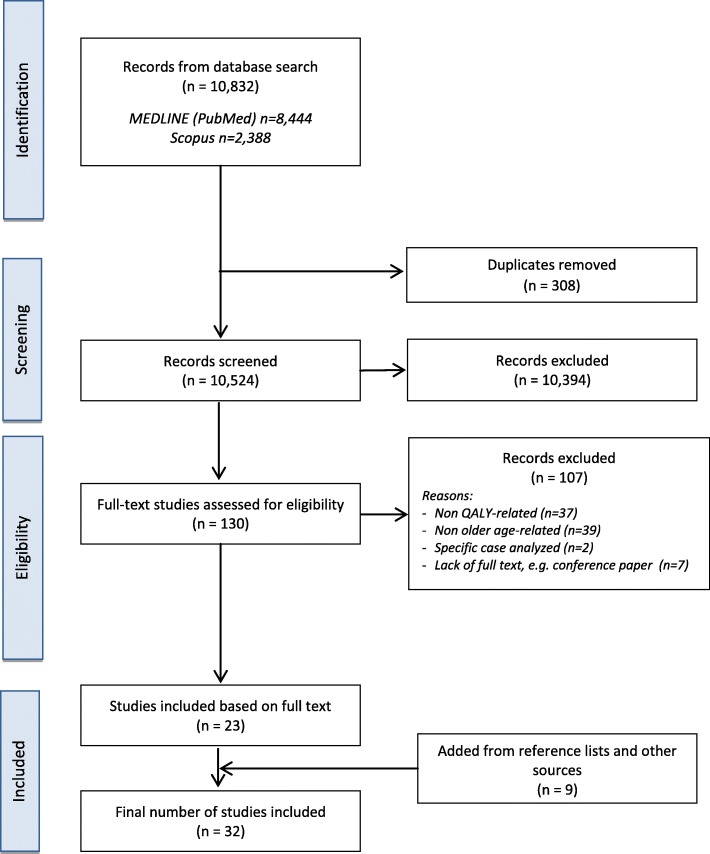
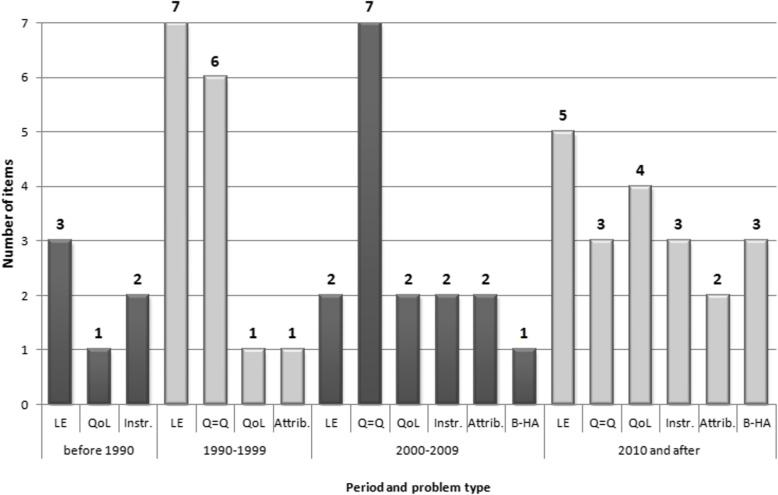
The database search identified 10,832 relevant items, finally 32 studies were included in the analysis. The main types of issues indicated in the studies were as follows: (1) lower life expectancy in the older population causes lower QALY gains; (2) an equal value of one QALY is used regardless of age; (3) poorer average health state causes lower QALY gains; (4) inadequate instruments to measure quality of life (QoL); (5) attributes of QoL used regardless of age; and (6) no beyond-health QoL aspects taken into account.
This review shows clearly that many problems of different types are connected with using QALY for the older population, but there is no consensus as to whether QALY discriminates against the older population or not - an opinion regarding this issue depends strongly on accepted principles, particularly the approach to equity and how one understands fairness. Health care resources should not be allocated solely on the basis of the health maximization rule because this can lead to discrimination against certain groups (e.g., older, disabled, and/or chronically ill people). To maintain the balance between efficiency and equity, the issues connected with age-based rationing should be widely discussed.
成本效用分析(CUA)是最常用的评估方法之一,它使用质量调整生命年(QALY)指标作为基于偏好的衡量标准,来评估特定项目的效果。此类评估通常会转化为医疗保健提供的优先事项;因此,有效选择结果评估方法对于确保稀缺资源的最佳分配至关重要。本范围综述的主要目的是确定在使用QALY指标评估老年人群健康干预效果时可能出现的各种问题和局限性。
为了在范围综述中识别文献,检索了通过PubMed的MEDLINE数据库和Scopus数据库。还对相关组织和协会的网站进行了手动搜索(欧盟卫生技术评估网络、药物经济学与结果研究国际协会以及负责分配决策的国家政府机构)。未设置关于出版日期的限制。提取并分析所有相关数据,然后编写了叙述性总结。
数据库搜索识别出10832个相关条目,最终32项研究被纳入分析。研究中指出的主要问题类型如下:(1)老年人群预期寿命较低导致QALY增益较低;(2)无论年龄大小,一个QALY的价值相等;(3)平均健康状况较差导致QALY增益较低;(4)测量生活质量(QoL)的工具不足;(5)使用的QoL属性与年龄无关;(6)未考虑健康以外的QoL方面。
本综述清楚地表明,使用QALY评估老年人群存在许多不同类型的问题,但对于QALY是否歧视老年人群尚无共识——关于这个问题的观点很大程度上取决于所接受的原则,特别是公平的方法以及人们对公平的理解。医疗保健资源不应仅基于健康最大化规则进行分配,因为这可能导致对某些群体(如老年人、残疾人或慢性病患者)的歧视。为了保持效率与公平之间的平衡,应广泛讨论与基于年龄的配给相关的问题。