Marques C A, Bahramy M S, Trainer C, Marković I, Watson M D, Mazzola F, Rajan A, Raub T D, King P D C, Wahl P
SUPA, School of Physics and Astronomy, University of St Andrews, North Haugh, St Andrews, Fife, KY16 9SS, UK.
Department of Physics and Astronomy, The University of Manchester, Oxford Road, Manchester, M13 9PL, UK.
Nat Commun. 2021 Nov 18;12(1):6739. doi: 10.1038/s41467-021-27082-1.
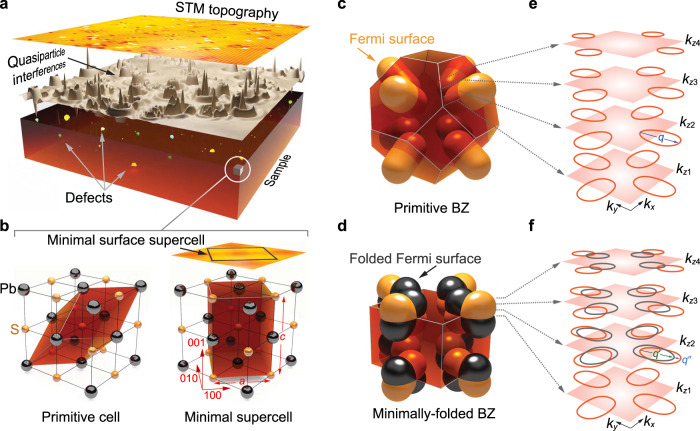
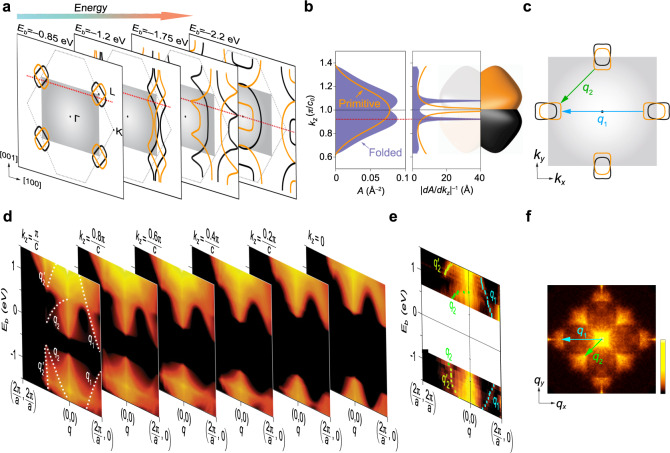
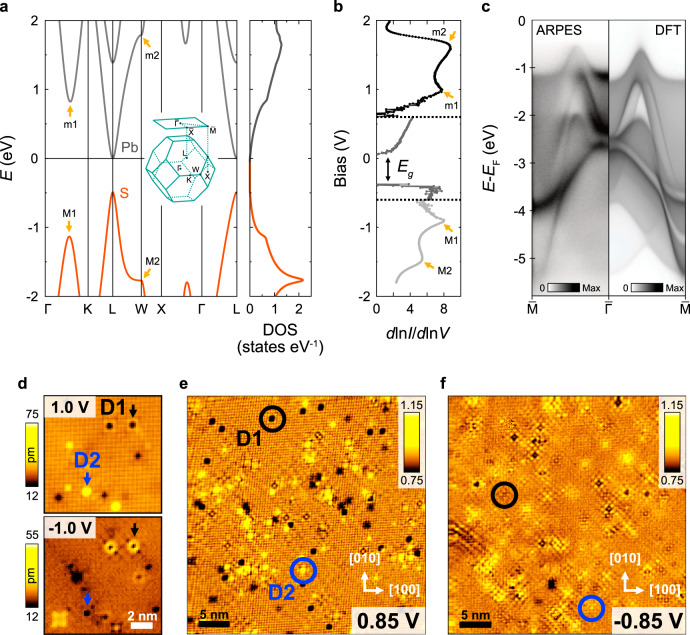
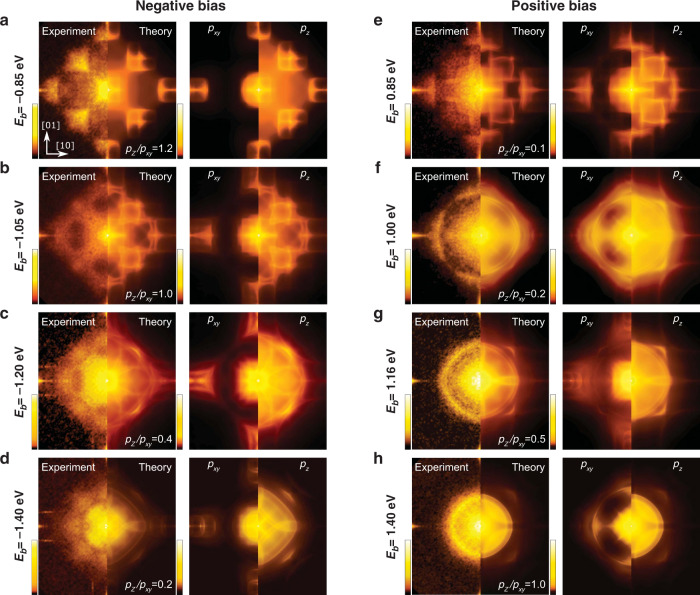
Quasiparticle interference (QPI) imaging is well established to study the low-energy electronic structure in strongly correlated electron materials with unrivalled energy resolution. Yet, being a surface-sensitive technique, the interpretation of QPI only works well for anisotropic materials, where the dispersion in the direction perpendicular to the surface can be neglected and the quasiparticle interference is dominated by a quasi-2D electronic structure. Here, we explore QPI imaging of galena, a material with an electronic structure that does not exhibit pronounced anisotropy. We find that the quasiparticle interference signal is dominated by scattering vectors which are parallel to the surface plane however originate from bias-dependent cuts of the 3D electronic structure. We develop a formalism for the theoretical description of the QPI signal and demonstrate how this quasiparticle tomography can be used to obtain information about the 3D electronic structure and orbital character of the bands.
准粒子干涉(QPI)成像已被广泛用于研究强关联电子材料中的低能电子结构,其能量分辨率无与伦比。然而,作为一种表面敏感技术,QPI的解释仅适用于各向异性材料,在这种材料中,垂直于表面方向的色散可以忽略不计,并且准粒子干涉由准二维电子结构主导。在这里,我们探索方铅矿的QPI成像,方铅矿是一种电子结构不表现出明显各向异性的材料。我们发现,准粒子干涉信号由平行于表面平面的散射矢量主导,然而这些散射矢量源自三维电子结构的偏置依赖截面。我们开发了一种形式体系来对QPI信号进行理论描述,并展示了这种准粒子断层扫描如何用于获取有关能带的三维电子结构和轨道特征的信息。