Department of Dermatology, University of Illinois at Chicago, Chicago, Illinois, USA.
Skin Tissue Engineering and Morphology (STEM) Core, Feinberg School of Medicine, Northwestern University, Chicago, Illinois, USA.
Exp Dermatol. 2022 Apr;31(4):615-621. doi: 10.1111/exd.14501. Epub 2021 Nov 26.
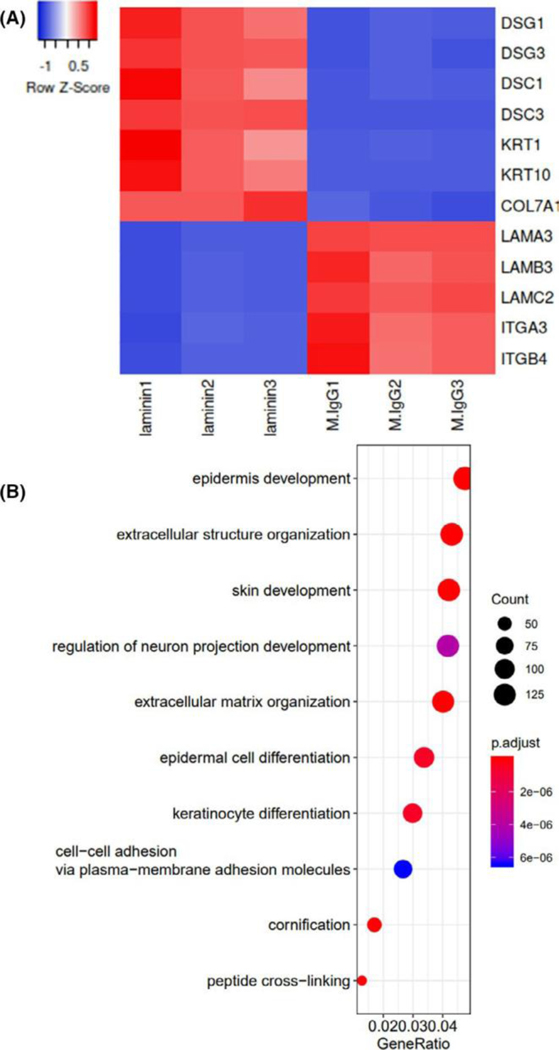
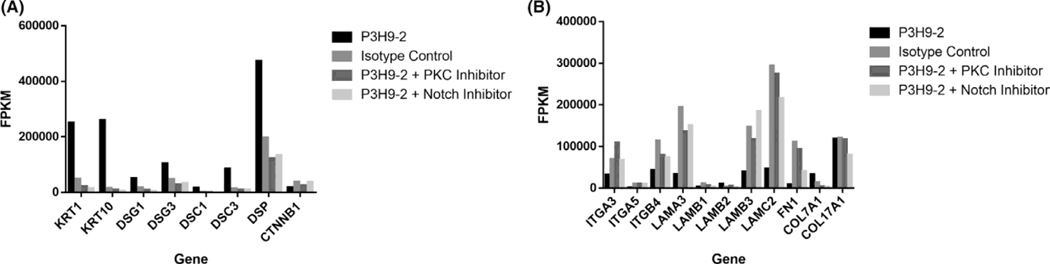
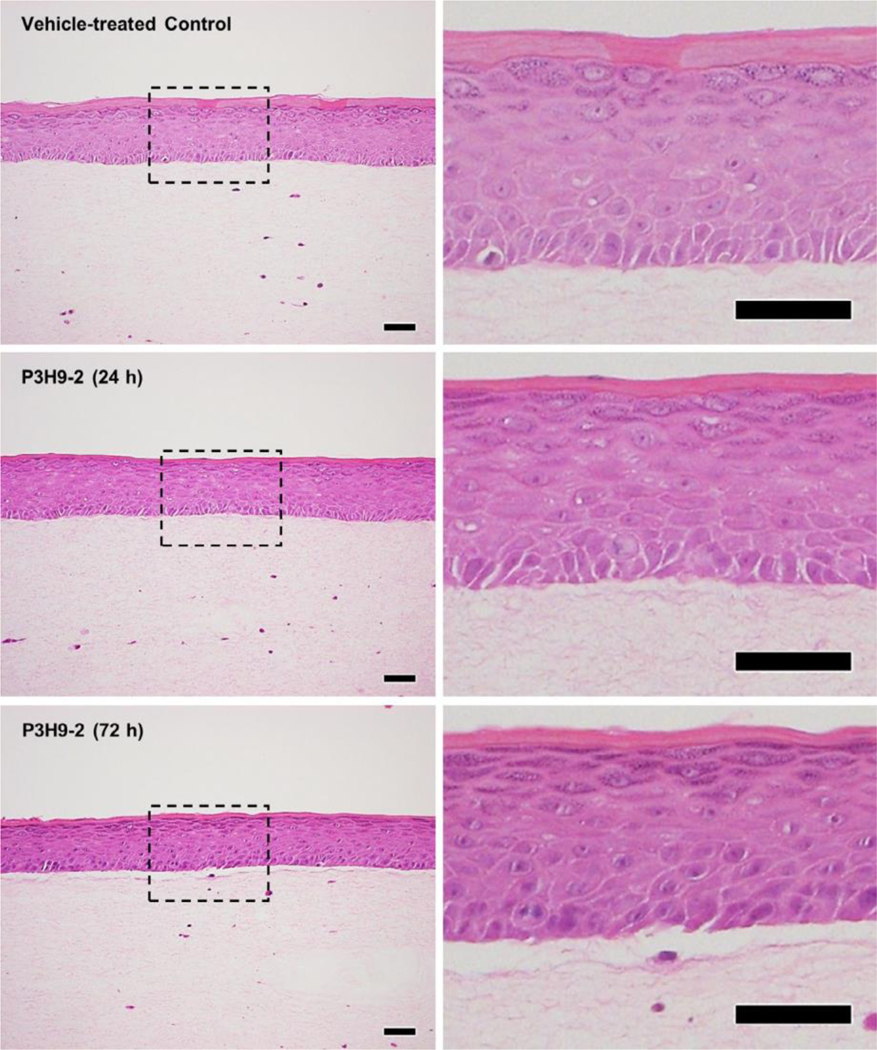
Laminin-332 pemphigoid is a rare and chronic autoimmune blistering disease which results in subepidermal blisters and erosive lesions predominantly localized to mucous membranes. As histologic inflammation is variable and non-complement-fixing IgG antibodies against laminin-332 are the predominant class of autoantibodies deposited at the epidermal basement membrane zone, we hypothesized that complement-independent pro-inflammatory and blistering pathways existed similarly to that previously shown in bullous pemphigoid. As autoantibodies to laminin α3 are most prevalent, we studied the major cellular response to blockade of laminin α3 using a well-characterized monoclonal antibody (P3H9-2). RNA-seq revealed upregulation of numerous desmosomal genes (DSG1, DSG3, DSC1, DSC3 and DSP) as well as KRT1 and KRT10. Additionally, P3H9-2-treated cells demonstrated downregulation of most hemidesmosomal genes. A pro-inflammatory response was not appreciated. Using pharmacological inhibitors, we identified both protein kinase C and NOTCH as key regulators of P3H9-2 induced differentiation. We lastly utilized 3D human skin equivalents to determine whether blockade of laminin α3 would lead to delayed blistering, consistent with keratinocyte differentiation. Significant blistering was noted after 72 h of treatment, with only minimal separation at 24 h. In summary, blockade of laminin α3 alters keratinocyte differentiation, representing a potential complement-independent mechanism of blistering.
层粘连蛋白 332 天疱疮是一种罕见的慢性自身免疫性水疱病,主要导致表皮下水疱和糜烂病变,主要局限于黏膜。由于组织学炎症是可变的,并且针对层粘连蛋白 332 的非补体结合 IgG 抗体是沉积在表皮基底膜带的主要自身抗体类别,我们假设存在类似于大疱性类天疱疮的补体非依赖性促炎和水疱形成途径。由于针对层粘连蛋白 α3 的自身抗体最为常见,我们使用经过充分表征的单克隆抗体(P3H9-2)研究了阻断层粘连蛋白 α3 的主要细胞反应。RNA-seq 显示了许多桥粒基因(DSG1、DSG3、DSC1、DSC3 和 DSP)以及 KRT1 和 KRT10 的上调。此外,P3H9-2 处理的细胞表现出大多数半桥粒基因的下调。未观察到促炎反应。使用药理抑制剂,我们确定蛋白激酶 C 和 NOTCH 是 P3H9-2 诱导分化的关键调节剂。最后,我们利用 3D 人皮肤等效物来确定阻断层粘连蛋白 α3 是否会导致与角质形成细胞分化一致的延迟水疱形成。在治疗 72 小时后明显出现水疱,在 24 小时后仅出现最小分离。总之,阻断层粘连蛋白 α3 改变角质形成细胞分化,代表一种潜在的补体非依赖性水疱形成机制。