NKC Institute of Gastroenterology and Hepatology, Songklanagarind Hospital, Prince of Songkla University, Hat Yai, Thailand.
Division of Gastroenterology, Faculty of Medicine, Siriraj Hospital, Mahidol University, Bangkok, Thailand.
Hepatol Commun. 2022 Apr;6(4):679-691. doi: 10.1002/hep4.1847. Epub 2021 Nov 19.
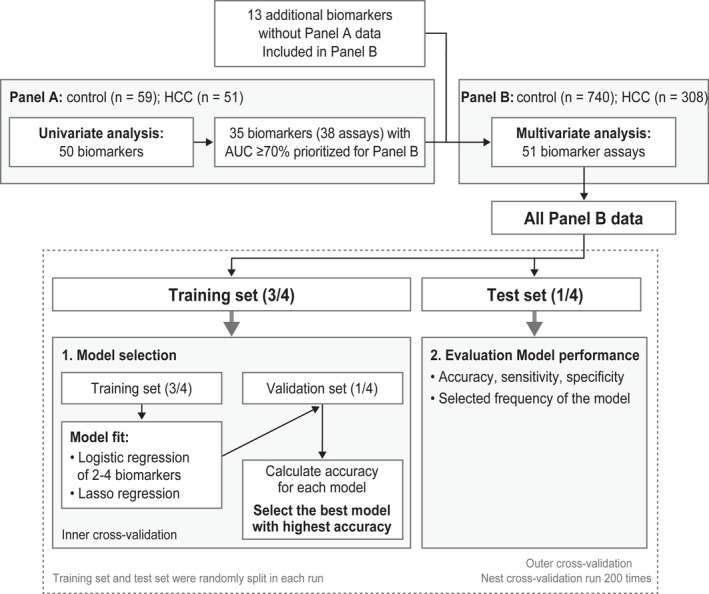
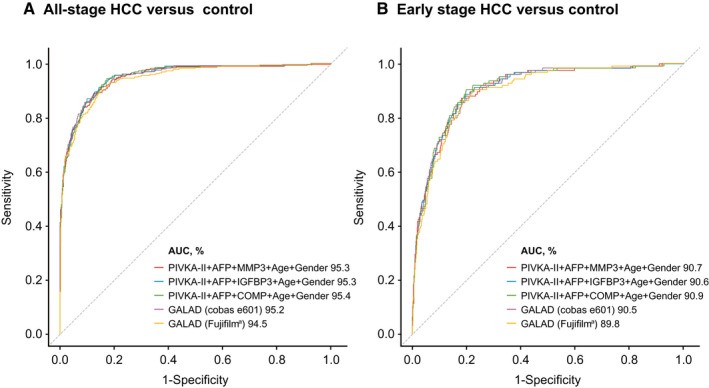
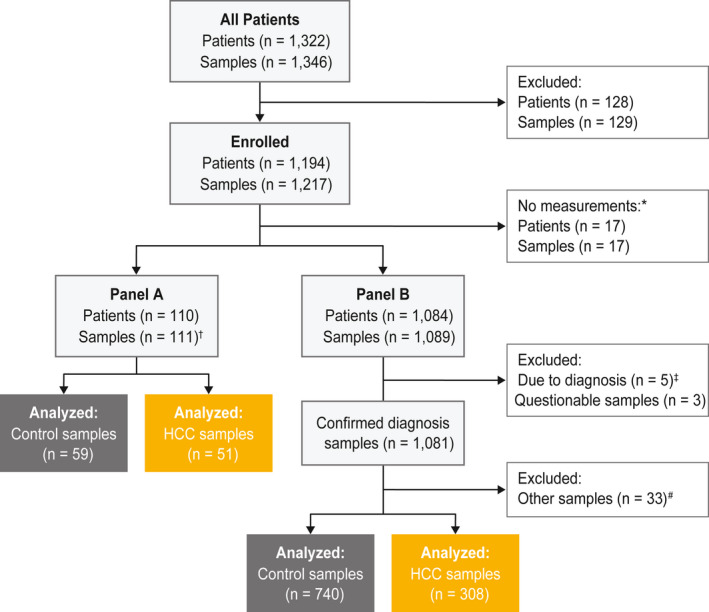
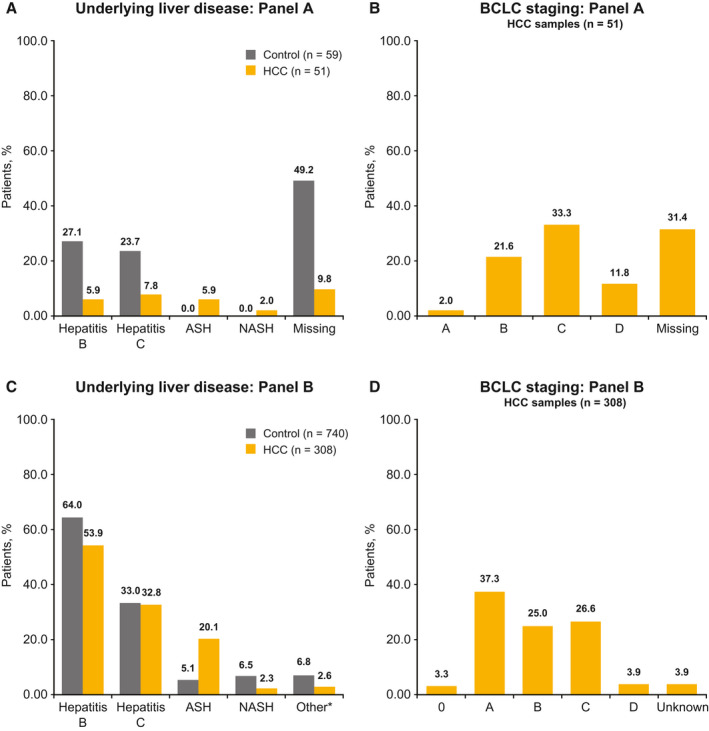
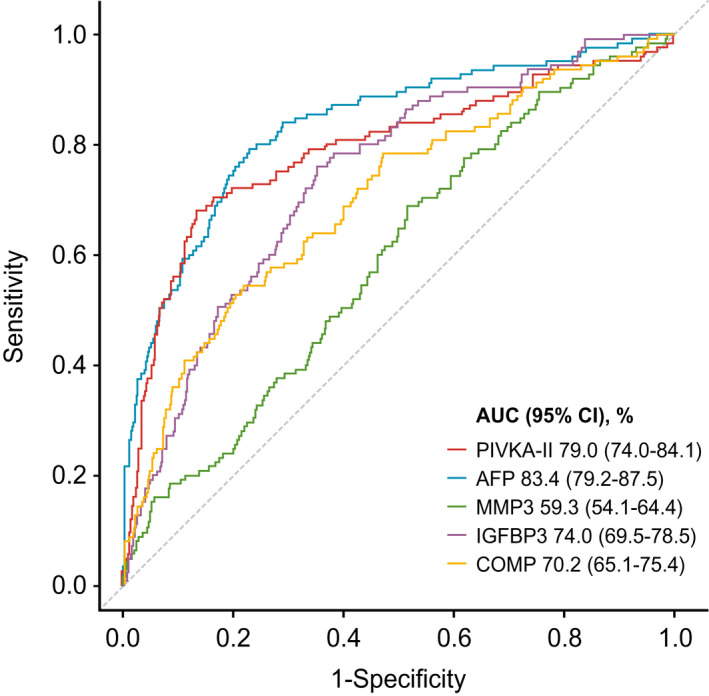
Hepatocellular carcinoma (HCC), the sixth most common cancer worldwide, has an incidence rate equal to mortality. Over 80% of HCC cases occur within a high-risk population, mainly patients with both cirrhosis and chronic hepatitis B or C. With a 5-year survival rate ranging from <16% for advanced HCC to >90% for early stage HCC, there is a high medical need for the early detection of HCC. In this study, we systematically evaluated biomarkers mentioned in international guidelines and peer-reviewed literature for HCC surveillance and diagnosis with the aim of identifying combinations that display high sensitivity and specificity for early stage HCC. Fifty biomarkers were measured in the first sample panel, panel A (n = 110), and subjected to univariate analysis. Of these, 35 biomarkers (38 assays) from panel A and an additional 13 biomarkers from the literature were prioritized for subsequent multivariate evaluation with lasso regression and exhaustive search of two- to four-biomarker combinations (panel B). Panel B included 1,081 samples from patients with HCC (n = 308) or with chronic liver diseases (n = 740). Among all patients, 61.0% had hepatitis B, 32.9% had hepatitis C, and 60.5% had cirrhosis; 40.6% of patients with HCC had early stage cancer. Protein induced by vitamin K absence-II (PIVKA-II; also known as des-gamma-carboxy prothrombin [DCP]) and alpha-fetoprotein (AFP) demonstrated the best clinical performance, both individually and in combination, and the addition of a third biomarker (Lens culinaris agglutinin-reactive fraction of AFP [AFP-L3], cartilage oligomeric matrix protein [COMP], insulin-like growth factor-binding protein 3 [IGFBP3], or matrix metalloproteinase 3 [MMP3]) further increased sensitivity for the detection of both early stage and all-stage HCC. The addition of age and sex to the three-biomarker panel resulted in an improved diagnostic performance. Conclusion: The combination of AFP and PIVKA-II, with either IGFBP3, COMP or MMP3, plus age and sex, demonstrated the best performance for the detection of early- and all-stage HCC. These novel panels performed similar to that of the GALAD score (sex [gender], age, plus serum levels of AFP, AFP-L3 and DCP [PIVKA-II]), a promising screening tool developed for HCC detection.
肝细胞癌(HCC)是全球第六大常见癌症,其发病率与死亡率相当。超过 80%的 HCC 病例发生在高危人群中,主要是患有肝硬化和慢性乙型或丙型肝炎的患者。HCC 的 5 年生存率差异很大,从晚期 HCC 的<16%到早期 HCC 的>90%,因此对于 HCC 的早期检测存在很高的医疗需求。在这项研究中,我们系统地评估了国际指南和同行评议文献中提到的用于 HCC 监测和诊断的生物标志物,旨在确定用于早期 HCC 的具有高灵敏度和特异性的组合。在第一个样本面板(A 面板)中测量了 50 种生物标志物(n=110),并进行了单变量分析。其中,A 面板的 35 种生物标志物(38 种检测)和文献中的另外 13 种生物标志物被优先用于随后的多变量评估,包括使用套索回归和穷尽搜索二至四标志物组合(B 面板)。B 面板包括来自 HCC 患者(n=308)或慢性肝病患者(n=740)的 1081 个样本。在所有患者中,61.0%患有乙型肝炎,32.9%患有丙型肝炎,60.5%患有肝硬化;40.6%的 HCC 患者患有早期癌症。维生素 K 缺乏诱导蛋白 II(PIVKA-II;也称为脱-γ-羧基凝血酶原[DCP])和甲胎蛋白(AFP)单独和联合显示出最佳的临床性能,而添加第三种生物标志物(菜豆凝集素反应性 AFP 片段[AFP-L3]、软骨寡聚基质蛋白[COMP]、胰岛素样生长因子结合蛋白 3[IGFBP3]或基质金属蛋白酶 3[MMP3])则进一步提高了早期和所有阶段 HCC 的检测灵敏度。将年龄和性别添加到三个生物标志物面板中,可提高诊断性能。结论:AFP 和 PIVKA-II 与 IGFBP3、COMP 或 MMP3 的组合,加上年龄和性别,对检测早期和所有阶段 HCC 的表现最佳。这些新的面板与 GALAD 评分(性别[性别]、年龄,加上 AFP、AFP-L3 和 DCP[PIVKA-II]的血清水平)的性能相似,GALAD 评分是一种用于 HCC 检测的有前途的筛查工具。