Department of Human Genetics, 6034Radboud University Medical Center, The Netherlands.
Faculty of Science, 6029Radboud University, The Netherlands.
J Oncol Pharm Pract. 2023 Jan;29(1):5-13. doi: 10.1177/10781552211049144. Epub 2021 Nov 19.
To investigate if dihydropyrimidine dehydrogenase phenotyping has added value when combined with genotyping in predicting fluoropyrimidine-related toxicity.
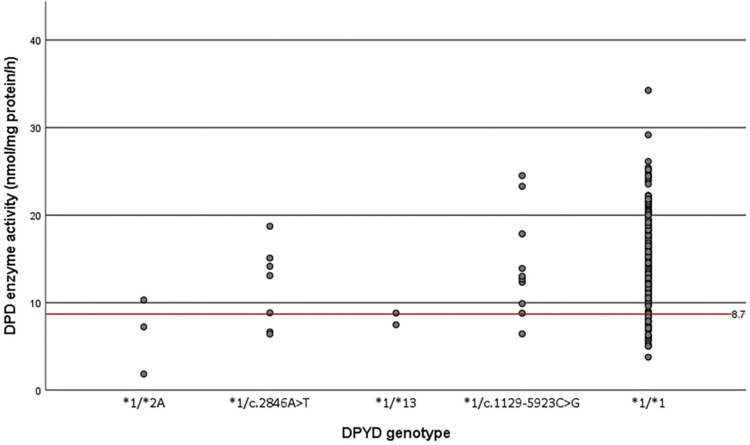
Retrospective cohort study in which treatment and toxicity data were collected of 228 patients genotyped for four variants and phenotyped using an peripheral blood mononuclear cell assay.
Severe toxicity occurred in 25% of patients with a variant and normal dihydropyrimidine dehydrogenase activity, in 21% of patients without a variant and with decreased dihydropyrimidine dehydrogenase activity, and in 29% of patients without a variant and with normal dihydropyrimidine dehydrogenase activity (controls). The majority of patients with a variant or a decreased dihydropyrimidine dehydrogenase activity received an initial dose reduction (68% and 53% vs 19% in controls) and had a lower mean dose intensity (75% and 81% vs 91% in controls). Fifty percent of patients with a variant and decreased enzyme activity experienced severe toxicity, despite the lowest initial dose and whole treatment dose intensity. They also experienced more grade 4/5 toxicities.
Our results indicate that a combined genotype-phenotype approach could be useful to identify patients at increased risk for fluoropyrimidine-associated toxicity (e.g. patients with a variant and decreased dihydropyrimidine dehydrogenase activity). Because the group sizes are too small to demonstrate statistically significant differences, this warrants further research in a prospective study in a larger cohort.
研究二氢嘧啶脱氢酶表型与基因分型相结合在预测氟嘧啶相关毒性方面是否具有附加价值。
这是一项回顾性队列研究,对 228 例接受四种变异基因分型和外周血单核细胞检测表型的患者进行了治疗和毒性数据的收集。
有变异且二氢嘧啶脱氢酶活性正常的患者中 25%出现严重毒性,无变异且二氢嘧啶脱氢酶活性降低的患者中 21%出现严重毒性,无变异且二氢嘧啶脱氢酶活性正常的患者(对照组)中 29%出现严重毒性。大多数有变异或二氢嘧啶脱氢酶活性降低的患者接受了初始剂量减少(分别为 68%和 53%,而对照组为 19%),且平均剂量强度较低(分别为 75%和 81%,而对照组为 91%)。尽管初始剂量最低且整个治疗剂量强度最低,但 50%有变异且酶活性降低的患者出现严重毒性,且经历了更多的 4/5 级毒性。
我们的结果表明,联合基因型-表型方法可能有助于识别氟嘧啶相关毒性风险增加的患者(例如,有变异且二氢嘧啶脱氢酶活性降低的患者)。由于组间大小太小,无法证明统计学上的显著差异,因此需要在更大的队列前瞻性研究中进一步研究。