Nutrition, Metabolism and Genomics Group, Division of Human Nutrition and Health, Wageningen University, Wageningen, The Netherlands.
J Lipid Res. 2021;62:100150. doi: 10.1016/j.jlr.2021.100150. Epub 2021 Nov 18.
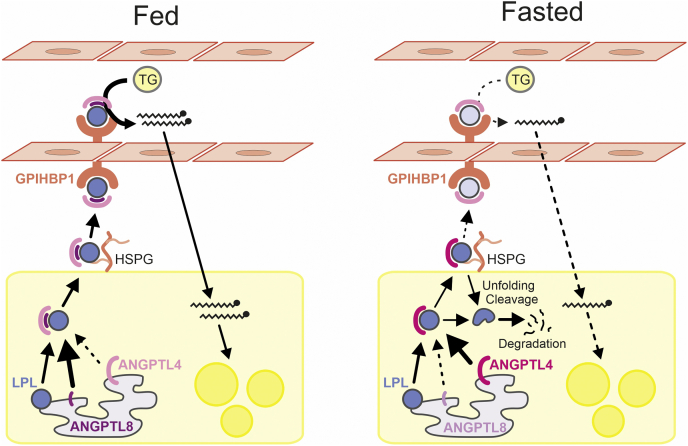
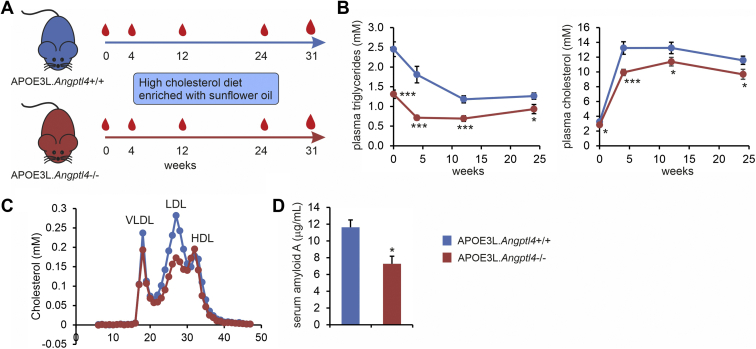
Triglycerides are carried in the bloodstream as the components of very low-density lipoproteins and chylomicrons. These circulating triglycerides are primarily hydrolyzed in muscle and adipose tissue by the enzyme lipoprotein lipase (LPL). The activity of LPL is regulated by numerous mechanisms, including by three members of the angiopoietin-like protein family: ANGPTL3, ANGPTL4, and ANGPTL8. In this review, we discuss the recent literature concerning the role and mechanism of action of ANGPTL4 in lipid metabolism. ANGPTL4 is a fasting- and lipid-induced factor secreted by numerous cells, including adipocytes, hepatocytes, (cardio)myocytes, and macrophages. In adipocytes, ANGPTL4 mediates the fasting-induced repression of LPL activity by promoting the unfolding of LPL, leading to the cleavage and subsequent degradation of LPL. The inhibition of LPL by ANGPTL4 is opposed by ANGPTL8, which keeps the LPL active after feeding. In macrophages and (cardio)myocytes, ANGPTL4 functions as a lipid-inducible feedback regulator of LPL-mediated lipid uptake. In comparison, in hepatocytes, ANGPTL4 functions as a local inhibitor of hepatic lipase and possibly as an endocrine inhibitor of LPL in extra-hepatic tissues. At the genetic level, loss-of-function mutations in ANGPTL4 are associated with lower plasma triglycerides and higher plasma HDL-C levels, and a reduced risk of coronary artery disease, suggesting that ANGPTL4 is a viable pharmacological target for reducing cardiovascular risk. Whole-body targeting of ANGPTL4 is contraindicated because of severe pathological complications, whereas liver-specific inactivation of ANGPTL4, either as monotherapy or coupled to anti-ANGPTL3 therapies might be a suitable strategy for lowering plasma triglycerides in selected patient groups. In conclusion, the tissue-specific targeting of ANGPTL4 appears to be a viable pharmacological approach to reduce circulating triglycerides.
甘油三酯作为极低密度脂蛋白和乳糜微粒的组成部分在血液中运输。这些循环中的甘油三酯主要在肌肉和脂肪组织中被脂蛋白脂肪酶(LPL)水解。LPL 的活性受多种机制调节,包括血管生成素样蛋白家族的三个成员:ANGPTL3、ANGPTL4 和 ANGPTL8。在这篇综述中,我们讨论了有关 ANGPTL4 在脂质代谢中作用和作用机制的最新文献。ANGPTL4 是一种禁食和脂质诱导的因子,由许多细胞分泌,包括脂肪细胞、肝细胞、(心肌)细胞和巨噬细胞。在脂肪细胞中,ANGPTL4 通过促进 LPL 的展开来介导禁食诱导的 LPL 活性抑制,导致 LPL 的裂解和随后的降解。ANGPTL4 对 LPL 的抑制作用被 ANGPTL8 拮抗,ANGPTL8 在进食后使 LPL 保持活性。在巨噬细胞和(心肌)细胞中,ANGPTL4 作为 LPL 介导的脂质摄取的脂质诱导反馈调节剂发挥作用。相比之下,在肝细胞中,ANGPTL4 作为肝脂肪酶的局部抑制剂和可能作为肝外组织中 LPL 的内分泌抑制剂发挥作用。在遗传水平上,ANGPTL4 的功能丧失突变与血浆甘油三酯降低和血浆 HDL-C 水平升高以及冠心病风险降低相关,这表明 ANGPTL4 是降低心血管风险的可行药物靶点。由于严重的病理并发症,全身性靶向 ANGPTL4 是不合适的,而肝特异性失活 ANGPTL4,无论是作为单一疗法还是与抗 ANGPTL3 疗法结合,可能是降低特定患者群体血浆甘油三酯的合适策略。总之,ANGPTL4 的组织特异性靶向似乎是降低循环甘油三酯的可行药物治疗方法。