Ihn Soo-Ghang, Jeong Daun, Kwon Eun Suk, Kim Sangmo, Chung Yeon Sook, Sim Myungsun, Chwae Jun, Koishikawa Yasushi, Jeon Soon Ok, Kim Jong Soo, Kim Joonghyuk, Nam Sungho, Kim Inkoo, Park Sangho, Kim Dae Sin, Choi Hyeonho, Kim Sunghan
Samsung Advanced Institute of Technology, Samsung Electronics Co., LTD, 130 Samsung-ro, Yeongtong-gu, Suwon-si, Gyeonggi-do, 16678, Korea.
CSE team, Data and Information Technology Center, Samsung Electronics Co., LTD, 1 Samsungjeonja-ro, Hwaseong-si, Gyeonggi-do, 18448, Korea.
Adv Sci (Weinh). 2022 Jan;9(3):e2102141. doi: 10.1002/advs.202102141. Epub 2021 Nov 21.
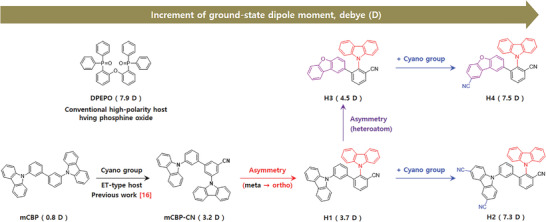
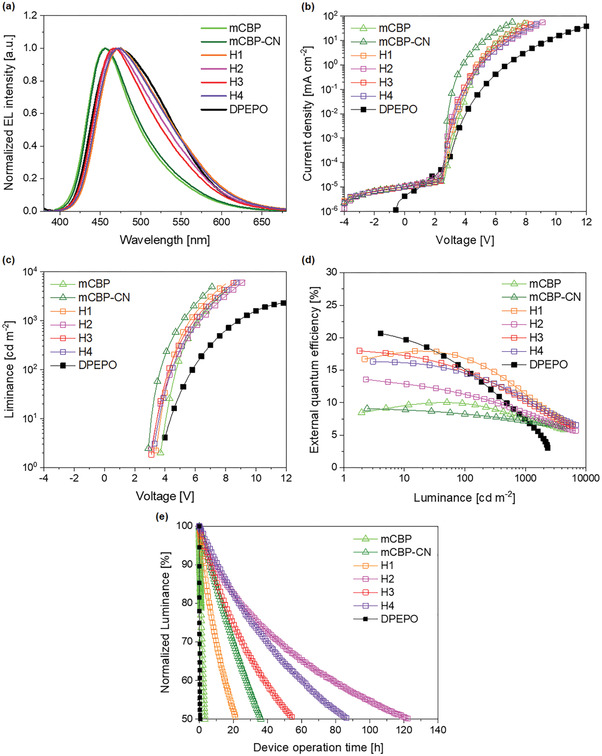
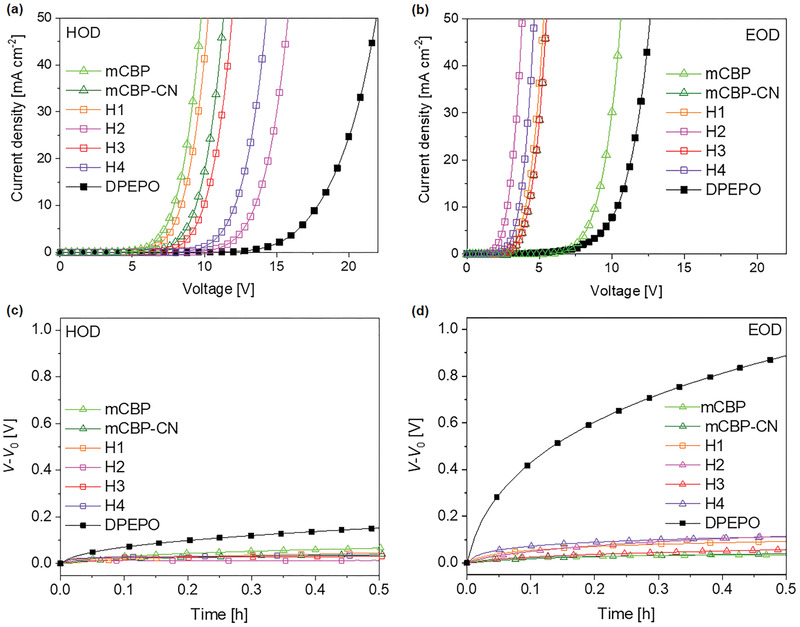
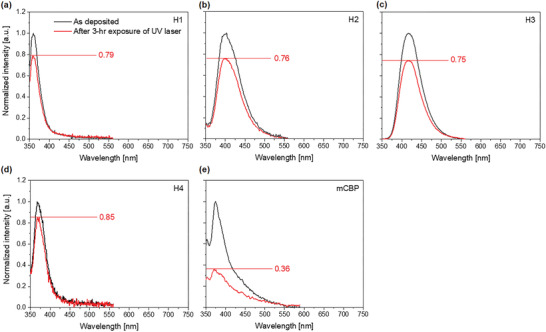
To utilize thermally activated delayed fluorescence (TADF) technology for future displays, it is necessary to develop host materials which harness the full potential of blue TADF emitters. However, no publication has reported such hosts yet. Although the most popular host for blue TADF, bis[2-(diphenylphosphino)phenyl]ether oxide (DPEPO) guarantees high-maximum external quantum efficiency (EQE ) TADF devices, they exhibit very short operational lifetimes. In contrast, long-lifespan blue TADF devices employing stable hosts such as 3',5-di(9H-carbazol-9-yl)-[1,1'-biphenyl]-3-carbonitrile (mCBP-CN) exhibit much lower EQE than the DPEPO-employed devices. Here, an elaborative approach for designing host molecules is suggested to achieve simultaneously stable and efficient blue TADF devices. The approach is based on engineering the molecular geometry, ground- and excited-state dipole moments of host molecules. The engineered hosts significantly enhance delayed fluorescence quantum yields of TADF emitters, as stabilizing the charge-transfer excited states of the TADF emitters and suppressing exciton quenching, and improve the charge balance. Moreover, they exhibit both photochemical and electrochemical stabilities. The best device employing one of the engineered hosts exhibits 79% increase in EQE compared to the mCBP-CN-employed device, together with 140% and 92-fold increases in operational lifetime compared to the respective mCBP-CN- and the DPEPO-based devices.
为了将热激活延迟荧光(TADF)技术应用于未来的显示器,有必要开发能够充分发挥蓝色TADF发光体潜力的主体材料。然而,目前尚无相关报道。尽管蓝色TADF最常用的主体材料双[2-(二苯基膦基)苯基]醚氧化物(DPEPO)能保证TADF器件具有较高的最大外量子效率(EQE),但其工作寿命非常短。相比之下,采用诸如3',5-二(9H-咔唑-9-基)-[1,1'-联苯]-3-腈(mCBP-CN)等稳定主体材料的长寿命蓝色TADF器件的EQE远低于采用DPEPO的器件。在此,我们提出了一种精心设计主体分子的方法,以同时实现稳定且高效的蓝色TADF器件。该方法基于对主体分子的分子几何结构、基态和激发态偶极矩进行设计。经过设计的主体材料显著提高了TADF发光体的延迟荧光量子产率,稳定了TADF发光体的电荷转移激发态并抑制了激子猝灭,同时改善了电荷平衡。此外,它们还具有光化学和电化学稳定性。采用其中一种经过设计的主体材料的最佳器件,其EQE相比采用mCBP-CN的器件提高了79%,工作寿命相比采用mCBP-CN和DPEPO的器件分别提高了140%和92倍。