
一种用于长寿命蓝色有机发光二极管的替代主体材料——基于热激活延迟荧光
An Alternative Host Material for Long-Lifespan Blue Organic Light-Emitting Diodes Using Thermally Activated Delayed Fluorescence.
作者信息
Ihn Soo-Ghang, Lee Namheon, Jeon Soon Ok, Sim Myungsun, Kang Hosuk, Jung Yongsik, Huh Dal Ho, Son Young Mok, Lee Sae Youn, Numata Masaki, Miyazaki Hiroshi, Gómez-Bombarelli Rafael, Aguilera-Iparraguirre Jorge, Hirzel Timothy, Aspuru-Guzik Alán, Kim Sunghan, Lee Sangyoon
机构信息
Samsung Advanced Institute of Technology Samsung Electronics Co., LTD130 Samsung-ro, Yeongtong-gu Suwon-si Gyeonggi-do 16678 South Korea.
Samsung SDI130 Samsung-ro, Yeongtong-gu Suwon-si Gyeonggi-do 16678 South Korea.
出版信息
Adv Sci (Weinh). 2017 Mar 23;4(8):1600502. doi: 10.1002/advs.201600502. eCollection 2017 Aug.
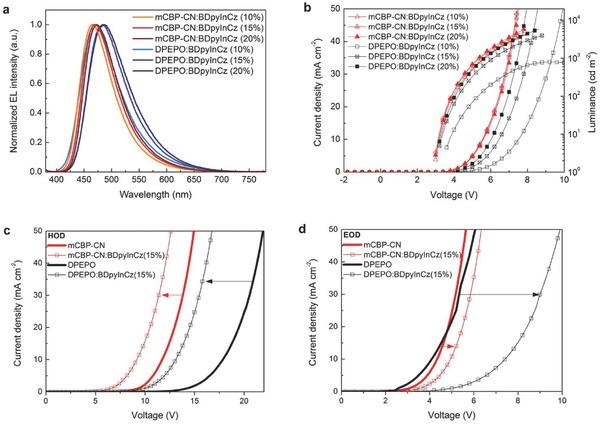
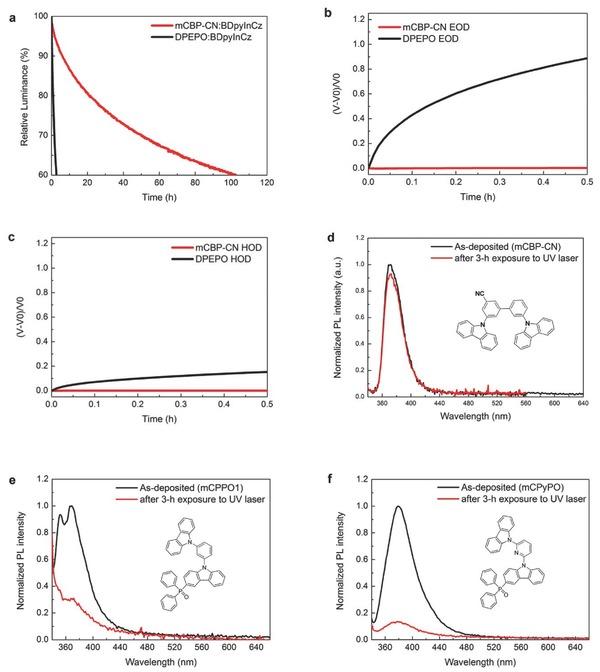
It has been challenging to find stable blue organic light emitting diodes (OLEDs) that rely on thermally activated delayed fluorescence (TADF). Lack of stable host materials well-fitted to the TADF emitters is one of the critical reasons. The most popular host for blue TADF, bis[2-(diphenylphosphino)phenyl] ether oxide (DPEPO), leads to unrealistically high maximum external quantum efficiency. DPEPO is however an unstable material and has a poor charge transporting ability, which in turn induces an intrinsic short OLED operating lifespan. Here, an alternative host material is introduced which educes the potential efficiency and device lifespan of given TADF emitters with the appropriateness of replacing the most popular host material, DPEPO, in developing blue TADF emitters. It simultaneously provides much longer device lifespan and higher external quantum efficiency at a practical brightness due to its high material stability and electron-transport-type character well-fitted for hole-transport-type TADF emitters.
寻找基于热激活延迟荧光(TADF)的稳定蓝色有机发光二极管(OLED)一直具有挑战性。缺乏与TADF发射体适配的稳定主体材料是关键原因之一。蓝色TADF最常用的主体材料双[2-(二苯基膦基)苯基]氧化醚(DPEPO)会导致过高的最大外量子效率,这不切实际。然而,DPEPO是一种不稳定的材料,电荷传输能力较差,进而导致OLED的固有工作寿命较短。在此,引入了一种替代主体材料,该材料在开发蓝色TADF发射体时,能够通过适当地替代最常用的主体材料DPEPO,发挥给定TADF发射体的潜在效率和器件寿命。由于其高材料稳定性和适合空穴传输型TADF发射体的电子传输型特性,它在实际亮度下同时提供了更长的器件寿命和更高的外量子效率。


 Zotero 插件