Department of Neurology, Massachusetts General Hospital, Boston, Massachusetts, USA.
Department of Medicine, Massachusetts General Hospital, Boston, Massachusetts, USA.
Ann Clin Transl Neurol. 2021 Dec;8(12):2270-2279. doi: 10.1002/acn3.51478. Epub 2021 Nov 21.
The purpose of this study was to examine critical care continuous electroencephalography (cEEG) utilization and downstream anti-seizure treatment patterns, their association with outcomes, and generate hypotheses for larger comparative effectiveness studies of cEEG-guided interventions.
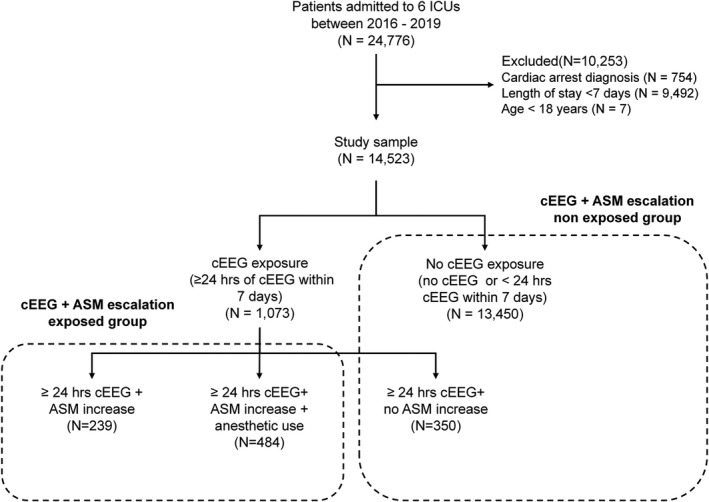
Single-center retrospective study of critically ill patients (n = 14,523, age ≥18 years). Exposure defined as ≥24 h of cEEG and subsequent anti-seizure medication (ASM) escalation, with or without concomitant anesthetic. Exposure window was the first 7 days of admission. Primary outcome was in-hospital mortality. Multivariable analysis was performed using penalized logistic regression.
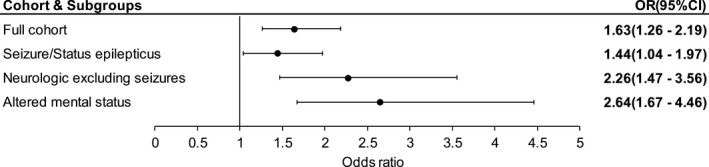
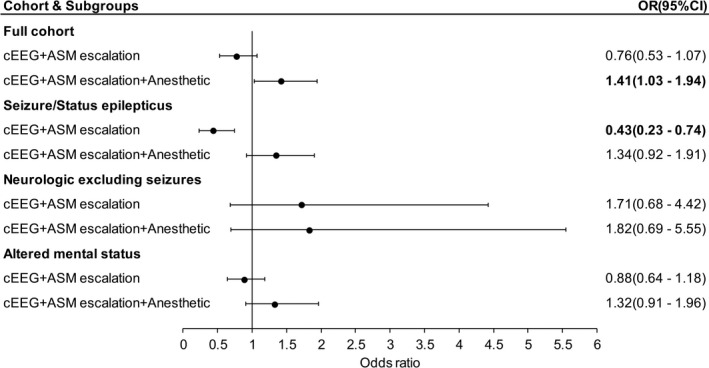
One thousand and seventy-three patients underwent ≥24 h of cEEG within 7 days of admission. After adjusting for disease severity, ≥24 h of cEEG followed by ASM escalation in patients not on anesthetics (n = 239) was associated with lower in-hospital mortality (OR 0.76 [0.53-1.07]), though the finding did not reach significance. ASM escalation with concomitant anesthetic use (n = 484) showed higher odds for mortality (OR 1.41 [1.03-1.94]). In the seizures/status epilepticus subgroup, post cEEG ASM escalation without anesthetics showed lower odds for mortality (OR 0.43 [0.23-0.74]). Within the same subgroup, ASM escalation with concomitant anesthetic use showed higher odds for mortality (OR 1.34 [0.92-1.91]) though not significant.
Based on our findings we propose the following hypotheses for larger comparative effectiveness studies investigating the direct causal effect of cEEG-guided treatment on outcomes: (1) cEEG-guided ASM escalation may improve outcomes in critically ill patients with seizures; (2) cEEG-guided treatment with combination of ASMs and anesthetics may not improve outcomes in all critically ill patients.
本研究旨在探讨重症监护连续脑电图(cEEG)的使用情况以及后续抗癫痫治疗模式,及其与结局的关系,并为更大规模的 cEEG 指导干预措施的比较效果研究提出假设。
对 14523 名年龄≥18 岁的危重症患者进行单中心回顾性研究。将暴露定义为≥24 小时的 cEEG 和随后的抗癫痫药物(ASM)升级,无论是否同时使用麻醉剂。暴露窗口为入院后的前 7 天。主要结局为院内死亡率。使用惩罚逻辑回归进行多变量分析。
1073 名患者在入院后 7 天内进行了≥24 小时的 cEEG。在调整疾病严重程度后,未使用麻醉剂的患者中进行≥24 小时的 cEEG 后进行 ASM 升级(n=239)与院内死亡率降低相关(OR 0.76 [0.53-1.07]),但该结果未达到显著水平。同时使用麻醉剂的 ASM 升级(n=484)显示死亡率的可能性更高(OR 1.41 [1.03-1.94])。在癫痫/癫痫持续状态亚组中,cEEG 后无麻醉剂的 ASM 升级显示死亡率的可能性较低(OR 0.43 [0.23-0.74])。在同一亚组中,同时使用麻醉剂的 ASM 升级显示死亡率的可能性更高(OR 1.34 [0.92-1.91]),但不显著。
基于我们的发现,我们为更大规模的比较效果研究提出了以下假设,以调查 cEEG 指导治疗对结局的直接因果影响:(1)cEEG 指导的 ASM 升级可能改善癫痫发作的危重症患者的结局;(2)cEEG 指导的治疗与 ASM 和麻醉剂的联合使用可能不会改善所有危重症患者的结局。