Negishi Takuo, Ito Kohta, Hosoda Koh, Nagura Takeo, Ota Tomohiko, Imanishi Nobuaki, Jinzaki Masahiro, Oishi Motoharu, Ogihara Naomichi
Department of Biological Science, Graduate School of Science, The University of Tokyo, 7-3-1, Hongo, Bunkyo-ku, Tokyo 113-0033, Japan.
Graduate School of Human Sciences, Osaka University, Suita, Osaka Japan.
R Soc Open Sci. 2021 Nov 17;8(11):211344. doi: 10.1098/rsos.211344. eCollection 2021 Nov.
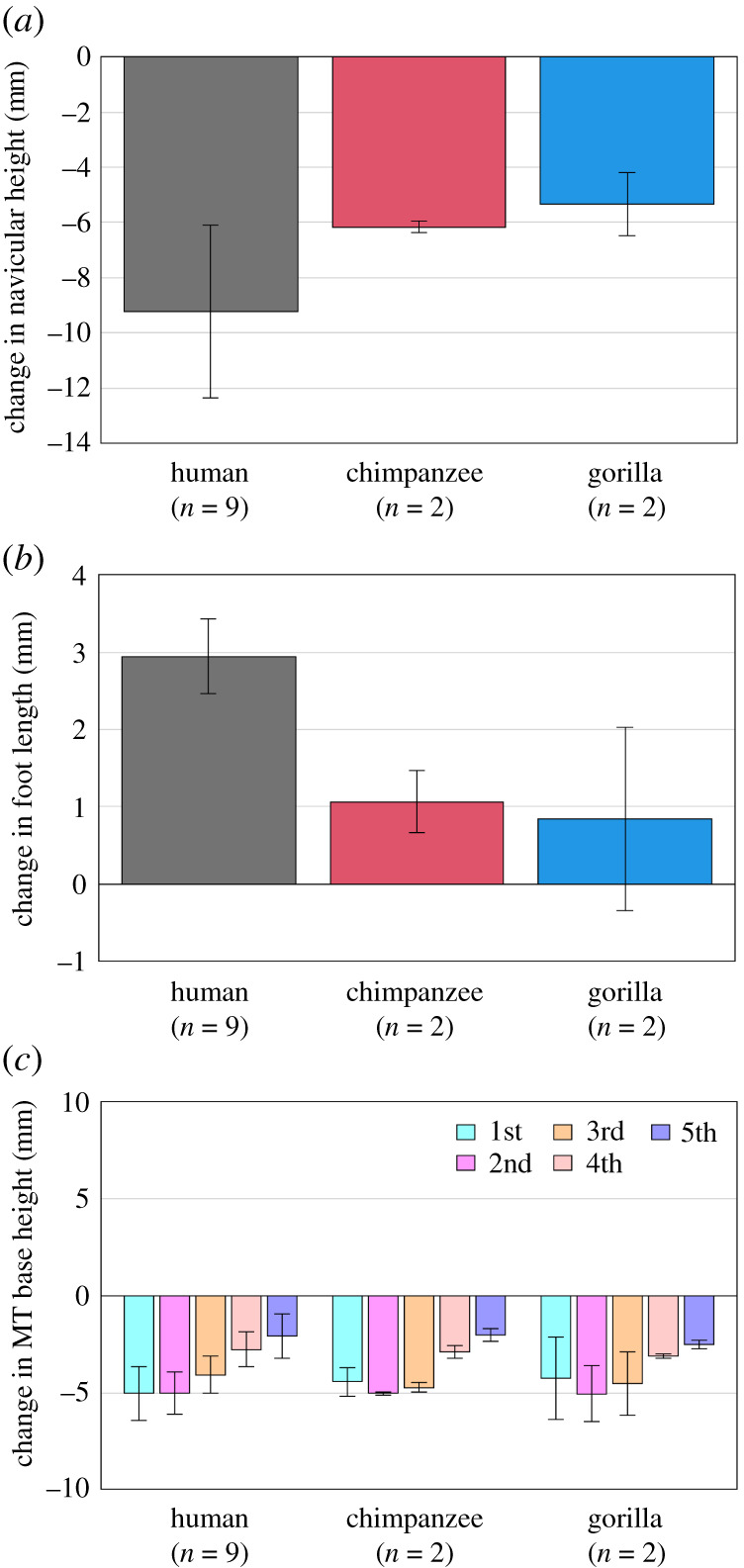
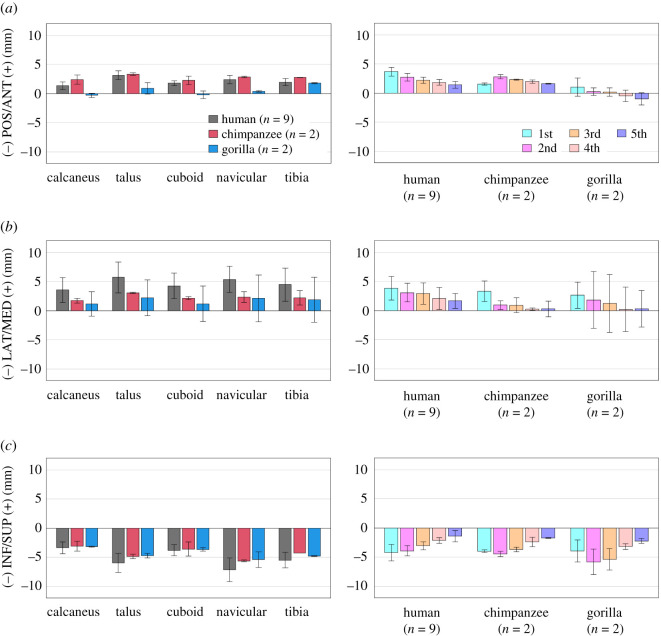
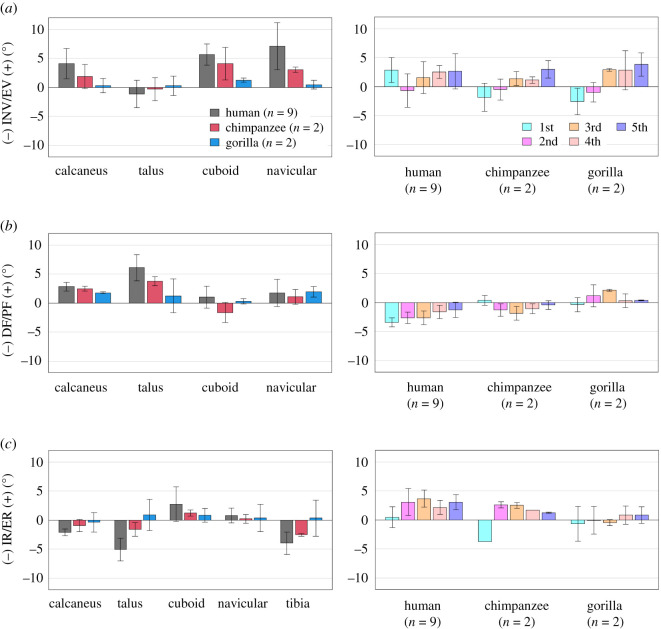
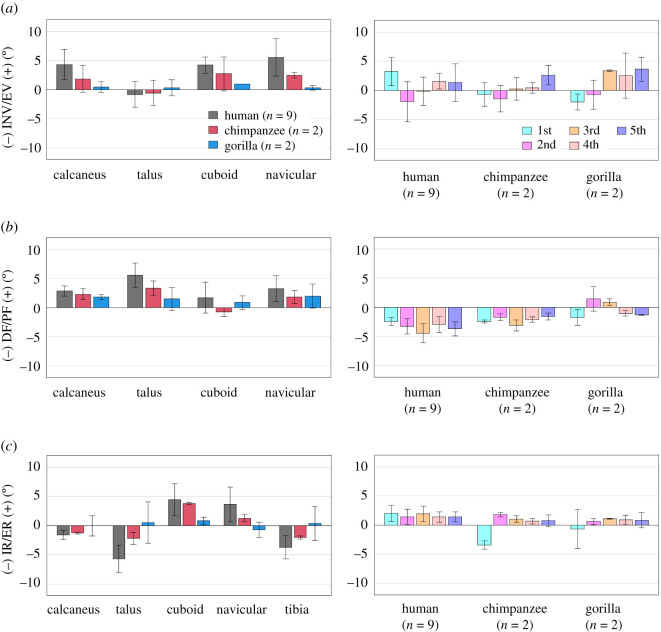
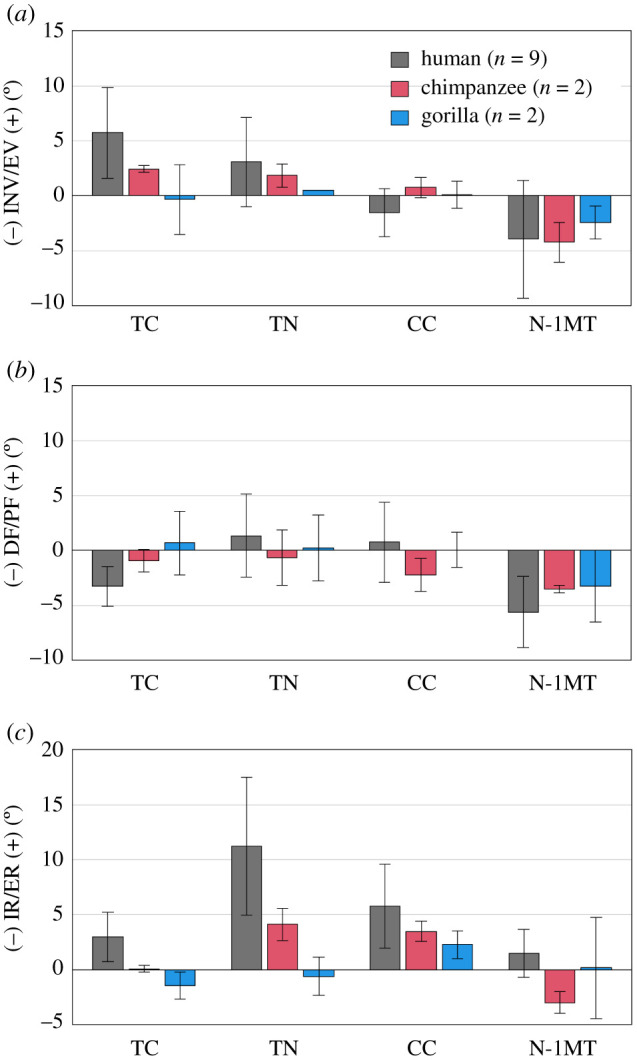
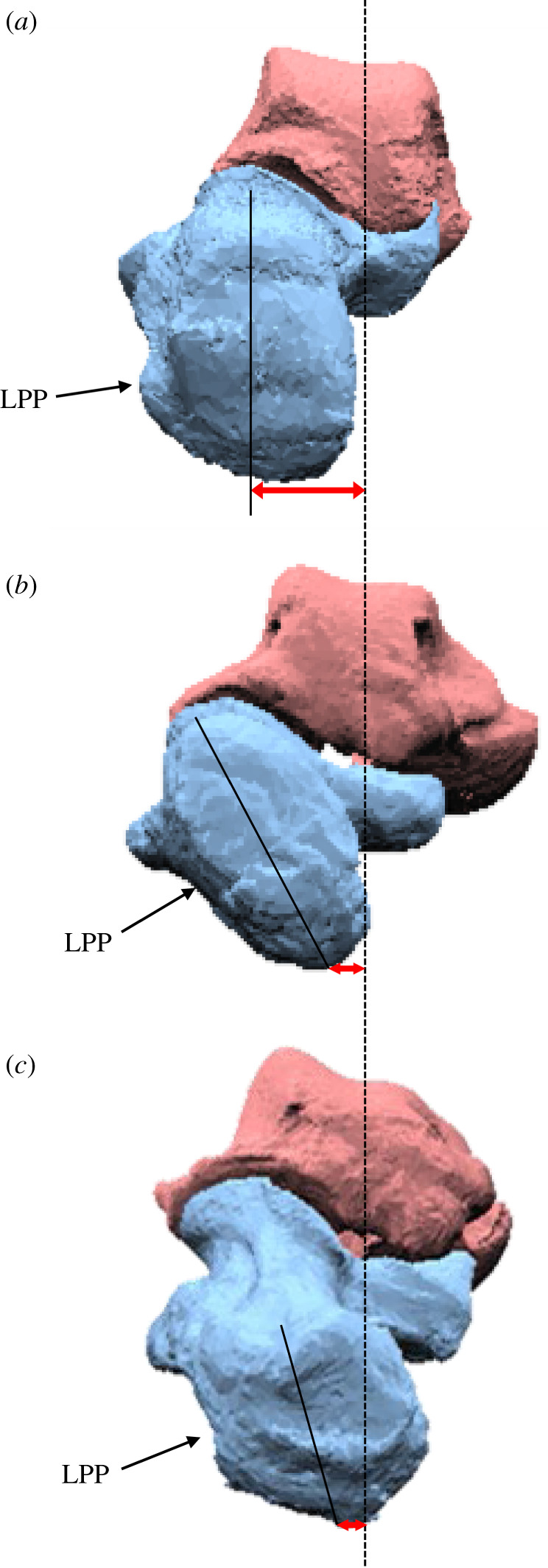
The human foot is considered to be morphologically adapted for habitual bipedal locomotion. However, how the mobility and mechanical interaction of the human foot with the ground under a weight-bearing condition differ from those of African great apes is not well understood. We compared three-dimensional (3D) bone kinematics of cadaver feet under axial loading of humans and African great apes using a biplanar X-ray fluoroscopy system. The calcaneus was everted and the talus and tibia were internally rotated in the human foot, but such coupling motion was much smaller in the feet of African great apes, possibly due to the difference in morphology of the foot bones and articular surfaces. This study also found that the changes in the length of the longitudinal arch were larger in the human foot than in the feet of chimpanzees and gorillas, indicating that the human foot is more deformable, possibly to allow storage and release of the elastic energy during locomotion. The coupling motion of the calcaneus and the tibia, and the larger capacity to be flattened due to axial loading observed in the human foot are possibly morphological adaptations for habitual bipedal locomotion that has evolved in the human lineage.
人类的足部在形态上被认为适应习惯性双足行走。然而,在负重条件下,人类足部与地面的移动性和机械相互作用与非洲大型猿类有何不同,目前还不太清楚。我们使用双平面X射线荧光透视系统,比较了人类和非洲大型猿类尸体足部在轴向负荷下的三维(3D)骨骼运动学。在人类足部,跟骨外翻,距骨和胫骨内旋,但在非洲大型猿类的足部,这种耦合运动要小得多,这可能是由于足部骨骼和关节面形态的差异。这项研究还发现,人类足部纵弓长度的变化比黑猩猩和大猩猩的足部更大,这表明人类足部更具可变形性,可能是为了在运动过程中储存和释放弹性能量。人类足部观察到的跟骨和胫骨的耦合运动,以及由于轴向负荷而更大的扁平能力,可能是人类谱系中为习惯性双足行走而进化出的形态适应。