Liu Jiachen, Sun Runlu, Yin Yuping, Li Jingyan, Liu Xuming, Liu Sheng, Zhang Zhanlei, Hu Jieting, Wan Xiaoting, Zhang Hong
Department of Nuclear Medicine, Sun Yat-sen Memorial Hospital, Sun Yat-sen University, Guangzhou, China.
Department of Cardiology, Sun Yat-sen Memorial Hospital, Sun Yat-sen University, Guangzhou, China.
Front Oncol. 2021 Nov 4;11:755899. doi: 10.3389/fonc.2021.755899. eCollection 2021.
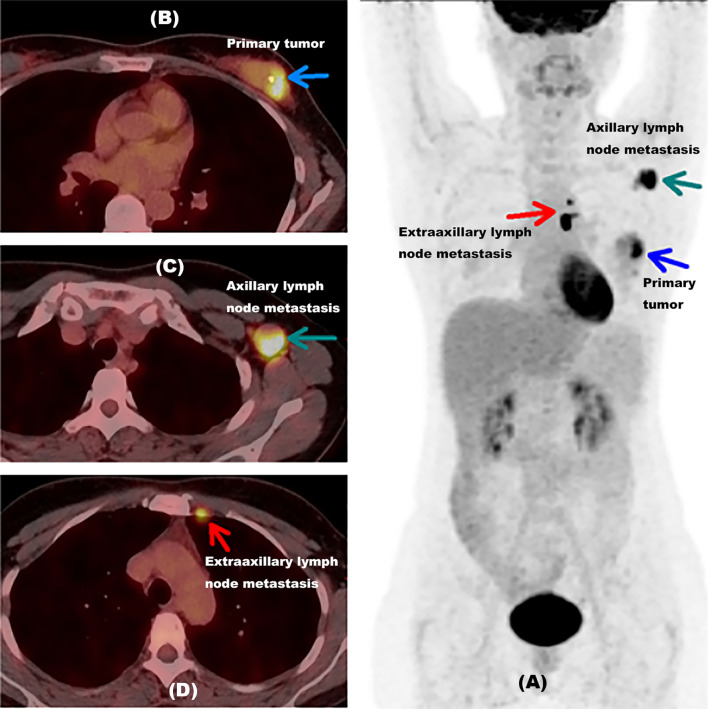
It is unclear whether the receptor status of breast malignancy or the proportion of receptors expression is useful in the interpretation of F-FDG PET/CT. This study's purpose was to analyze whether F-FDG PET/CT was valuable for helping newly diagnosed breast cancer patients find suspected or unsuspected metastasis lesions based on the proportion of receptors expression.
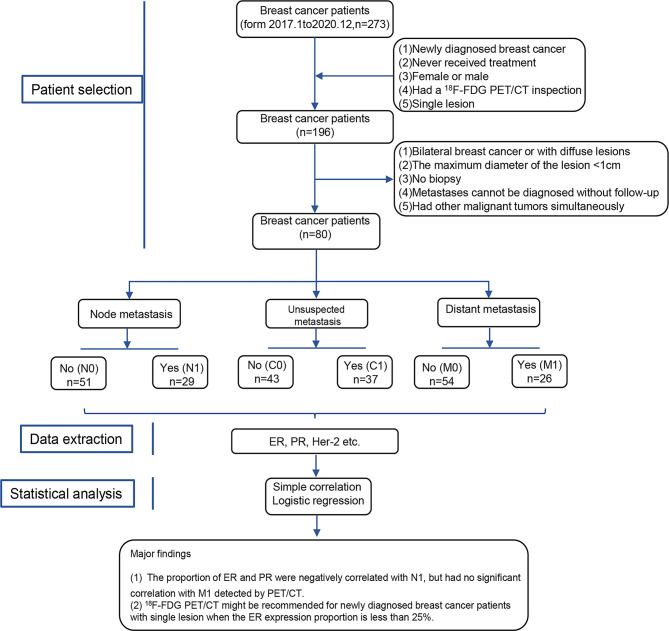
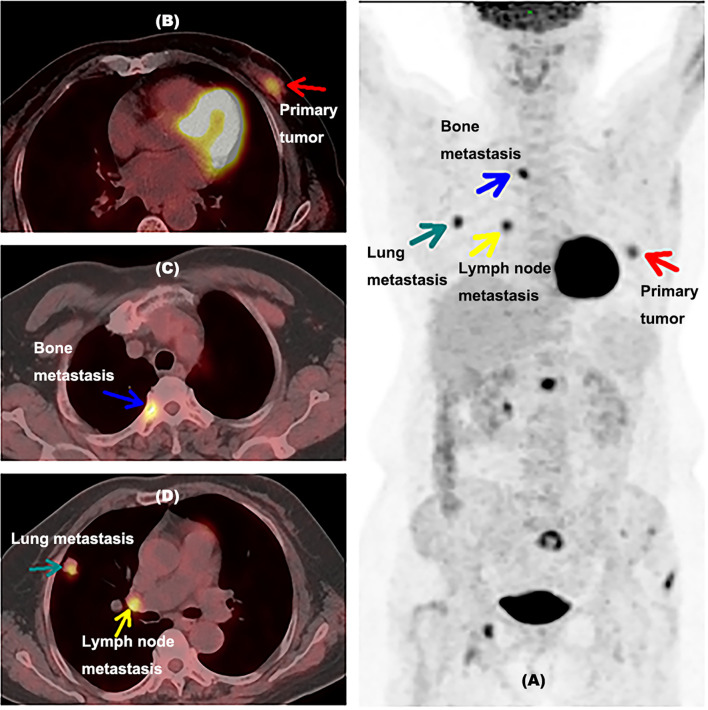
Eighty newly diagnosed breast cancer patients were divided into six groups, containing N0 (no extraaxillary lymph node metastasis), N1 (extraaxillary lymph node metastasis), M0 (no distant metastasis), and M1 (distant metastasis) groups, C0 (no unsuspected metastasis), and C1 (unsuspected metastasis and treatment plan changed) detected by PET/CT. The main data, including the proportion of receptors ER (estrogen receptor), PR (progesterone receptor), and Her-2 (human epidermal growth factor receptor 2) status, were extracted. Simple correlation and logistic regression were preformed to analyze the association between them.
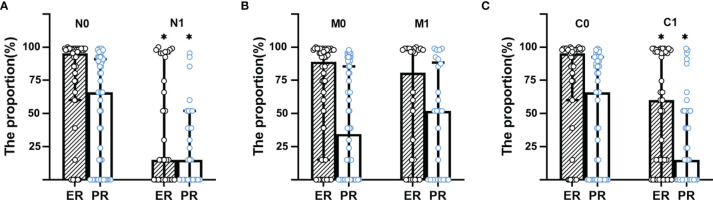
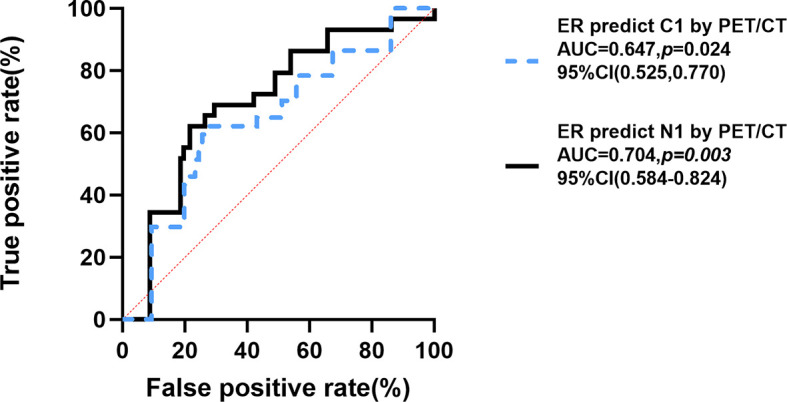
Patients in N1 group had lower proportion of ER (%) and PR (%) than that in N0 group (ER: 2 [0-80] 80 [15-95]; PR: 1 [0-10] 20 [0-45], <0.001). Moreover, the proportions of ER and PR were negatively correlated with N1 (ER: [r= -0.339, = 0.002], PR: [r= -0.247, = 0.011]) by simple correlation. Also, patients in C1 group had lower proportion of ER (%) and PR (%) than those in C0 group (ER: 10 [0-85] 80 [15-90], =0.026; PR: 1 [0-10] 20 [0-70], =0.041), while the distribution of ER and PR between M1 and M0 group had no significant difference. After the adjustment of traditional factors, the negative correlation between the proportion of ER (OR=0.986, 95% CI of OR [0.972-0.999], p=0.016) and C1 was found by logistic regression, cutoff value was 25% (ER) calculated by ROC (Receiver Operating Characteristic) curve (AUC [Area Under Curve]= 0.647, =0.024).
The proportion of ER in newly diagnosed breast cancer was negatively correlated with unsuspected metastasis detected by F-FDG PET/CT. F-FDG PET/CT might be recommended for newly diagnosed breast cancer patients with single lesions when the ER expression proportion is less than 25% to find unsuspected metastasis lesions and to modify treatment plan contrasted with conventional imaging and clinical examination.
尚不清楚乳腺恶性肿瘤的受体状态或受体表达比例在F-FDG PET/CT的解读中是否有用。本研究的目的是基于受体表达比例分析F-FDG PET/CT对帮助新诊断的乳腺癌患者发现可疑或意外转移病灶是否有价值。
80例新诊断的乳腺癌患者被分为六组,包括N0(无腋窝外淋巴结转移)、N1(腋窝外淋巴结转移)、M0(无远处转移)和M1(远处转移)组,以及通过PET/CT检测出的C0(无意外转移)和C1(有意外转移且治疗方案改变)组。提取主要数据,包括雌激素受体(ER)、孕激素受体(PR)和人表皮生长因子受体2(Her-2)的受体状态比例。进行简单相关性分析和逻辑回归分析以分析它们之间的关联?
N1组患者的ER(%)和PR(%)比例低于N0组(ER:2[0-80]对80[15-95];PR:1[0-10]对20[0-45],<0.001)。此外,通过简单相关性分析,ER和PR的比例与N1呈负相关(ER:[r = -0.339,P = 0.002],PR:[r = -0.247,P = 0.011])。同样,C1组患者的ER(%)和PR(%)比例低于C0组(ER:10[0-85]对80[15-90],P = 0.026;PR:1[0-10]对20[0-70],P = 0.041),而M1组和M0组之间ER和PR的分布无显著差异。在调整传统因素后,通过逻辑回归发现ER比例与C1之间存在负相关(OR = 0.986,OR的95%置信区间[0.972-0.999],P = 0.016),通过ROC(受试者工作特征)曲线计算的截断值为25%(ER)(曲线下面积[AUC]=0.647,P = 0.024)。
新诊断乳腺癌中ER的比例与F-FDG PET/CT检测出的意外转移呈负相关。对于ER表达比例小于25%的新诊断的单发乳腺癌患者,可能推荐使用F-FDG PET/CT来发现意外转移病灶,并与传统影像学和临床检查相比修改治疗方案。