Fabre Cyprien, Pauly Vanessa, Baumstarck Karine, Etchecopar-Etchart Damien, Orleans Veronica, Llorca Pierre-Michel, Blanc Julie, Lancon Christophe, Auquier Pascal, Boyer Laurent, Fond Guillaume
Aix-Marseille Univ., CEReSS - Health Service Research and Quality of Life Center, Marseille, France.
Department of Medical Information, Assistance Publique - Hôpitaux Marseille, Marseille, France.
Lancet Reg Health Eur. 2021 Sep 7;10:100209. doi: 10.1016/j.lanepe.2021.100209. eCollection 2021 Nov.
Existing studies evaluating the association between schizophrenia and complications associated with pregnancy, delivery and neonatal outcomes are based on data prior to 2014 and have reported heterogeneous results. The objective of our study was to determine whether pregnant women with schizophrenia were at increased risk of pregnancy, delivery and neonatal complications compared with women without severe mental disorders.
We performed a population-based cohort study of all singleton deliveries in France between Jan. 1, 2015, and Dec. 31, 2019. We divided this population into cases ( women with schizophrenia) and controls ( women without a diagnosis of severe mental disorder). Cases and controls were matched (1:4) inside the same hospital and the same year by age, social deprivation, parity, smoking, alcohol and substance addictions, malnutrition, obesity, and comorbidities. Univariate and multivariate models with odds ratios and 95% confidence intervals (ORs [95% CIs]) were used to estimate the association between schizophrenia and 24 pregnancy, delivery and neonatal outcomes.
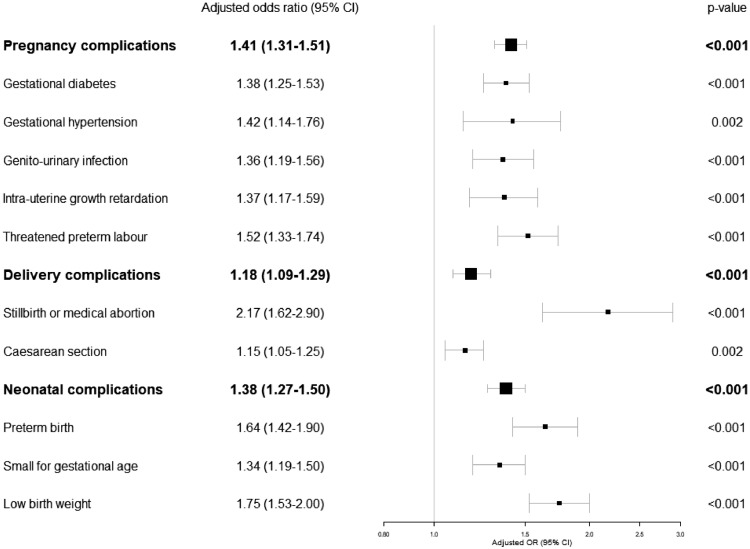
Over 5 years, 3,667,461 singleton deliveries were identified, of which 3,108 occurred in women with schizophrenia. Compared to controls, women with schizophrenia were found to be older; have more frequent smoking, alcohol and substance addictions; suffer from obesity, diabetes and chronic obstructive pulmonary disease; and often be hospitalized in tertiary maternity hospitals. Compared to matched controls, women with schizophrenia had more pregnancy complications (adjusted OR=1.41[95%CI 1.31-1.51]) (, gestational diabetes, gestational hypertension, genito-urinary infection, intrauterine growth retardation and threatened preterm labour). They had more delivery complications (aOR=1.18[95%CI 1.09 1.29]) with more still births/medical abortions (aOR=2.17[95%CI 1.62-2.90]) and caesarean sections (aOR=1.15[95%CI 1.05-1.25]). Newborns of women with schizophrenia had more neonatal complications (aOR=1.38[95%CI 1.27-1.50]) with more born preterm (aOR=1.64[95%CI1.42 -1.90]), small for gestational age (aOR=1.34[95%CI 1.19-1.50]) and low birth weight (aOR=1.75[95%CI 1.53-2.00]).
Our results highlight the importance of health disparities between pregnant women with and without schizophrenia, as well as in their newborns. Our study calls for health policy interventions during and before pregnancy, including proportionate intensified care to the level of needs, effective case management and preventive and social determinant approaches.
No funding.
现有评估精神分裂症与妊娠、分娩及新生儿结局相关并发症之间关联的研究基于2014年以前的数据,且结果各异。我们研究的目的是确定与无严重精神障碍的女性相比,患有精神分裂症的孕妇发生妊娠、分娩及新生儿并发症的风险是否增加。
我们对2015年1月1日至2019年12月31日期间在法国所有单胎分娩进行了一项基于人群的队列研究。我们将该人群分为病例组(患有精神分裂症的女性)和对照组(未诊断出严重精神障碍的女性)。病例组和对照组在同一家医院且同年按年龄、社会剥夺程度、产次、吸烟、酗酒和药物成瘾、营养不良、肥胖及合并症进行匹配(1:4)。使用单因素和多因素模型及比值比和95%置信区间(ORs[95%CIs])来估计精神分裂症与24种妊娠、分娩及新生儿结局之间的关联。
在5年期间,共识别出3,667,461例单胎分娩,其中3108例发生在患有精神分裂症的女性中。与对照组相比,患有精神分裂症的女性年龄更大;吸烟、酗酒和药物成瘾更频繁;患有肥胖症、糖尿病和慢性阻塞性肺疾病;且常入住三级妇产医院。与匹配的对照组相比,患有精神分裂症的女性有更多的妊娠并发症(调整后的OR=1.41[95%CI 1.31-1.51])(包括妊娠期糖尿病、妊娠期高血压、泌尿生殖系统感染、胎儿宫内生长受限和先兆早产)。她们有更多的分娩并发症(调整后的OR=1.18[95%CI 1.09-1.29]),更多的死产/人工流产(调整后的OR=2.17[95%CI 1.62-2.90])和剖宫产(调整后的OR=1.15[95%CI 1.05-1.25])。患有精神分裂症的女性所生新生儿有更多的新生儿并发症(调整后的OR=1.38[95%CI 1.27-1.50]),更多的早产(调整后的OR=1.64[95%CI1.42 -1.90])、小于胎龄儿(调整后的OR=1.34[95%CI 1.19-1.50])和低出生体重儿(调整后的OR=1.75[95%CI 1.53-2.00])。
我们的结果凸显了患有和未患有精神分裂症的孕妇及其新生儿之间健康差异的重要性。我们的研究呼吁在孕期及孕前采取卫生政策干预措施,包括根据需求程度进行适当强化护理、有效的病例管理以及预防性和社会决定因素方法。
无资金支持。