• 文献检索
  • 文档翻译
  • 深度研究
  • 学术资讯
  • Suppr Zotero 插件Zotero 插件
  • 邀请有礼
  • 套餐&价格
  • 历史记录
应用&插件
Suppr Zotero 插件Zotero 插件浏览器插件Mac 客户端Windows 客户端微信小程序
定价
高级版会员购买积分包购买API积分包
服务
文献检索文档翻译深度研究API 文档MCP 服务
关于我们
关于 Suppr公司介绍联系我们用户协议隐私条款
关注我们

Suppr 超能文献

核心技术专利:CN118964589B侵权必究
粤ICP备2023148730 号-1Suppr @ 2026

文献检索

告别复杂PubMed语法,用中文像聊天一样搜索,搜遍4000万医学文献。AI智能推荐,让科研检索更轻松。

立即免费搜索

文件翻译

保留排版,准确专业,支持PDF/Word/PPT等文件格式,支持 12+语言互译。

免费翻译文档

深度研究

AI帮你快速写综述,25分钟生成高质量综述,智能提取关键信息,辅助科研写作。

立即免费体验

肝病患者的抗血栓治疗:基于人群的处方趋势、依从性、持续性以及对中风和出血影响的差异见解。

Antithrombotic therapy in patients with liver disease: population-based insights on variations in prescribing trends, adherence, persistence and impact on stroke and bleeding.

作者信息

Chang Wai Hoong, Mueller Stefanie H, Tan Yen Yi, Lai Alvina G

机构信息

Institute of Health Informatics, University College London, London, UK.

出版信息

Lancet Reg Health Eur. 2021 Sep 8;10:100222. doi: 10.1016/j.lanepe.2021.100222. eCollection 2021 Nov.

DOI:10.1016/j.lanepe.2021.100222
PMID:34806071
原文链接:https://pmc.ncbi.nlm.nih.gov/articles/PMC8589727/
Abstract

BACKGROUND

Patients with liver disease have complex haemostasis and due to such contraindications, landmark randomised controlled trials investigating antithrombotic medicines have often excluded these patients. As a result, there has been limited consensus on the safety, efficacy and monitoring practices of anticoagulant and antiplatelet therapy in patients with liver disease. This study aims to investigate prescribing prevalence, adherence, persistence and impact of adherence on bleeding and stroke risk in people with and without liver disease taking anticoagulants and antiplatelets.

METHODS

We employed a population-based cohort consisting of person-level linked records from primary care, secondary care and the death registry. The cohort consisted of 3,929,596 adults aged ≥ 30 years during the study period of 1998 to 2020 and registered with an NHS general practitioner in England. The primary outcome was prescribing prevalence, adherence to and persistence with anticoagulant and antiplatelet therapy comparing patients with and without liver disease. Risk factors for non-adherence and non-persistence were analysed using multivariable logistic regression and Cox regression. Impact of adherence on bleeding and ischaemic stroke was assessed.

FINDINGS

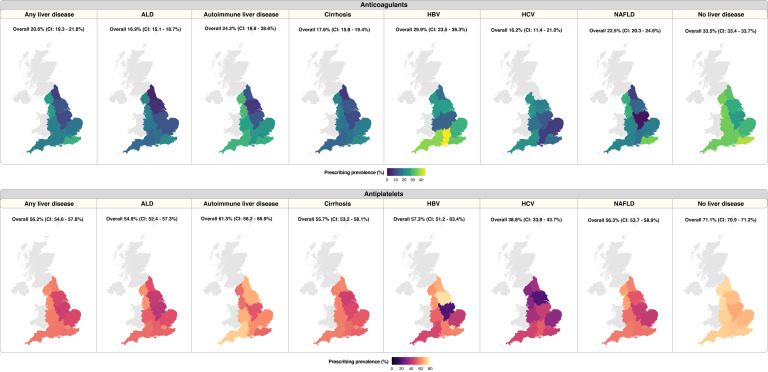
Among patients with any of the six liver diseases (ALD, autoimmune liver disease, cirrhosis, HBV, HCV and NAFLD), we identified 4,237 individuals with incident atrial fibrillation (indication for anticoagulants) and 4,929 individuals with incident myocardial infarction, transient ischaemic attack, unstable angina or peripheral arterial disease (indication for antiplatelets). Among patients without liver disease, 321,510 and 386,643 individuals were identified as having indications for anticoagulant and antiplatelet therapy, respectively. Among drug-naïve individuals, prescribing prevalence was lower in patients with liver disease compared with individuals without liver disease: anticoagulants (20.6% [806/3,921] vs. 33.5% [103,222/307,877]) and antiplatelets (56.2% [2,207/3,927] vs. 71.1% [249,258/350,803]). Primary non-adherence rates (stopping after one prescription) were higher in patients with liver disease, compared with those without liver disease: anticoagulants (7.9% [64/806] vs. 4.7% [4,841/103,222]) and antiplatelets (6.2% [137/2,207] vs. 4.4% [10,993/249,258]). Among individuals who were not primary non-adherent and had at least 12 months of follow-up, patients with liver disease however had a higher one-year adherence rate: anticoagulants (33.1% [208/628] vs. 29.4% [26,615/90,569]) and antiplatelets (40.9% [743/1,818] vs. 34.4% [76,834/223,154]). Likelihood of non-adherence was lower in apixaban and rivaroxaban (relative to warfarin) and lower in clopidogrel (relative to aspirin). Increased comorbidity burden (by CHADSVASc score) was associated with decreased risk of non-adherence and non-persistence with anticoagulants. Overall rates of 'non-adherent, non-persistent' were highest in warfarin (compared with apixaban and rivaroxaban) and aspirin (compared with clopidogrel or dipyridamole) in patients with and without liver disease. Among patients without liver disease, not taking antithrombotic medications for >3 months was associated with a higher risk of stroke, however, adherence to these medications was also associated with a small increase in risk of bleeding. Patients with liver disease (when compared with those without liver disease) had higher risks of stroke, especially when they stopped taking antiplatelets for >3 months. Patients with liver disease who were adherent to antiplatelets, however, had a higher risk of bleeding compared with patients without liver disease.

INTERPRETATION

Use of antithrombotic medicines in patients with and without liver disease is suboptimal with heterogeneity across medicines. As patients with liver disease are excluded from major randomised trials for these drugs, our results provide real-world evidence that may inform medicine optimisation strategies. We outline challenges and opportunities for tackling non-adherence, which begins with understanding patients' views of medicines to help them make informed decisions about appropriate use.

FUNDING

AGL is supported by funding from the Wellcome Trust (204841/Z/16/Z), National Institute for Health Research (NIHR) University College London Hospitals Biomedical Research Centre (BRC714/HI/RW/101440), NIHR Great Ormond Street Hospital Biomedical Research Centre (19RX02), the Health Data Research UK Better Care Catalyst Award (CFC0125) and the Academy of Medical Sciences (SBF006\1084). The funders have no role in the writing of the manuscript or the decision to submit it for publication.
https://cdn.ncbi.nlm.nih.gov/pmc/blobs/22bd/8589727/3f272cb84b72/gr3.jpg
https://cdn.ncbi.nlm.nih.gov/pmc/blobs/22bd/8589727/a94e1dbe5b2d/gr1.jpg
https://cdn.ncbi.nlm.nih.gov/pmc/blobs/22bd/8589727/6840f9fbde19/gr2.jpg
https://cdn.ncbi.nlm.nih.gov/pmc/blobs/22bd/8589727/3f272cb84b72/gr3.jpg
https://cdn.ncbi.nlm.nih.gov/pmc/blobs/22bd/8589727/a94e1dbe5b2d/gr1.jpg
https://cdn.ncbi.nlm.nih.gov/pmc/blobs/22bd/8589727/6840f9fbde19/gr2.jpg
https://cdn.ncbi.nlm.nih.gov/pmc/blobs/22bd/8589727/3f272cb84b72/gr3.jpg
摘要

背景

肝病患者的止血功能复杂,由于存在此类禁忌证,一些研究抗血栓药物的标志性随机对照试验常常将这些患者排除在外。因此,对于肝病患者抗凝和抗血小板治疗的安全性、有效性及监测方法,目前尚未达成广泛共识。本研究旨在调查服用抗凝药和抗血小板药物的肝病患者与非肝病患者的处方开具率、依从性、持续性以及依从性对出血和中风风险的影响。

方法

我们采用了一个基于人群的队列,该队列由来自初级保健、二级保健和死亡登记处的个人层面关联记录组成。该队列包括在1998年至2020年研究期间年龄≥30岁且在英格兰国民保健服务(NHS)全科医生处注册的3,929,596名成年人。主要结局是比较肝病患者与非肝病患者抗凝和抗血小板治疗的处方开具率、依从性和持续性。使用多变量逻辑回归和Cox回归分析不依从和不持续的危险因素。评估依从性对出血和缺血性中风的影响。

研究结果

在患有六种肝病(酒精性肝病、自身免疫性肝病、肝硬化、乙肝、丙肝和非酒精性脂肪性肝病)中的任何一种的患者中,我们确定了4237例新发房颤患者(抗凝治疗指征)和4929例新发心肌梗死、短暂性脑缺血发作、不稳定型心绞痛或外周动脉疾病患者(抗血小板治疗指征)。在无肝病患者中,分别有321,510例和386,643例被确定有抗凝和抗血小板治疗指征。在未用过药的个体中,肝病患者的处方开具率低于非肝病患者:抗凝药(20.6%[806/3921]对33.5%[103,222/307,877])和抗血小板药(56.2%[2207/3927]对71.1%[249,258/350,803])。与非肝病患者相比,肝病患者的初次不依从率(一剂处方后停药)更高:抗凝药(7.9%[64/806]对4.7%[4841/103,222])和抗血小板药(6.2%[137/2207]对4.4%[10,993/249,258])。然而,在非初次不依从且至少随访12个月的个体中,肝病患者的一年依从率更高:抗凝药(33.1%[208/628]对29.4%[26,615/90,569])和抗血小板药(40.9%[743/1818]对34.4%[76,834/223,154])。阿哌沙班和利伐沙班(相对于华法林)的不依从可能性较低,氯吡格雷(相对于阿司匹林)的不依从可能性较低。合并症负担增加(通过CHADSVASc评分)与抗凝药不依从和不持续风险降低相关。在有肝病和无肝病的患者中,“不依从、不持续”的总体发生率在华法林(与阿哌沙班和利伐沙班相比)和阿司匹林(与氯吡格雷或双嘧达莫相比)中最高。在无肝病患者中,未服用抗血栓药物超过3个月与中风风险较高相关,然而,坚持服用这些药物也与出血风险略有增加相关。肝病患者(与无肝病患者相比)中风风险更高,尤其是当他们停止服用抗血小板药物超过3个月时。然而,坚持服用抗血小板药物的肝病患者与无肝病患者相比出血风险更高。

解读

无论有无肝病,抗血栓药物的使用都不理想,不同药物之间存在异质性。由于肝病患者被排除在这些药物的主要随机试验之外,我们的结果提供了真实世界的证据,可为药物优化策略提供参考。我们概述了解决不依从问题的挑战和机遇,这首先要了解患者对药物的看法,以帮助他们就合理用药做出明智的决定。

资金来源

AGL得到了惠康信托基金(204841/Z/16/Z)、国家卫生研究院(NIHR)伦敦大学学院医院生物医学研究中心(BRC714/HI/RW/101440)、NIHR大奥蒙德街医院生物医学研究中心(19RX02)、英国健康数据研究更好护理催化剂奖(CFC0125)和医学科学院(SBF006\1084)的资助。资助者在撰写本文或决定提交发表方面没有任何作用。

相似文献

1
Antithrombotic therapy in patients with liver disease: population-based insights on variations in prescribing trends, adherence, persistence and impact on stroke and bleeding.肝病患者的抗血栓治疗:基于人群的处方趋势、依从性、持续性以及对中风和出血影响的差异见解。
Lancet Reg Health Eur. 2021 Sep 8;10:100222. doi: 10.1016/j.lanepe.2021.100222. eCollection 2021 Nov.
2
Triple versus guideline antiplatelet therapy to prevent recurrence after acute ischaemic stroke or transient ischaemic attack: the TARDIS RCT.急性缺血性卒中和短暂性脑缺血发作后预防复发的三联抗血小板治疗与指南推荐抗血小板治疗的随机对照试验(TARDIS RCT)。
Health Technol Assess. 2018 Aug;22(48):1-76. doi: 10.3310/hta22480.
3
Adherence to Rivaroxaban, Dabigatran, and Apixaban for Stroke Prevention in Incident, Treatment-Naïve Nonvalvular Atrial Fibrillation.依诺肝素、达比加群和阿哌沙班预防新发、未经治疗的非瓣膜性心房颤动卒中和体循环栓塞的依从性。
J Manag Care Spec Pharm. 2016 Nov;22(11):1319-1329. doi: 10.18553/jmcp.2016.22.11.1319.
4
Adherence and persistence to direct oral anticoagulants in atrial fibrillation: a population-based study.房颤患者直接口服抗凝剂的依从性和持久性:一项基于人群的研究。
Heart. 2020 Jan;106(2):119-126. doi: 10.1136/heartjnl-2019-315307. Epub 2019 Oct 10.
5
Dose specific effectiveness and safety of DOACs in patients with non-valvular atrial fibrillation: A Canadian retrospective cohort study.非瓣膜性心房颤动患者 DOACs 的剂量特异性有效性和安全性:一项加拿大回顾性队列研究。
Thromb Res. 2021 Jul;203:121-130. doi: 10.1016/j.thromres.2021.05.005. Epub 2021 May 11.
6
Comparing clinical trial population representativeness to real-world populations: an external validity analysis encompassing 43 895 trials and 5 685 738 individuals across 989 unique drugs and 286 conditions in England.比较临床试验人群代表性与真实世界人群:一项涵盖英国989种独特药物和286种病症的43895项试验及5685738名个体的外部有效性分析。
Lancet Healthy Longev. 2022 Oct;3(10):e674-e689. doi: 10.1016/S2666-7568(22)00186-6. Epub 2022 Sep 20.
7
Antiplatelet versus anticoagulation treatment for patients with heart failure in sinus rhythm.窦性心律心力衰竭患者的抗血小板治疗与抗凝治疗对比
Cochrane Database Syst Rev. 2016 Sep 15;9(9):CD003333. doi: 10.1002/14651858.CD003333.pub3.
8
Oral Anticoagulants for Nonvalvular Atrial Fibrillation in Patients With High Risk of Gastrointestinal Bleeding.非瓣膜性心房颤动患者中胃肠道出血高危风险者的口服抗凝剂。
JAMA Netw Open. 2021 Aug 2;4(8):e2120064. doi: 10.1001/jamanetworkopen.2021.20064.
9
Real-world data on the incidence, mortality, and cost of ischaemic stroke and major bleeding events among non-valvular atrial fibrillation patients in England.关于英格兰非瓣膜性心房颤动患者缺血性中风和重大出血事件的发病率、死亡率及成本的真实世界数据。
J Eval Clin Pract. 2021 Feb;27(1):119-133. doi: 10.1111/jep.13400. Epub 2020 Apr 21.
10
Combined anticoagulation and antiplatelet therapy for high-risk patients with atrial fibrillation: a systematic review.合并抗凝和抗血小板治疗用于伴有房颤的高危患者:一项系统评价。
Health Technol Assess. 2013 Jul;17(30):1-188. doi: 10.3310/hta17300.

引用本文的文献

1
Association of sociodemographic factors and comorbidity with non-receipt of medications for secondary prevention: a cohort study of 12,204 myocardial infarction survivors.社会人口学因素及合并症与二级预防用药未依从性的关联:一项对12204名心肌梗死幸存者的队列研究。
BMC Med. 2025 Jul 1;23(1):381. doi: 10.1186/s12916-025-04160-5.
2
Real-world management, resource use, patient-reported outcomes and adherence in patients receiving direct oral anticoagulants for first stroke attributed to non-valvular atrial fibrillation in secondary care: A UK mixed-methods observational study.二级医疗保健中接受直接口服抗凝剂治疗首次非瓣膜性心房颤动所致卒中患者的真实世界管理、资源利用、患者报告结局及依从性:一项英国混合方法观察性研究。
PLoS One. 2025 May 23;20(5):e0321621. doi: 10.1371/journal.pone.0321621. eCollection 2025.
3

本文引用的文献

1
Oral anticoagulants and risk of acute liver injury in patients with nonvalvular atrial fibrillation: a propensity-weighted nationwide cohort study.口服抗凝剂与非瓣膜性心房颤动患者急性肝损伤的风险:一项倾向评分加权的全国性队列研究。
Sci Rep. 2020 Jul 15;10(1):11624. doi: 10.1038/s41598-020-68304-8.
2
Direct Oral Anticoagulants in Patients With Atrial Fibrillation and Advanced Liver Disease: An Exploratory Meta-Analysis.直接口服抗凝剂用于心房颤动合并晚期肝病患者:一项探索性荟萃分析。
Hepatol Commun. 2020 May 7;4(7):1034-1040. doi: 10.1002/hep4.1513. eCollection 2020 Jul.
3
Direct Oral Anticoagulants in Patients with Liver Disease in the Era of Non-Alcoholic Fatty Liver Disease Global Epidemic: A Narrative Review.
Microvesicle Tissue Factor Procoagulant Activity Is Elevated and Correlated With Disease Severity in Patients With Cirrhosis.微泡组织因子促凝活性在肝硬化患者中升高且与疾病严重程度相关。
Liver Int. 2025 Apr;45(4):e16192. doi: 10.1111/liv.16192. Epub 2024 Nov 27.
4
Drug-drug interactions with oral anticoagulants: information consistency assessment of three commonly used online drug interactions databases in Switzerland.口服抗凝剂的药物相互作用:瑞士三个常用在线药物相互作用数据库的信息一致性评估
Front Pharmacol. 2024 Apr 2;15:1332147. doi: 10.3389/fphar.2024.1332147. eCollection 2024.
5
Patients with metabolic dysfunction-associated steatotic liver disease have preserved responses to antiplatelet drugs.患有代谢功能障碍相关脂肪性肝病的患者对抗血小板药物仍有反应。
Res Pract Thromb Haemost. 2023 Oct 10;7(7):102217. doi: 10.1016/j.rpth.2023.102217. eCollection 2023 Oct.
6
Management of Patients Treated with Direct Oral Anticoagulants in Clinical Practice and Challenging Scenarios.临床实践及复杂情况下接受直接口服抗凝剂治疗患者的管理
J Clin Med. 2023 Sep 13;12(18):5955. doi: 10.3390/jcm12185955.
7
Management of Stroke in Patients With Chronic Liver Disease: A Practical Review.慢性肝脏疾病患者脑卒中的管理:实用综述。
Stroke. 2023 Sep;54(9):2461-2471. doi: 10.1161/STROKEAHA.123.043011. Epub 2023 Jul 7.
8
Persistence and Adherence to Cardiovascular Medicines in Australia.澳大利亚心血管药物的坚持和依从性。
J Am Heart Assoc. 2023 Jul 4;12(13):e030264. doi: 10.1161/JAHA.122.030264. Epub 2023 Jun 29.
9
Drug-drug interactions between antithrombotics and direct-acting antivirals in hepatitis C virus (HCV) patients: A brief, updated report.丙型肝炎病毒(HCV)患者中抗血栓药物与直接作用抗病毒药物之间的药物相互作用:简要的最新报告。
Front Pharmacol. 2022 Aug 9;13:916361. doi: 10.3389/fphar.2022.916361. eCollection 2022.
10
Antithrombotic therapy in chronic liver disease: to clot or not to clot.慢性肝病中的抗栓治疗:凝血还是不凝血。
Lancet Reg Health Eur. 2021 Oct 1;10:100226. doi: 10.1016/j.lanepe.2021.100226. eCollection 2021 Nov.
直接口服抗凝剂在非酒精性脂肪性肝病全球流行时代肝病患者中的应用:一项叙述性综述。
Adv Ther. 2020 May;37(5):1910-1932. doi: 10.1007/s12325-020-01307-z. Epub 2020 Apr 13.
4
Adherence and persistence to direct oral anticoagulants in atrial fibrillation: a population-based study.房颤患者直接口服抗凝剂的依从性和持久性:一项基于人群的研究。
Heart. 2020 Jan;106(2):119-126. doi: 10.1136/heartjnl-2019-315307. Epub 2019 Oct 10.
5
A cross-sectional study of the public health response to non-alcoholic fatty liver disease in Europe.一项关于欧洲对非酒精性脂肪性肝病公共卫生应对措施的横断面研究。
J Hepatol. 2020 Jan;72(1):14-24. doi: 10.1016/j.jhep.2019.08.027. Epub 2019 Sep 10.
6
Contemporary Epidemiology of Chronic Liver Disease and Cirrhosis.慢性肝病和肝硬化的当代流行病学。
Clin Gastroenterol Hepatol. 2020 Nov;18(12):2650-2666. doi: 10.1016/j.cgh.2019.07.060. Epub 2019 Aug 8.
7
UK phenomics platform for developing and validating electronic health record phenotypes: CALIBER.英国表型组学平台用于开发和验证电子健康记录表型:CALIBER。
J Am Med Inform Assoc. 2019 Dec 1;26(12):1545-1559. doi: 10.1093/jamia/ocz105.
8
Use of Antiplatelet Agents Is Inversely Associated With Liver Fibrosis in Patients With Cardiovascular Disease.抗血小板药物的使用与心血管疾病患者的肝纤维化呈负相关。
Hepatol Commun. 2018 Oct 5;2(12):1601-1609. doi: 10.1002/hep4.1254. eCollection 2018 Dec.
9
Modeling NAFLD disease burden in China, France, Germany, Italy, Japan, Spain, United Kingdom, and United States for the period 2016-2030.建立中国、法国、德国、意大利、日本、西班牙、英国和美国 2016-2030 年非酒精性脂肪性肝病疾病负担模型。
J Hepatol. 2018 Oct;69(4):896-904. doi: 10.1016/j.jhep.2018.05.036. Epub 2018 Jun 8.
10
The 2018 European Heart Rhythm Association Practical Guide on the use of non-vitamin K antagonist oral anticoagulants in patients with atrial fibrillation.2018 年欧洲心脏病学会关于非维生素 K 拮抗剂口服抗凝剂在心房颤动患者中应用的实用指南。
Eur Heart J. 2018 Apr 21;39(16):1330-1393. doi: 10.1093/eurheartj/ehy136.