Department of Pediatrics, Washington University in St. Louis, St Louis, MO.
Institute for Clinical and Translational Research, Baylor College of Medicine, Houston, TX.
Blood Adv. 2022 Jan 25;6(2):420-428. doi: 10.1182/bloodadvances.2021005118.
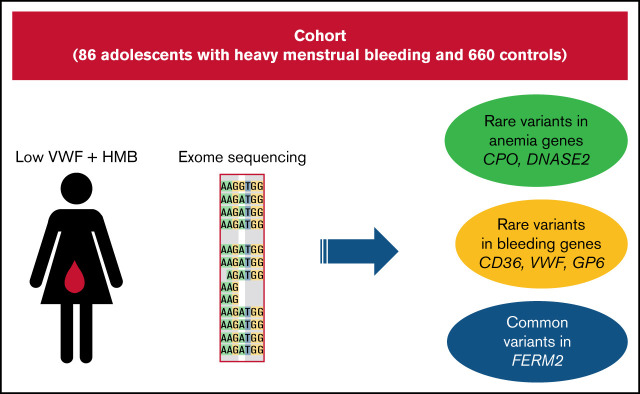
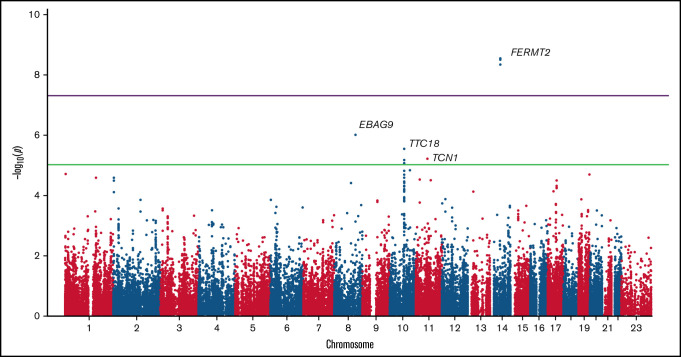
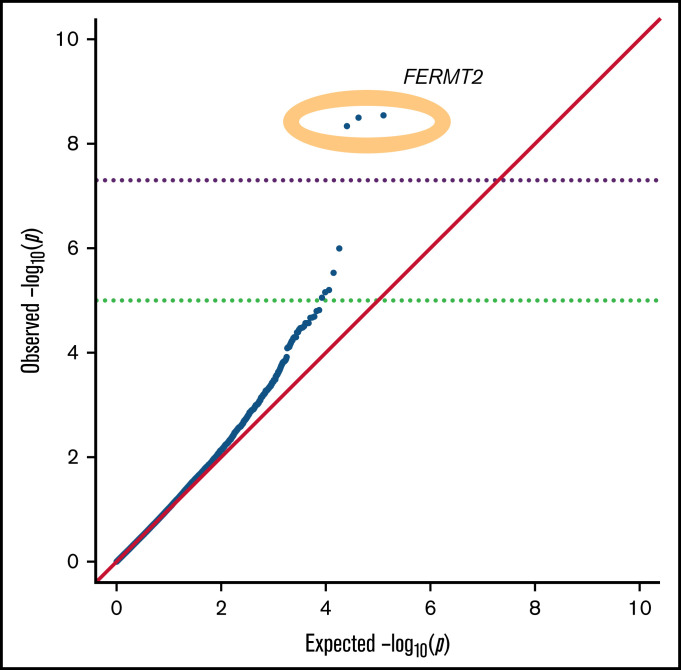
Adolescents with low von Willebrand factor (VWF) levels and heavy menstrual bleeding (HMB) experience significant morbidity. There is a need to better characterize these patients genetically and improve our understanding of the pathophysiology of bleeding. We performed whole-exome sequencing on 86 postmenarchal patients diagnosed with low VWF levels (30-50 IU/dL) and HMB and compared them with 660 in-house controls. We compared the number of rare stop-gain/stop-loss and rare ClinVar "pathogenic" variants between cases and controls, as well as performed gene burden and gene-set burden analyses. We found an enrichment in cases of rare stop-gain/stop-loss variants in genes involved in bleeding disorders and an enrichment of rare ClinVar "pathogenic" variants in genes involved in anemias. The 2 most significant genes in the gene burden analysis, CFB and DNASE2, are associated with atypical hemolytic uremia and severe anemia, respectively. VWF also surpassed exome-wide significance in the gene burden analysis (P = 7.31 × 10⁻⁶). Gene-set burden analysis revealed an enrichment of rare nonsynonymous variants in cases in several hematologically relevant pathways. Further, common variants in FERMT2, a gene involved in the regulation of hemostasis and angiogenesis, surpassed genome-wide significance. We demonstrate that adolescents with HMB and low VWF have an excess of rare nonsynonymous and pathogenic variants in genes involved in bleeding disorders and anemia. Variants of variable penetrance in these genes may contribute to the spectrum of phenotypes observed in patients with HMB and could partially explain the bleeding phenotype. By identifying patients with HMB who possess these variants, we may be able to improve risk stratification and patient outcomes.
患有低血管性血友病因子 (VWF) 水平和月经过多 (HMB) 的青少年会出现明显的发病。因此,需要更好地从遗传学角度来描述这些患者,并加深我们对出血病理生理学的理解。我们对 86 名初潮后被诊断为低 VWF 水平(30-50 IU/dL)和 HMB 的患者进行了全外显子组测序,并与 660 名内部对照进行了比较。我们比较了病例组和对照组之间罕见的停止增益/停止丢失和罕见的 ClinVar“致病性”变异的数量,以及进行了基因负担和基因集负担分析。我们发现,在涉及出血性疾病的基因中,罕见的停止增益/停止丢失变异在病例中存在富集,在涉及贫血的基因中,罕见的 ClinVar“致病性”变异也存在富集。在基因负担分析中,最显著的两个基因是 CFB 和 DNASE2,分别与非典型溶血性尿毒综合征和严重贫血有关。VWF 在基因负担分析中也超过了外显子组水平的显著意义(P = 7.31×10⁻⁶)。基因集负担分析显示,在几种与血液学相关的途径中,病例中罕见的非同义变异存在富集。此外,FERMT2 基因(参与止血和血管生成的调节)的常见变异也超过了全基因组水平的显著意义。我们证明,患有 HMB 和低 VWF 的青少年在涉及出血性疾病和贫血的基因中存在罕见的非同义变异和致病性变异过多。这些基因中的变异可能具有不同的外显率,这些变异可能导致 HMB 患者观察到的表型谱的部分解释,并导致出血表型。通过识别具有这些变异的 HMB 患者,我们可能能够改善风险分层和患者预后。