Academic Unit for Ageing and Stroke Research, Leeds Institute of Health Sciences, University of Leeds, Leeds, United Kingdom.
Academic Unit for Ageing and Stroke Research, Bradford Teaching Hospitals NHS Foundation Trust, Bradford Institute for Health Research, Bradford, United Kingdom.
PLoS One. 2021 Nov 23;16(11):e0259103. doi: 10.1371/journal.pone.0259103. eCollection 2021.
Self-management is a promising approach to improve quality of life after stroke. However, evidence for the appropriateness and effectiveness of self-management for stroke survivors with aphasia is limited. This article reports on the process used to develop a supported self-management intervention for stroke survivors with aphasia (SSWA) using co-production and behaviour change theory. Preparatory research included systematic reviews, and qualitative interviews and focus groups with SSWA, family members and speech and language therapists (SLTs).
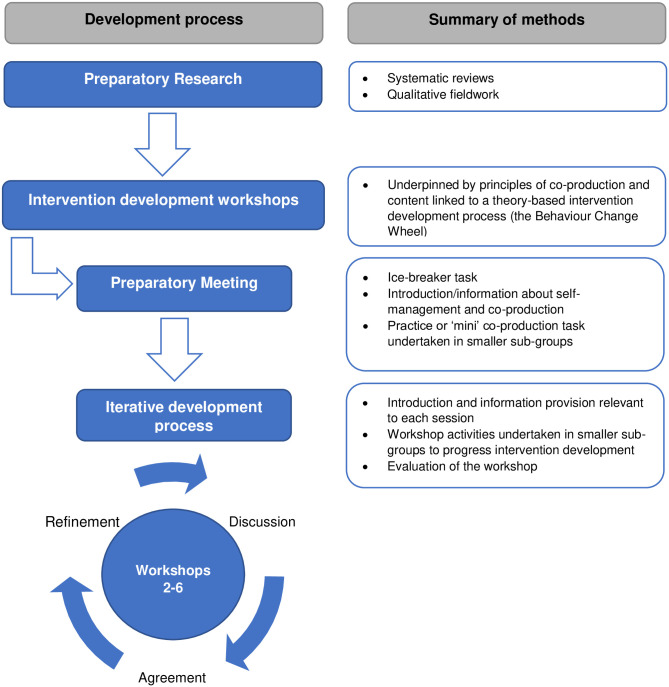
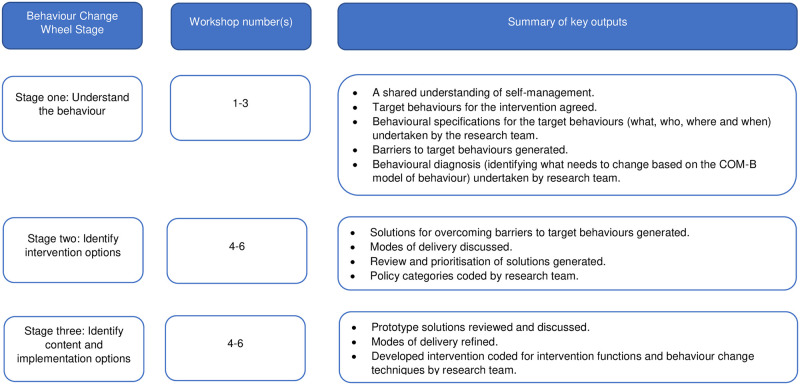
We conducted six, 2 hour long intervention development workshops with key stakeholders. The workshops were informed by principles of co-production and the intervention development process outlined by the Behaviour Change Wheel (BCW). We also incorporated the findings of our preparatory research within workshops. Each workshop included an introduction, 1-2 co-production tasks and time for feedback at the end of the session. Data were analysed on an ongoing basis so that findings could be used to feed in to subsequent workshops and intervention development.
Workshop participants (n = 12) included; SSWA (n = 5), family members (n = 3) and SLTs (n = 4). Together, participants engaged with accessible and participatory co-production tasks which aligned with the BCW framework. Participants engaged in discussion to define self-management in behavioural terms (behavioural diagnosis) and to identify what needed to change to support self-management. Participant's co-produced solutions for supporting self-management and discussed options to implement these in practice. Prototype materials were generated by the research team and evaluated by participants. Intervention functions and behaviour change techniques (BCTs) were mapped to the solutions generated by participants by the research team, after the final workshop. A supported self-management intervention for SSWA was developed which will be delivered by SLTs through community stroke services.
This paper reports the process we used to integrate co-production work with behaviour change theory to develop a complex self-management intervention. This is of relevance for researchers looking to harness the strengths of co-production methods and theory in intervention design. Future research will feasibility test the supported self-management intervention developed. This paper provides transparency to our intervention development process which will help others to better interpret the findings of our feasibility work.
自我管理是一种改善中风后生活质量的有前途的方法。然而,对于患有失语症的中风幸存者来说,自我管理的适当性和有效性的证据有限。本文报告了使用共同生产和行为改变理论为患有失语症的中风幸存者开发支持性自我管理干预措施(SSWA)的过程。预备研究包括系统评价以及与 SSWA、家庭成员和言语治疗师(SLT)的定性访谈和焦点小组。
我们与主要利益相关者进行了六次 2 小时的干预措施开发研讨会。研讨会遵循共同生产原则和行为改变轮(BCW)概述的干预措施开发过程。我们还在研讨会上纳入了预备研究的结果。每个研讨会都包括介绍、1-2 个共同生产任务以及在会议结束时进行反馈的时间。数据在进行中进行分析,以便将研究结果应用于后续研讨会和干预措施的开发。
研讨会参与者(n=12)包括:SSWA(n=5)、家庭成员(n=3)和 SLT(n=4)。参与者共同参与了易于访问和参与的共同生产任务,这些任务与 BCW 框架一致。参与者就自我管理的行为定义进行了讨论(行为诊断),并确定了支持自我管理所需的改变。参与者共同提出了支持自我管理的解决方案,并讨论了在实践中实施这些方案的选择。研究团队生成了原型材料,并由参与者进行了评估。干预功能和行为改变技术(BCTs)由研究团队根据参与者提出的解决方案进行映射,在最后一次研讨会之后。开发了一种针对 SSWA 的支持性自我管理干预措施,将由 SLT 通过社区中风服务提供。
本文报告了我们将共同生产工作与行为改变理论相结合以开发复杂自我管理干预措施的过程。这对于希望利用共同生产方法和理论在干预设计中的优势的研究人员具有重要意义。未来的研究将对开发的支持性自我管理干预措施进行可行性测试。本文提供了我们干预措施开发过程的透明度,这将有助于其他人更好地解释我们可行性工作的结果。