Maharajgunj Medical Campus, Tribhuvan University Institute of Medicine, P.O. Box: 44600, Kathmandu, Nepal.
Department of Neurology, Tribhuvan University Teaching Hospital, Maharajgunj, Kathmandu, 44600, Nepal.
BMC Neurol. 2021 Nov 23;21(1):458. doi: 10.1186/s12883-021-02488-y.
Interleukin-6-receptor inhibitors like Tocilizumab and Satralizumab are showing promising results in the treatment of Neuromyelitis Optica spectrum disorder (NMOSD). We aimed to investigate the efficacy and safety of various Interleukin-6-receptor inhibitors in the management of NMO/NMOSD.
PubMed, Embase, and The Cochrane Library were systematically searched for suitable studies. Change in Annualized Relapse Ratio (ARR), Change in Extended Disability Status Scale (EDSS) s, the proportion of relapse-free patients and proportion of patients with adverse events, including serious adverse events and mortality were the parameters considered for the meta-analysis for Tocilizumab. Mean difference (MD) with 95% CI was used to quantify the change in ARR and change in EDSS before and after treatment. A forest plot was prepared to indicate the efficacy and adverse effects outcomes. The results were compared with those of Satralizumab included in two trials.
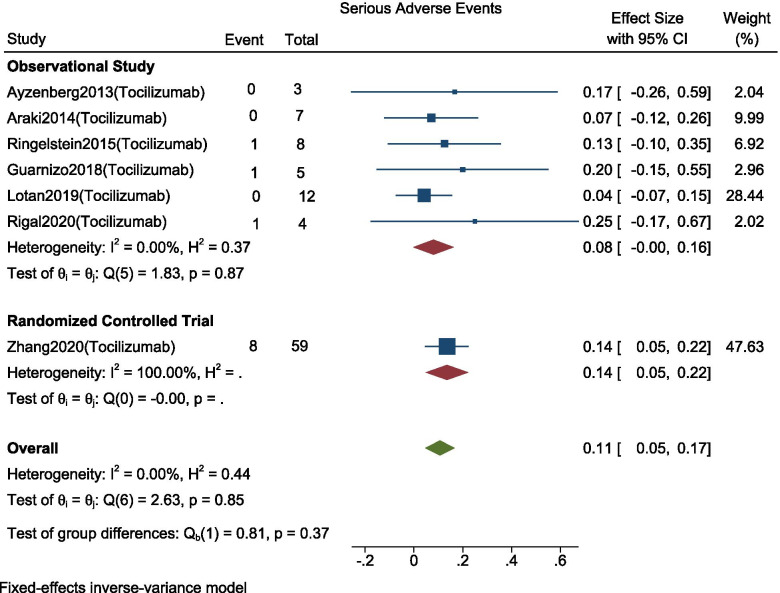
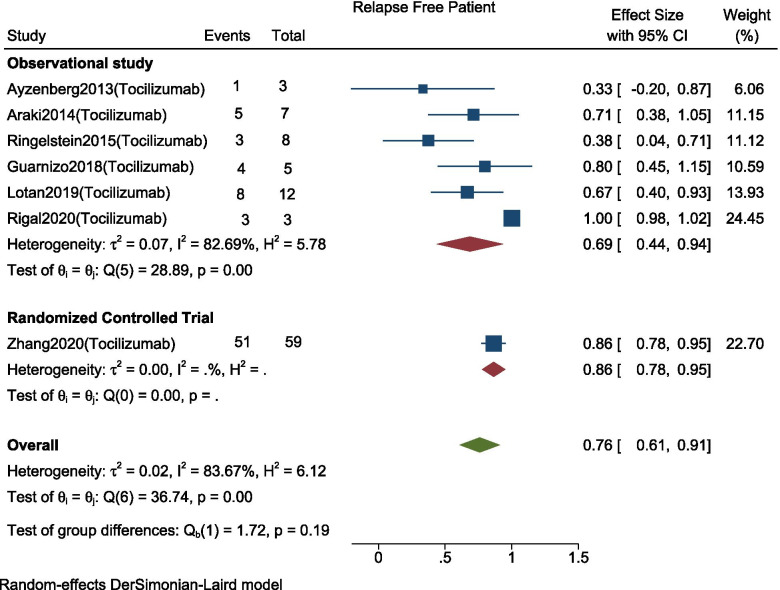
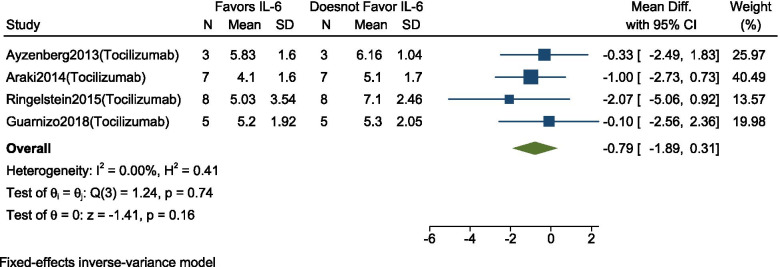
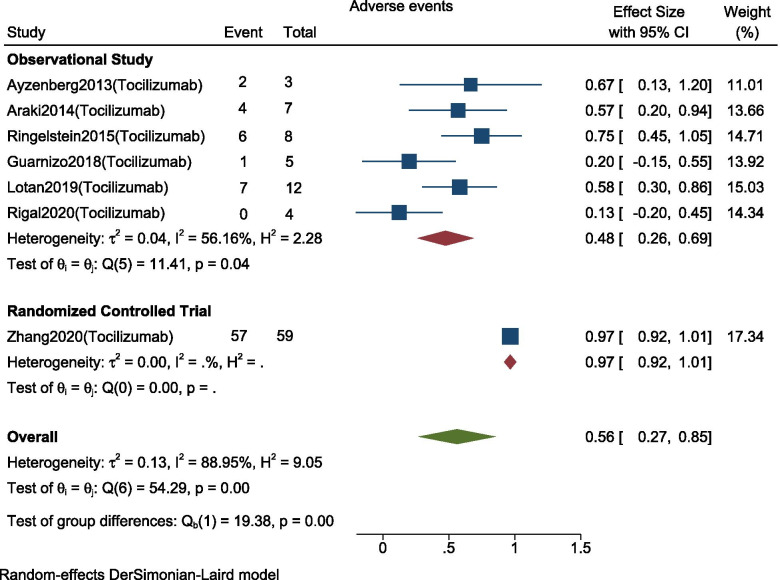
A total of nine studies with 202 patients were included in our study. Tocilizumab found a good proportion (76.95% CI: 0.61-0.91; p < 0.001) of relapse free patients at follow up. It also significantly reduced mean ARR (mean difference: -2.6, 95% CI: - 2.71 to - 1.68; p < 0.001) and but did not show significant difference in change in EDSS score (mean difference = - 0.79, 95% CI: - 1.89 to - 0.31; p = 0.16). Also, the toxicity profile of Tocilizumab was acceptable considering the proportions of patients with adverse events 56% (95% C.I.;0.27-0.85, I = 88.95%, p < 0.001), proportions of patients with serious adverse events 11% (95% C.I.; 0.05 to 0.17, I = 0%, p < 0.001) and zero treatment related deaths. SAkura studies for Satralizumab showed similar relapse free patients (70% to 80%) and reduction of ARR and EDSS from baseline. Some studies of Tocilizumab have shown to reduce pain and fatigue while trials of Satralizumab had non-significant findings.
Interleukin-6-receptor inhibitors therapy showed a promising result with good efficacy and acceptable adverse events profile for treatment of NMOSD.
白细胞介素-6 受体抑制剂,如托珠单抗和 Satralizumab,在治疗视神经脊髓炎谱系疾病(NMOSD)方面显示出良好的疗效。我们旨在研究各种白细胞介素-6 受体抑制剂在治疗 NMOSD/NMOSD 中的疗效和安全性。
系统地检索了 PubMed、Embase 和 The Cochrane Library 以寻找合适的研究。主要疗效终点为年复发率(ARR)的变化、扩展残疾状况量表(EDSS)的变化、无复发患者的比例和不良事件(包括严重不良事件和死亡率)的比例。托珠单抗的治疗前后 ARR 和 EDSS 的变化采用均数差(MD)和 95%置信区间(CI)进行量化。绘制森林图以表示疗效和不良反应的结果。结果与两项试验中包含的 Satralizumab 进行了比较。
共有 9 项研究,共 202 例患者纳入本研究。托珠单抗在随访时发现了很好比例(76.95% CI:0.61-0.91;p<0.001)的无复发患者。它还显著降低了平均 ARR(平均差异:-2.6,95% CI:-2.71 至-1.68;p<0.001),但 EDSS 评分的变化没有显著差异(平均差异=-0.79,95% CI:-1.89 至-0.31;p=0.16)。此外,考虑到不良事件患者比例为 56%(95% CI:0.27-0.85,I=88.95%,p<0.001),严重不良事件患者比例为 11%(95% CI:0.05 至 0.17,I=0%,p<0.001)和零与治疗相关的死亡,托珠单抗的毒性谱是可以接受的。Sakura 研究表明 Satralizumab 具有相似的无复发患者(70%至 80%),ARR 和 EDSS 均从基线降低。一些托珠单抗的研究表明可以减轻疼痛和疲劳,而 Satralizumab 的研究则没有显著发现。
白细胞介素-6 受体抑制剂治疗显示出良好的疗效和可接受的不良事件谱,为 NMOSD 的治疗提供了希望。