Department of Neurology, Tianjin Neurological Institute, Tianjin Medical University General Hospital, Tianjin Medical University, Tianjin, China; China National Clinical Research Center for Neurological Diseases, Advanced Innovation Center for Human Brain Protection, Department of Neurology, Beijing Tiantan Hospital, Capital Medical University, Beijing, China.
Department of Neurology, First Hospital of Shanxi Medical University, Taiyuan, China.
Lancet Neurol. 2020 May;19(5):391-401. doi: 10.1016/S1474-4422(20)30070-3.
Azathioprine is used as a first-line treatment to prevent relapses of neuromyelitis optica spectrum disorder (NMOSD). Tocilizumab has been reported to reduce NMOSD disease activity in retrospective case reports. We aimed to compare the safety and efficacy of tocilizumab and azathioprine in patients with highly relapsing NMOSD.
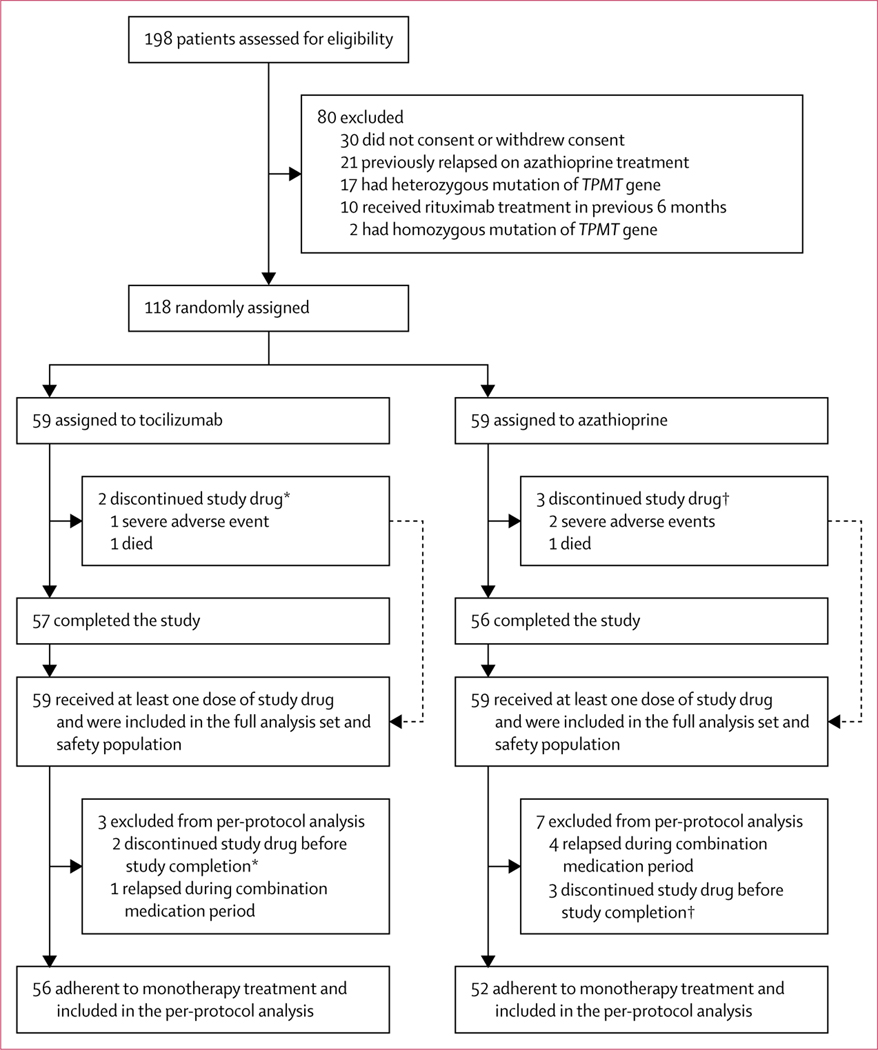
We did an open-label, multicentre, randomised, phase 2 trial at six hospitals in China. We recruited adult patients (aged ≥18 years) with highly relapsing NMOSD diagnosed according to 2015 International Panel for Neuromyelitis Optica Diagnosis criteria, who had an Expanded Disability Status Scale (EDSS) score of 7·5 or lower, and had a history of at least two clinical relapses during the previous 12 months or three relapses during the previous 24 months with at least one relapse within the previous 12 months. Patients were randomly assigned (1:1) to intravenous tocilizumab (8 mg/kg every 4 weeks) or oral azathioprine (2-3 mg/kg per day) by an independent statistician using computer-generated randomisation software with permuted blocks of four. The central review committee, EDSS raters, laboratory personnel, and radiologists were masked to the treatment assignment, but investigators and patients were aware of treatment allocation. The minimum planned duration of treatment was 60 weeks following randomisation. The primary outcome was time to first relapse in the full analysis set, which included all randomly assigned patients who received at least one dose of study drug, and the per-protocol population, which included all patients who used azathioprine or tocilizumab as monotherapy. For the analyses of the primary outcome, the patients were prespecified into two subgroups according to concomitant autoimmune disease status. Safety was assessed in the full analysis set. This study is registered with ClinicalTrials.gov, NCT03350633.
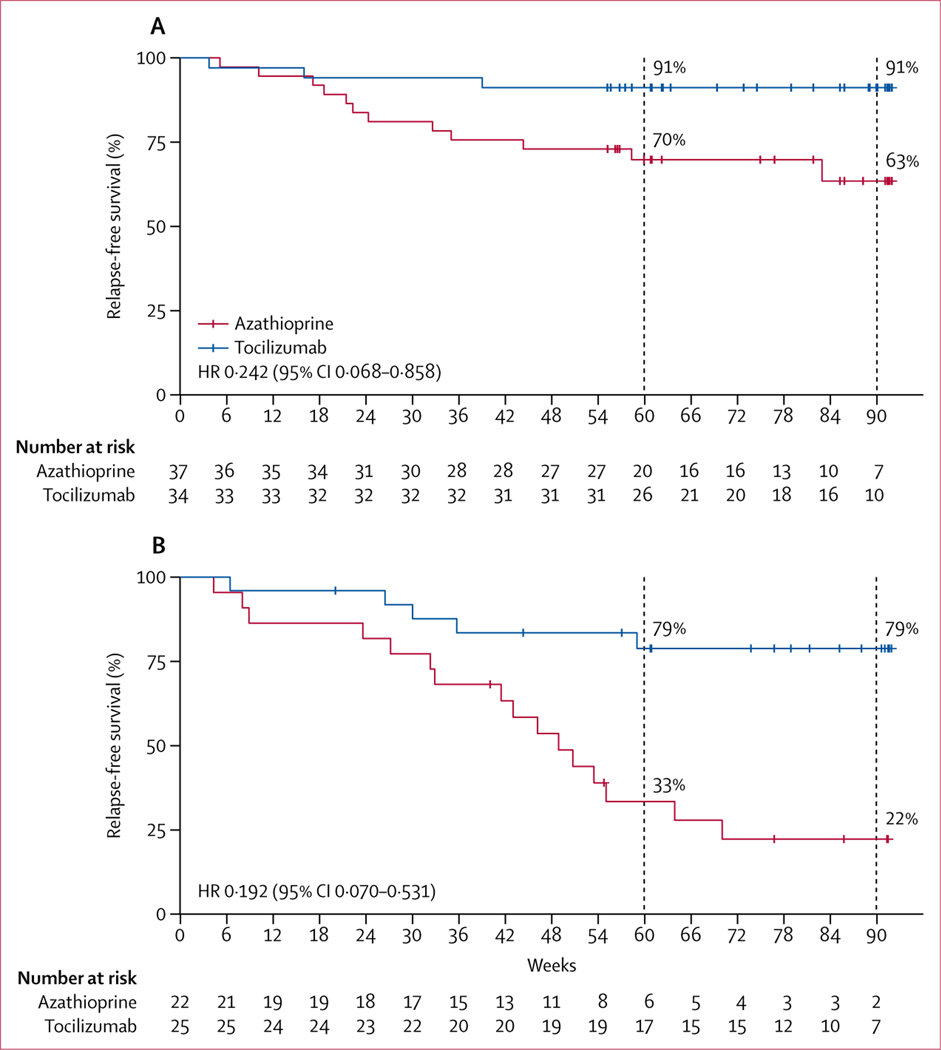
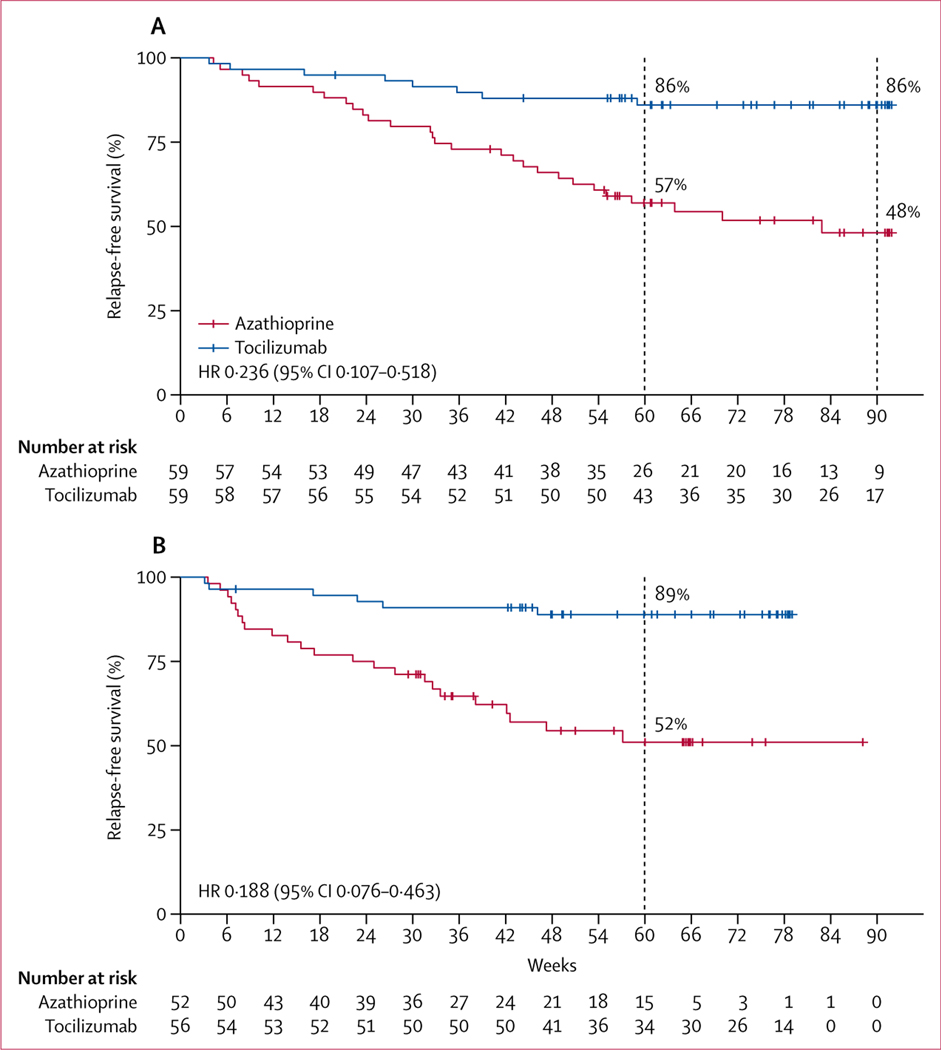
Between Nov 1, 2017, and Aug 3, 2018, we enrolled 118 patients, of whom 59 were randomly assigned to tocilizumab and 59 were randomly assigned to azathioprine. All 118 patients received one dose of study drug and were included in the full analysis set. 108 participants were included in the per-protocol analysis (56 in the tocilizumab group and 52 in the azathioprine group). In the full analysis set, median time to the first relapse was longer in the tocilizumab group than the azathioprine group (78·9 weeks [IQR 58·3-90·6] vs 56·7 [32·9-81·7] weeks; p=0·0026). Eight (14%) of 59 patients in the tocilizumab group and 28 (47%) of 59 patients in the azathioprine group had a relapse at the end of the study (hazard ratio [HR] 0·236 [95% CI 0·107-0·518]; p<0·0001). In the per-protocol analysis, 50 (89%) of 56 patients in the tocilizumab group were relapse-free compared with 29 (56%) of 52 patients in the azathioprine group at the end of the study (HR 0·188 [95% CI 0·076-0·463]; p<0·0001); the median time to first relapse was also longer in the tocilizumab group than the azathioprine group (67·2 weeks [IQR 47·9-77·9] vs 38·0 [23·6-64·9]; p<0·0001). In the prespecified subgroup analysis of the full analysis set stratified by concomitant autoimmune diseases, among patients without concomitant autoimmune diseases, three (9%) of 34 patients in the tocilizumab group and 13 (35%) of 37 patients in the azathioprine group had relapsed by the end of the study. Among patients with concomitant autoimmune diseases, a lower proportion of patients in the tocilizumab group had a relapse than in the azathioprine group (five [20%] of 25 patients vs 15 [68%] of 22 patients; HR 0·192 [95% CI 0·070-0·531]; p=0·0004). 57 (97%) of 59 patients in the tocilizumab group and 56 (95%) of 59 patients in the azathioprine group had adverse events. Treatment-associated adverse events occurred in 36 (61%) of 59 tocilizumab-treated patients and 49 (83%) of 59 azathioprine-treated patients. One death (2%) occurred in the tocilizumab group and one (2%) in the azathioprine group, but neither of the deaths were treatment-related.
Tocilizumab significantly reduced the risk of a subsequent NMOSD relapse compared with azathioprine. Tocilizumab might therefore be another safe and effective treatment to prevent relapses in patients with NMOSD.
Tianjin Medical University, Advanced Innovation Center for Human Brain Protection, National Key Research and Development Program of China, National Science Foundation of China.
巯嘌呤被用作治疗视神经脊髓炎谱系疾病(NMOSD)复发的一线药物。已有报道称,托珠单抗可降低 NMOSD 疾病活动度。我们旨在比较托珠单抗和巯嘌呤在高复发 NMOSD 患者中的安全性和疗效。
我们在六家中国医院进行了一项开放标签、多中心、随机、2 期试验。我们招募了根据 2015 年国际视神经脊髓炎诊断小组标准诊断的高复发 NMOSD 成年患者(年龄≥18 岁),这些患者的扩展残疾状况量表(EDSS)评分为 7.5 或更低,并且在过去 12 个月内有至少两次临床复发,或在过去 24 个月内有三次复发,其中至少一次复发发生在过去 12 个月内。患者按 1:1 随机分配(1:1)至静脉注射托珠单抗(每 4 周 8mg/kg)或口服巯嘌呤(每天 2-3mg/kg),由独立的统计学家使用计算机生成的随机化软件和四组交替块进行分组。中央审查委员会、EDSS 评分者、实验室人员和放射科医生对治疗分配情况不知情,但研究者和患者了解治疗分组情况。随机分组后,计划的最低治疗时间为 60 周。主要结局是全分析集(包括至少接受一剂研究药物的所有随机分配患者)和意向治疗人群(包括所有使用巯嘌呤或托珠单抗作为单药治疗的患者)中首次复发的时间。对于主要结局的分析,根据同时存在自身免疫性疾病的情况,将患者预先指定为两个亚组。全分析集评估安全性。本研究在 ClinicalTrials.gov 注册,编号为 NCT03350633。
在 2017 年 11 月 1 日至 2018 年 8 月 3 日期间,我们纳入了 118 名患者,其中 59 名随机分配至托珠单抗组,59 名随机分配至巯嘌呤组。所有 118 名患者均接受了一剂研究药物,并纳入全分析集。108 名患者纳入意向治疗分析(托珠单抗组 56 名,巯嘌呤组 52 名)。在全分析集中,托珠单抗组首次复发的中位时间长于巯嘌呤组(78.9 周 [IQR 58.3-90.6] vs 56.7 [32.9-81.7] 周;p=0.0026)。托珠单抗组 59 名患者中有 8 名(14%)和巯嘌呤组 59 名患者中有 28 名(47%)在研究结束时复发(风险比[HR] 0.236 [95%CI 0.107-0.518];p<0.0001)。在意向治疗分析中,托珠单抗组 56 名患者中有 50 名(89%)在研究结束时无复发,而巯嘌呤组 52 名患者中有 29 名(56%)(HR 0.188 [95%CI 0.076-0.463];p<0.0001);托珠单抗组首次复发的中位时间也长于巯嘌呤组(67.2 周 [IQR 47.9-77.9] vs 38.0 [23.6-64.9];p<0.0001)。在全分析集按同时存在自身免疫性疾病分层的亚组分析中,在无同时存在自身免疫性疾病的患者中,托珠单抗组 34 名患者中有 3 名(9%)和巯嘌呤组 37 名患者中有 13 名(35%)在研究结束时复发。在同时存在自身免疫性疾病的患者中,托珠单抗组的复发比例低于巯嘌呤组(25 名患者中有 5 名[20%],22 名患者中有 15 名[68%];HR 0.192 [95%CI 0.070-0.531];p=0.0004)。托珠单抗组 59 名患者中有 57 名(97%)和巯嘌呤组 59 名患者中有 56 名(95%)发生不良事件。托珠单抗治疗组 59 名患者中有 36 名(61%)和巯嘌呤治疗组 59 名患者中有 49 名(83%)发生治疗相关不良事件。托珠单抗组发生 1 例死亡(2%),巯嘌呤组发生 1 例死亡(2%),但均与治疗无关。
托珠单抗显著降低了 NMOSD 复发的风险,与巯嘌呤相比。因此,托珠单抗可能是另一种安全有效的治疗方法,可预防 NMOSD 患者的复发。
天津医科大学、人脑保护先进创新中心、国家重点研发计划、国家自然科学基金。