Department of Physiology, School of Medicine, Pusan National University, Yangsan 50612, Korea; Department of Pharmacology, University of Texas Southwestern Medical Center, Dallas 75390-9071, TX, USA.
Department of Physiology, School of Medicine, Pusan National University, Yangsan 50612, Korea.
BMB Rep. 2022 Apr;55(4):175-180. doi: 10.5483/BMBRep.2022.55.4.137.
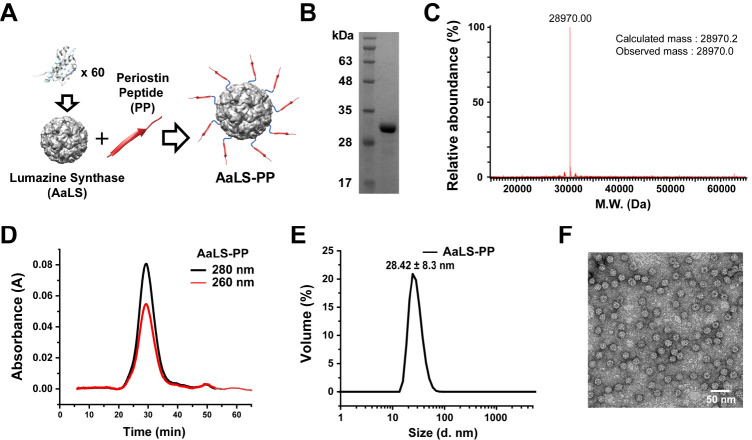
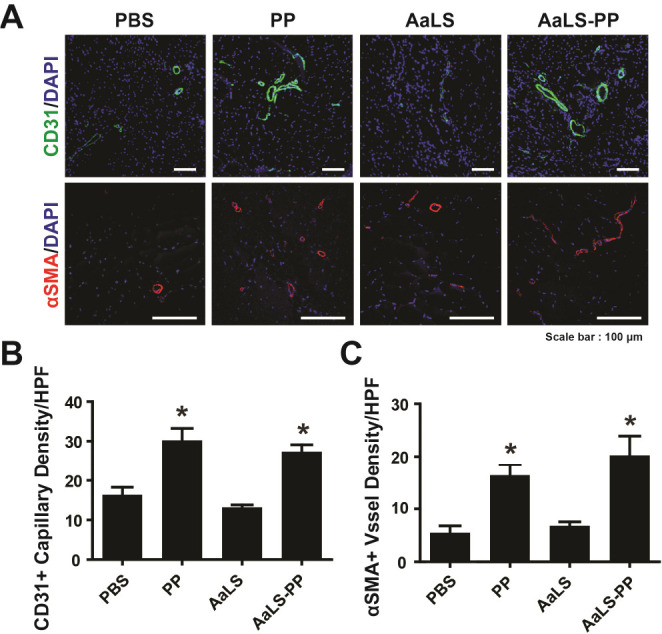
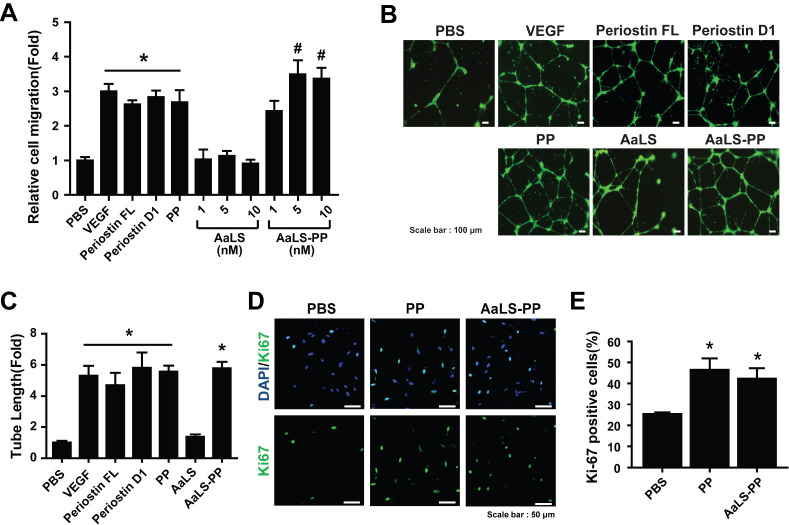
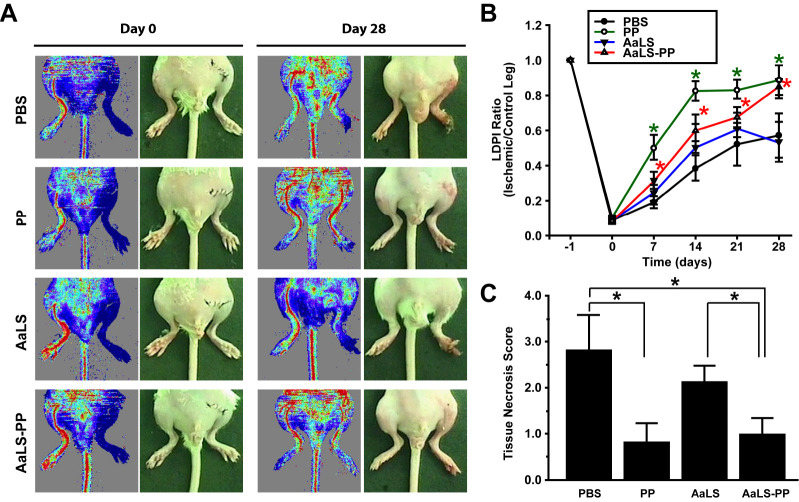
Peptides are gaining substantial attention as therapeutics for human diseases. However, they have limitations such as low bioavailability and poor pharmacokinetics. Periostin, a matricellular protein, can stimulate the repair of ischemic tissues by promoting angiogenesis. We have previously reported that a novel angiogenic peptide (amino acids 142-151) is responsible for the pro-angiogenic activity of periostin. To improve the in vivo delivery efficiency of periostin peptide (PP), we used proteins self-assembled into a hollow cage-like structure as a drug delivery nanoplatform in the present study. The periostin peptide was genetically inserted into lumazine synthase (isolated from Aquifex aeolicus) consisting of 60 identical subunits with an icosahedral capsid architecture. The periostin peptide-bearing lumazine synthase protein cage nanoparticle with 60 periostin peptides multivalently displayed was expressed in Escherichia coli and purified to homogeneity. Next, we examined angiogenic activities of this periostin peptide-bearing lumazine synthase protein cage nanoparticle. AaLS-periostin peptide (AaLS-PP), but not AaLS, promoted migration, proliferation, and tube formation of human endothelial colony-forming cells in vitro. Intramuscular injection of PP and AaLS-PP increased blood perfusion and attenuated severe limb loss in the ischemic hindlimb. However, AaLS did not increase blood perfusion or alleviate tissue necrosis. Moreover, in vivo administration of AaLS-PP, but not AaLS, stimulated angiogenesis in the ischemic hindlimb. These results suggest that AaLS is a highly useful nanoplatform for delivering pro-angiogenic peptides such as PP. [BMB Reports 2022; 55(4): 175-180].
肽类物质作为治疗人类疾病的药物正受到广泛关注。然而,它们存在生物利用度低和药代动力学差等局限性。成纤维细胞表面蛋白(periostin)是一种基质细胞蛋白,可通过促进血管生成来刺激缺血组织的修复。我们之前的研究报告称,一种新型血管生成肽(氨基酸 142-151)是成纤维细胞表面蛋白发挥促血管生成活性的原因。为了提高成纤维细胞表面蛋白肽(PP)的体内递送效率,本研究中我们使用蛋白质自组装成具有中空笼状结构的纳米载体作为药物递送平台。将成纤维细胞表面蛋白肽插入由 60 个相同亚基组成的具有二十面体衣壳结构的光氨酸合酶(来自水生栖热菌)中。表达并纯化了具有 60 个成纤维细胞表面蛋白肽的多价展示的带有成纤维细胞表面蛋白肽的光氨酸合酶蛋白笼纳米颗粒。接下来,我们研究了这种带有成纤维细胞表面蛋白肽的光氨酸合酶蛋白笼纳米颗粒的血管生成活性。AaLS-periostin 肽(AaLS-PP)而非 AaLS 可促进人内皮集落形成细胞的迁移、增殖和管状结构形成。PP 和 AaLS-PP 的肌内注射增加了缺血后肢的血液灌注,并减轻了严重的肢体缺失。然而,AaLS 并未增加血液灌注或减轻组织坏死。此外,体内给予 AaLS-PP 而非 AaLS 可刺激缺血后肢的血管生成。这些结果表明,AaLS 是递送促血管生成肽(如 PP)的一种非常有用的纳米载体。[BMB Reports 2022; 55(4): 175-180]。