DeMott Ella, Dickinson Daniel J, Doonan Ryan
Glow Worms Stream, Freshman Research Initiative, Texas Institute for Discovery Education in Science, College of Natural Sciences, The University of Texas at Austin, Austin TX, USA.
Department of Molecular Biosciences, The University of Texas at Austin, Austin TX, USA.
MicroPubl Biol. 2021 Nov 19;2021. doi: 10.17912/micropub.biology.000499. eCollection 2021.
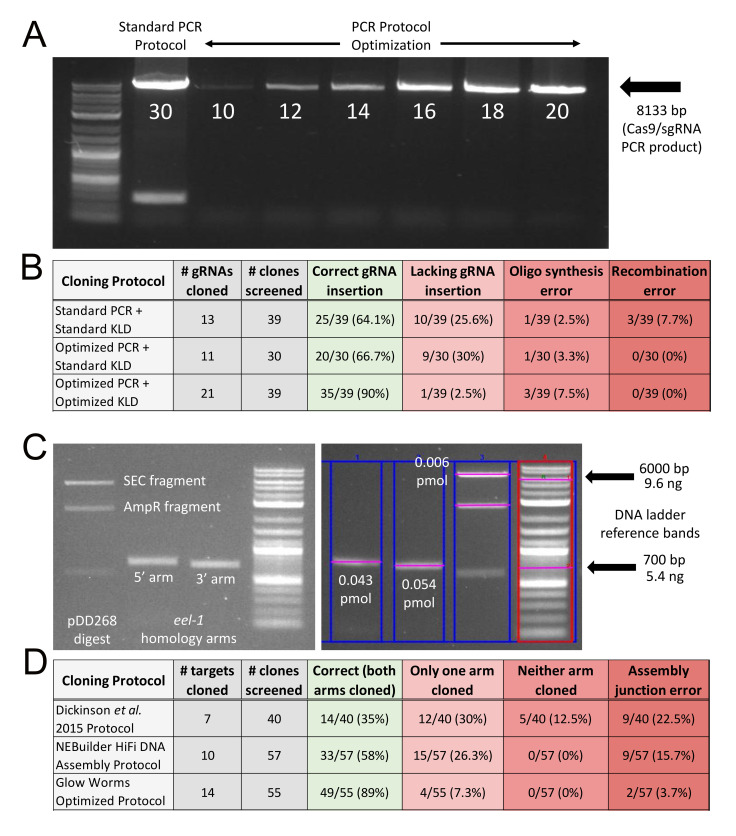
Plasmid-based CRISPR knock-in is a streamlined, scalable, and versatile approach for generating fluorescent protein tags in (Dickinson . 2015; Schwartz and Jorgensen 2016). However, compared to more recent protocols that utilize commercially available Cas9/RNP products and linear DNA repair templates (Dokshin . 2018; Ghanta and Mello 2020), the cloning required for plasmid-based protocols has been cited as a drawback of this knock-in approach. Using thorough quantitative assessment, we have found that cloning efficiency can reproducibly reach 90% for the plasmids of the self-excising cassette (SEC) selection method, essentially resolving cloning as a burden for plasmid-based CRISPR knock-in.
基于质粒的CRISPR敲入是一种用于在(Dickinson. 2015;Schwartz和Jorgensen 2016)中生成荧光蛋白标签的简化、可扩展且通用的方法。然而,与使用市售Cas9/RNP产品和线性DNA修复模板的更新协议(Dokshin. 2018;Ghanta和Mello 2020)相比,基于质粒的协议所需的克隆被认为是这种敲入方法的一个缺点。通过全面的定量评估,我们发现自切割盒(SEC)选择方法的质粒克隆效率可重复达到90%,基本解决了克隆作为基于质粒的CRISPR敲入负担的问题。