López Steinmetz Lorena Cecilia, Fong Shao Bing, Leyes Candela Abigail, Dutto Florio María Agustina, Godoy Juan Carlos
Laboratorio de Psicología, Instituto de Investigaciones Psicológicas (IIPsi), Universidad Nacional de Córdoba (UNC)-Consejo Nacional de Investigaciones Científicas y Técnicas (CONICET), Córdoba, Argentina.
Decanato de Ciencias Sociales, Universidad Siglo 21, Córdoba, Argentina.
Front Glob Womens Health. 2020 Sep 17;1:580652. doi: 10.3389/fgwh.2020.580652. eCollection 2020.
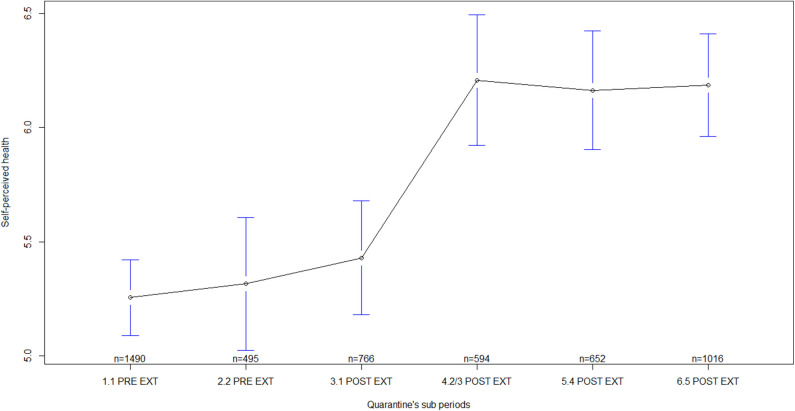
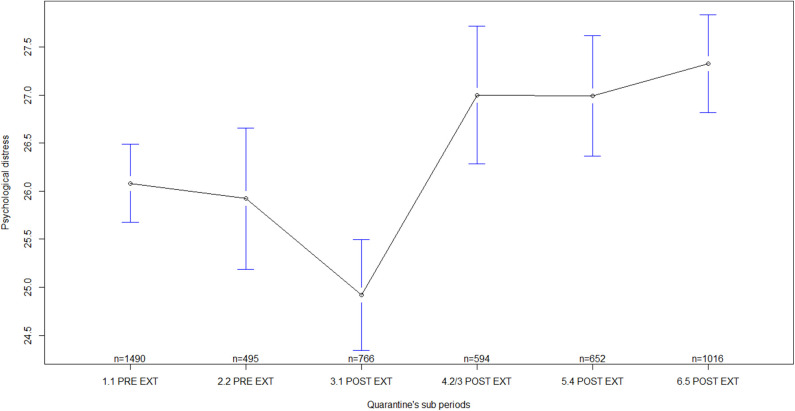
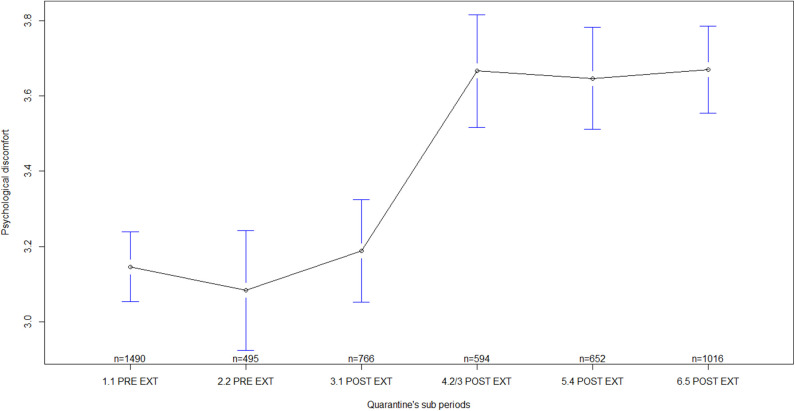
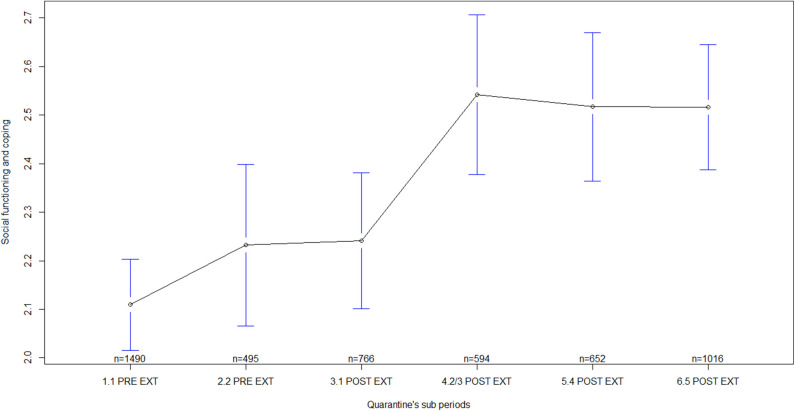
Argentinean quarantine during the COVID-19 pandemic is one of the most long-lasting worldwide. We focused on the first 80-days of this quarantine on Argentinean women. Our aims were to analyze differences in general mental health state (MHS) indicators, by the (1) sites of residence with different prevalence of COVID-19 cases, and (2) quarantine duration; (3) to assess multiple relationships between each general MHS indicator and potentially affecting factors. We used a cross-sectional design with convenience successive sampling ( = 5,013). The online survey included a socio-demographic questionnaire (elaborated ) with standardized and validated self-reported questionnaires (General Health Questionnaire, Kessler Psychological Distress Scale) measuring the MHS indicators: self-perceived health, psychological discomfort, social functioning and coping, and psychological distress. Worse self-perceived health and higher psychological discomfort affected significantly more women residing in sites with high prevalence of COVID-19 cases, compared to those residing in sites with intermediate prevalence, but effect sizes were small. Mean scores of all general MHS indicators were significantly worse for longer quarantine sub-periods (up to 53, 68, and 80-day duration) than for shorter sub-periods (up to seven, 13, and 25-day duration). Being a younger age, having mental disorder history, and longer quarantine durations were associated to worsening MHS, while the lack of previous suicide attempt has a protective effect. Our findings show that a worse MHS during quarantine may not be attributed to the objective risk of contagion (measured greater or less), and under quarantine, women MHS-as indicated by group central tendency measures-got worse as time went by. This strongly suggests that special attention needs to be paid to younger women and to women with history of mental disorder. Along with physical health, mental health must be a priority for the Government during and after quarantine and the COVID-19 pandemic.
新冠疫情期间阿根廷的隔离措施是全球持续时间最长的之一。我们聚焦于阿根廷女性在此次隔离的前80天的情况。我们的目的是分析一般心理健康状况(MHS)指标的差异,具体基于:(1)新冠病例患病率不同的居住地点;(2)隔离时长;(3)评估每个一般MHS指标与潜在影响因素之间的多重关系。我们采用了便利连续抽样的横断面设计(n = 5013)。在线调查包括一份社会人口学问卷(精心编制)以及用于测量MHS指标的标准化且经过验证的自填问卷(一般健康问卷、凯斯勒心理困扰量表),这些指标包括自我感知健康、心理不适、社会功能与应对以及心理困扰。与居住在中等患病率地区的女性相比,自我感知健康状况较差和心理不适程度较高对居住在新冠病例高患病率地区的女性影响更为显著,但效应量较小。所有一般MHS指标的平均得分在较长隔离子时段(长达53天、68天和80天)显著低于较短隔离子时段(长达7天、13天和25天)。年龄较小、有精神疾病史以及隔离时间较长与心理健康状况恶化相关,而既往无自杀未遂史则具有保护作用。我们的研究结果表明,隔离期间较差的心理健康状况可能并非归因于客观的感染风险(无论高低),并且在隔离期间,从群体集中趋势测量来看,女性的心理健康状况随时间推移而变差。这强烈表明,需要特别关注年轻女性以及有精神疾病史的女性。在隔离期间及之后以及新冠疫情期间,除了身体健康外,心理健康也必须是政府的优先事项。