Tewari Abha, Praveen Devarsetty, Madhira Pavitra, Josyula Lakshmi K, Joshi Rohina, Kokku Suresh B, Garg Vandana, Rawal Ishita, Chopra Kanika, Chakma Nantu, Ahmed Sabrina, Pathmeswaran Arunasalam, Godamunne Pavithra, Lata A S, Sahay Rakesh, Patel Tulsi, Gupta Yashdeep, Tandon Nikhil, Naheed Aliya, Patel Anushka, Kapoor Deksha
George Institute for Global Health, New Delhi, India.
University of New South Wales, Sydney, NSW, Australia.
Front Glob Womens Health. 2020 Nov 27;1:587607. doi: 10.3389/fgwh.2020.587607. eCollection 2020.
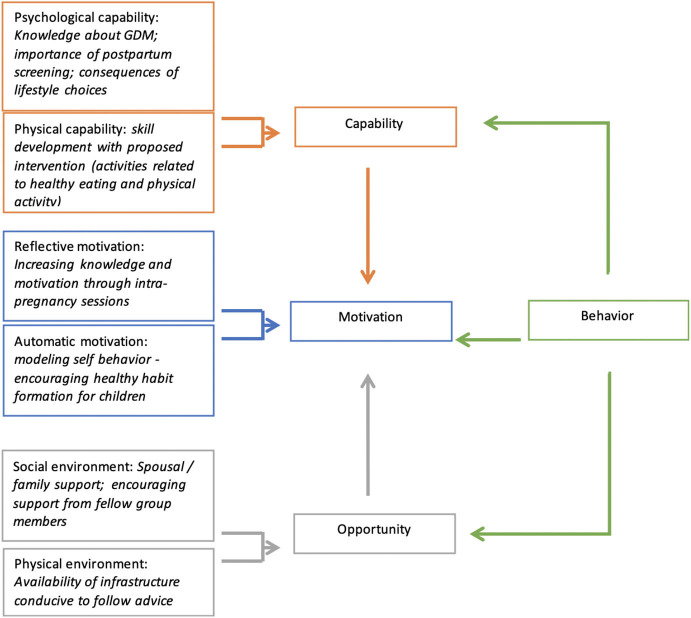
To refine and contextually adapt a postpartum lifestyle intervention for prevention of type 2 diabetes mellitus (T2DM) in women with prior gestational diabetes mellitus (GDM) in Bangladesh, India, and Sri Lanka. In-depth interviews (IDIs) and focus group discussions (FGDs) were conducted with women with current diagnosis of GDM, and health care professionals involved in their management, to understand relevant local contextual factors for intervention optimization and implementation. This paper describes facilitators and barriers as well as feedback from participants on how to improve the proposed intervention. These factors were grouped and interpreted along the axes of the three main determinants of behavior-capability, opportunity, and motivation. IDIs and FGDs were digitally recorded, transcribed, and translated. Data-driven inductive thematic analysis was undertaken to identify and analyze patterns and themes. Two interrelated themes emerged from the IDIs and FGDs: (i) The lifestyle intervention was acceptable and considered to have the potential to improve the existing model of care for women with GDM; and (ii) Certain barriers such as reduced priority of self-care, and adverse societal influences postpartum need to be addressed for the improvement of GDM care. Based on the feedback, the intervention was optimized by including messages for family members in the content of the intervention, providing options for both text and voice messages as reminders, and finalizing the format of the intervention session delivery. This study highlights the importance of contextual factors in influencing postpartum care and support for women diagnosed with GDM in three South Asian countries. It indicates that although provision of postpartum care is complex, a group lifestyle intervention program is highly acceptable to women with GDM, as well as to health care professionals, at urban hospitals.
为优化并根据具体情况调整产后生活方式干预措施,以预防孟加拉国、印度和斯里兰卡既往患有妊娠期糖尿病(GDM)的女性患2型糖尿病(T2DM)。对目前诊断为GDM的女性以及参与其管理的医疗保健专业人员进行了深入访谈(IDI)和焦点小组讨论(FGD),以了解相关的当地背景因素,以便优化和实施干预措施。本文描述了促进因素和障碍,以及参与者对如何改进拟议干预措施的反馈。这些因素按照行为的三个主要决定因素——能力、机会和动机的轴进行分组和解释。IDI和FGD进行了数字录音、转录和翻译。采用数据驱动的归纳主题分析来识别和分析模式与主题。IDI和FGD产生了两个相互关联的主题:(i)生活方式干预是可以接受的,并被认为有潜力改善现有的GDM女性护理模式;(ii)为改善GDM护理,需要解决某些障碍,如自我护理优先级降低以及产后不利的社会影响。根据反馈,通过在干预内容中纳入针对家庭成员的信息、提供文本和语音信息作为提醒的选项以及确定干预课程交付的形式,对干预措施进行了优化。本研究强调了背景因素对南亚三个国家诊断为GDM的女性产后护理和支持的影响。它表明,尽管提供产后护理很复杂,但团体生活方式干预计划在城市医院中对于GDM女性以及医疗保健专业人员来说是高度可接受的。