Universidade Federal de Minas Gerais, Programa de Pós-Graduação em Neurociências, Belo Horizonte MG, Brazil.
Universidade Federal de Minas Gerais, Faculdade de Medicina, Departamento de Clínica Médica, Grupo de Pesquisa em Neurologia Cognitiva e do Comportamento, Belo Horizonte MG, Brazil.
Arq Neuropsiquiatr. 2022 Jan;80(1):23-29. doi: 10.1590/0004-282X-ANP-2021-0012.
Validation of cognitive instruments for detection of Alzheimer's disease (AD) based on correlation with diagnostic biomarkers allows more reliable identification of the disease.
To investigate the accuracy of the Brief Cognitive Screening Battery (BCSB) in the differential diagnosis between AD, non-AD cognitive impairment (both defined by cerebrospinal fluid [CSF] biomarkers) and healthy cognition, and to correlate CSF biomarker results with cognitive performance.
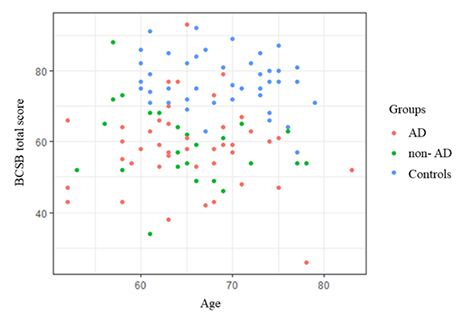
Overall, 117 individuals were evaluated: 45 patients with mild cognitive impairment (MCI) or mild dementia within the AD continuum defined by the AT(N) classification [A+T+/-(N)+/]; 27 non-AD patients with MCI or mild dementia [A-T+/-(N)+/-]; and 45 cognitively healthy individuals without CSF biomarker results. All participants underwent evaluation using the BCSB.
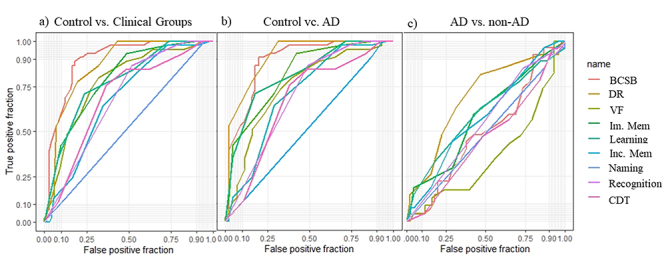
The total BCSB and delayed recall (DR) scores of the BCSB memory test showed high diagnostic accuracy, as indicated by areas under the ROC curve (AUC): 0.89 and 0.87, respectively, for discrimination between AD and non-AD versus cognitively healthy controls. Similarly, total BCSB and DR displayed high accuracy (AUC-ROC curves of 0.89 and 0.91, respectively) for differentiation between AD and controls. BCSB tests displayed low accuracy for differentiation between AD and non-AD. The CSF levels of biomarkers correlated significantly, though weakly, with DR.
Total BCSB and DR scores presented good accuracy for differentiation between patients with a biological AD diagnosis and cognitively healthy individuals, but low accuracy for differentiating AD from non-AD patients.
基于与诊断生物标志物的相关性来验证用于检测阿尔茨海默病(AD)的认知工具,可以更可靠地识别该疾病。
调查Brief Cognitive Screening Battery(BCSB)在 AD、非 AD 认知障碍(均由脑脊液 [CSF] 生物标志物定义)与健康认知之间的鉴别诊断中的准确性,并将 CSF 生物标志物结果与认知表现相关联。
共评估了 117 名个体:45 名处于 AD 连续体中的轻度认知障碍(MCI)或轻度痴呆患者,根据 AT(N)分类[A+T+/-(N)+/]定义;27 名非 AD 的 MCI 或轻度痴呆患者[A-T+/-(N)+/-];以及 45 名认知健康个体,无 CSF 生物标志物结果。所有参与者均接受了 BCSB 的评估。
BCSB 的总评分和 BCSB 记忆测试的延迟回忆(DR)评分显示出较高的诊断准确性,ROC 曲线下面积(AUC)分别为 0.89 和 0.87,用于区分 AD 和非 AD 与认知健康对照组。同样,BCSB 的总评分和 DR 也显示出较高的准确性(AUC-ROC 曲线分别为 0.89 和 0.91),用于区分 AD 和对照组。BCSB 测试在区分 AD 和非 AD 方面的准确性较低。CSF 生物标志物水平与 DR 呈显著相关,但相关性较弱。
BCSB 的总评分和 DR 评分在区分具有生物学 AD 诊断的患者和认知健康个体方面具有较好的准确性,但在区分 AD 与非 AD 患者方面准确性较低。