Department of Infectious Diseases, St. Jude Children's Research Hospital, Memphis, Tennessee, USA.
Microbiol Spectr. 2021 Dec 22;9(3):e0154621. doi: 10.1128/Spectrum.01546-21. Epub 2021 Nov 24.
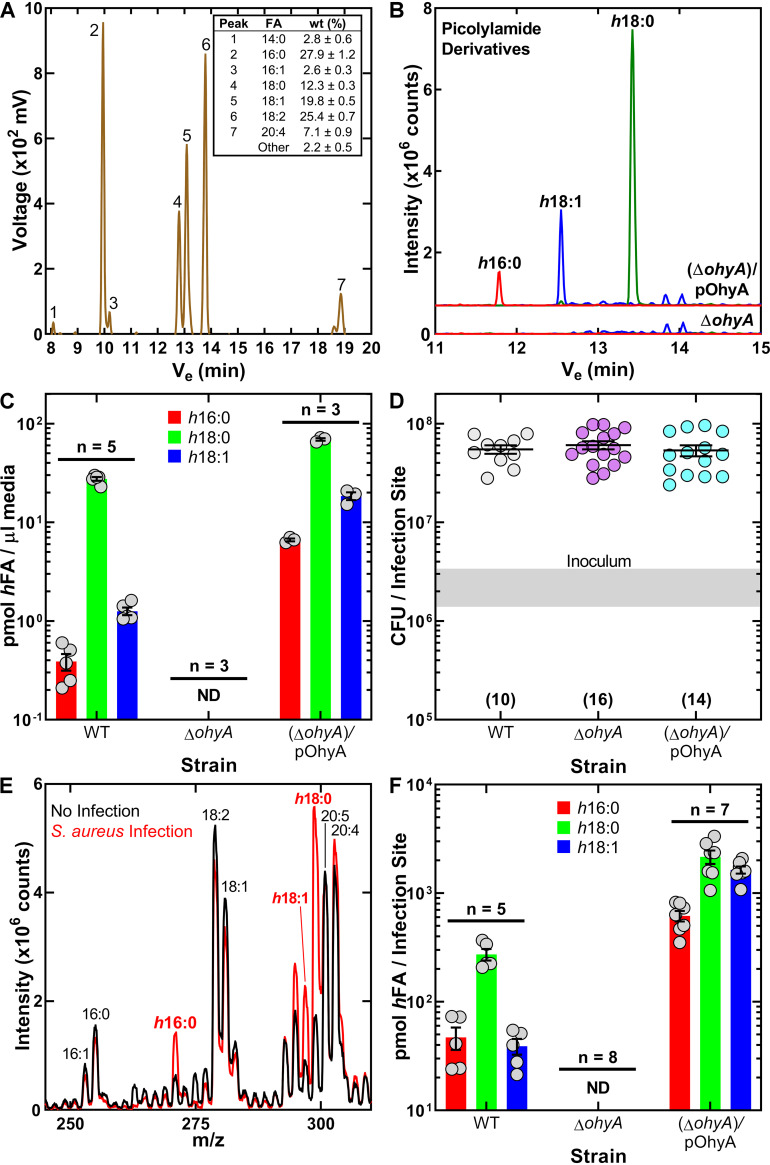
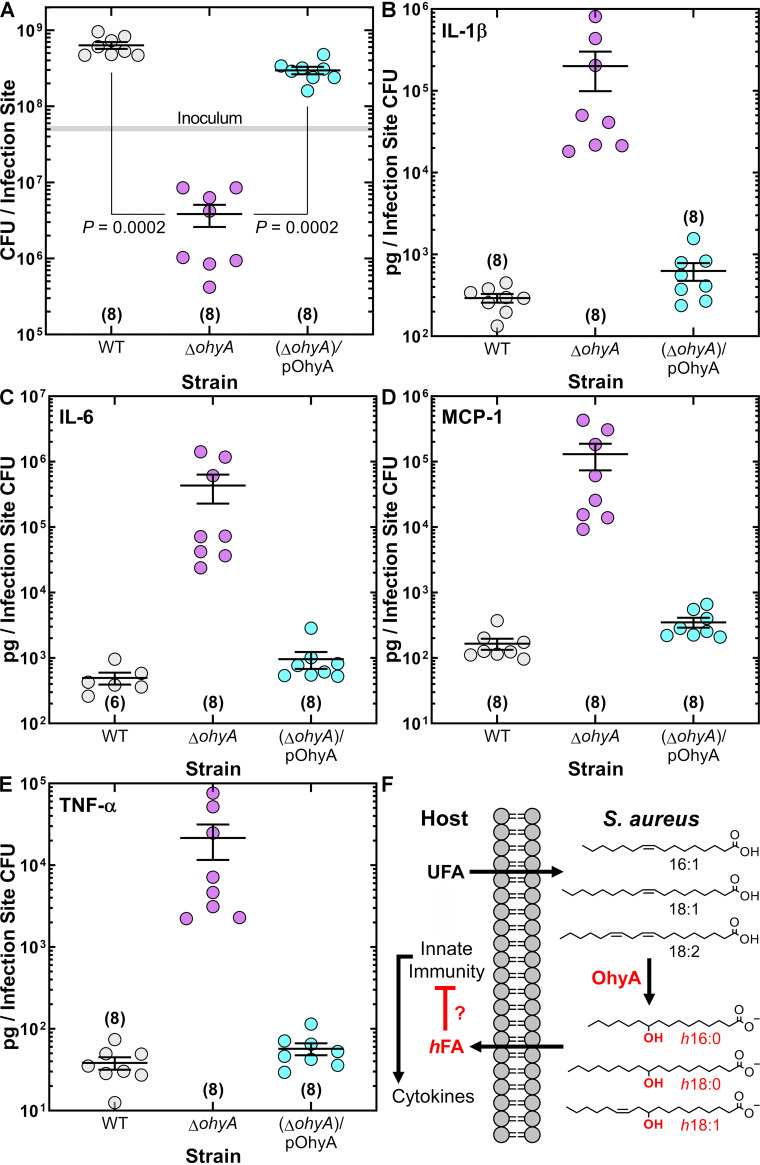
Staphylococcus aureus is an important pathogen that relies on a variety of mechanisms to evade and counteract the immune system. We show that S. aureus uses oleate hydratase (OhyA) to convert host -9 unsaturated fatty acids to their 10-hydroxy derivatives in human serum and at the infection site in a mouse neutropenic thigh model. Wild-type and Δ strains were equally infective in the neutropenic thigh model, but recovery of the Δ strain was 2 orders of magnitude lower in the immunocompetent skin infection model. Despite the lower bacterial abundance at the infection site, the levels of interleukin 6 (IL-6), monocyte chemoattractant protein 1 (MCP-1), IL-1β, and tumor necrosis factor alpha (TNF-α) elicited by the Δ strain were as robust as those of either the wild-type or the complemented strain, indicating that the immune system was more highly activated by the Δ strain. Thus, OhyA functions to promote S. aureus virulence. The oleate hydratase protein family was discovered in commensal bacteria that utilize host unsaturated fatty acids as the substrates to produce a spectrum of hydroxylated products. These hydroxy fatty acids are thought to act as signaling molecules that suppress the inflammatory response to create a more tolerant environment for the microbiome. S. aureus is a significant human pathogen, and defining the mechanisms used to evade the immune response is critical to understanding pathogenesis. S. aureus expresses an OhyA that produces at least three 10-hydroxy fatty acids from host unsaturated fatty acids at the infection site, and an S. aureus strain lacking the gene has compromised virulence in an immunocompetent infection model. These data suggest that OhyA plays a role in immune modulation in S. aureus pathogenesis similar to that in commensal bacteria.
金黄色葡萄球菌是一种重要的病原体,它依赖多种机制来逃避和抵抗免疫系统。我们表明,金黄色葡萄球菌利用油酸水解酶(OhyA)将宿主-9 不饱和脂肪酸转化为其在人血清中和在小鼠中性粒细胞减少性大腿模型中的感染部位的 10-羟基衍生物。野生型和Δ菌株在中性粒细胞减少性大腿模型中的感染能力相同,但在免疫功能正常的皮肤感染模型中,Δ菌株的恢复能力低 2 个数量级。尽管感染部位的细菌丰度较低,但Δ菌株引起的白细胞介素 6 (IL-6)、单核细胞趋化蛋白 1 (MCP-1)、IL-1β 和肿瘤坏死因子 α (TNF-α)的水平与野生型或互补菌株一样强大,表明Δ菌株更能激活免疫系统。因此,OhyA 促进了金黄色葡萄球菌的毒力。油酸水解酶蛋白家族在利用宿主不饱和脂肪酸作为底物产生一系列羟基化产物的共生菌中被发现。这些羟基脂肪酸被认为是作为信号分子,抑制炎症反应,为微生物组创造一个更耐受的环境。金黄色葡萄球菌是一种重要的人类病原体,确定逃避免疫反应的机制对于理解发病机制至关重要。金黄色葡萄球菌表达一种 OhyA,它至少可以从宿主不饱和脂肪酸中产生三种 10-羟基脂肪酸在感染部位,并且缺乏基因的金黄色葡萄球菌菌株在免疫功能正常的感染模型中的毒力受损。这些数据表明,OhyA 在金黄色葡萄球菌发病机制中的免疫调节作用类似于共生菌中的作用。