Sierra Eye Associates, Reno, Nevada.
Reno School of Medicine, University of Nevada, Reno.
JAMA Ophthalmol. 2022 Jan 1;140(1):20-28. doi: 10.1001/jamaophthalmol.2021.4585.
Limited data exist on the real-world safety outcomes of patients with neovascular age-related macular degeneration treated with brolucizumab (Beovu).
To determine the real-world incidence of intraocular inflammation (IOI), including retinal vasculitis (RV) and/or retinal vascular occlusion (RO), for patients with neovascular age-related macular degeneration who underwent brolucizumab treatment. Additionally, potential risk factors associated with these adverse events were evaluated.
DESIGN, SETTING, AND PARTICIPANTS: This cohort study included patients with neovascular age-related macular degeneration in the Intelligent Research in Sight (IRIS) Registry and Komodo Healthcare Map. Patients initiating and receiving 1 or more brolucizumab injections from October 8, 2019, to June 5, 2020, with up to 6 months of follow-up were included.
Brolucizumab injections.
Incidence of IOI (including RV) and/or RO and RV and/or RO and risk stratification for the identified risk factors.
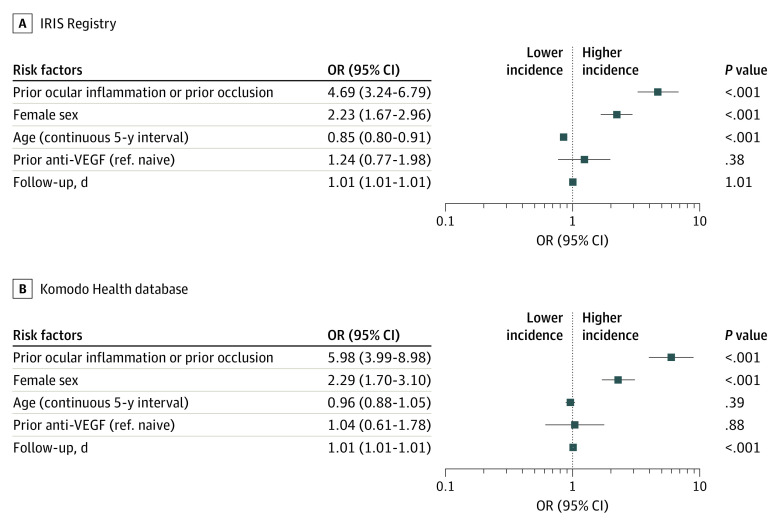
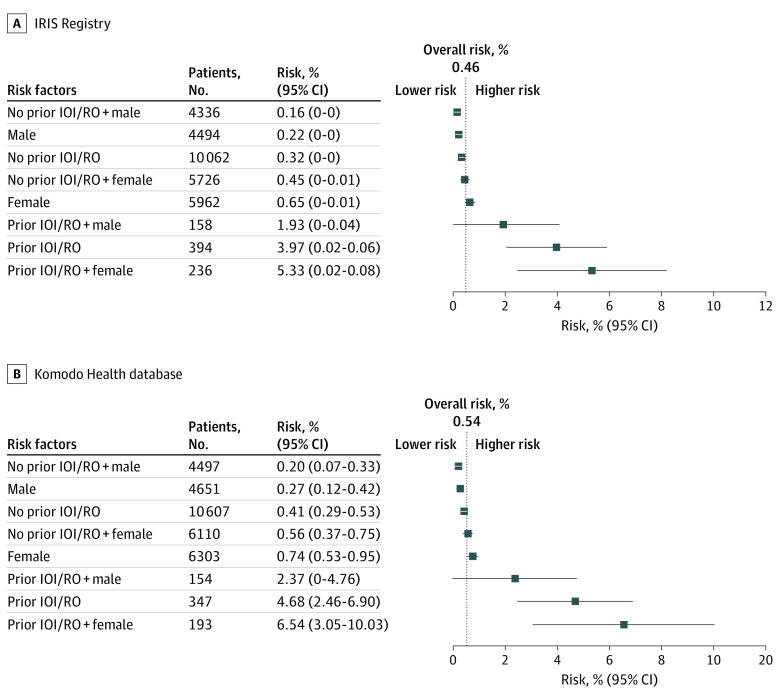
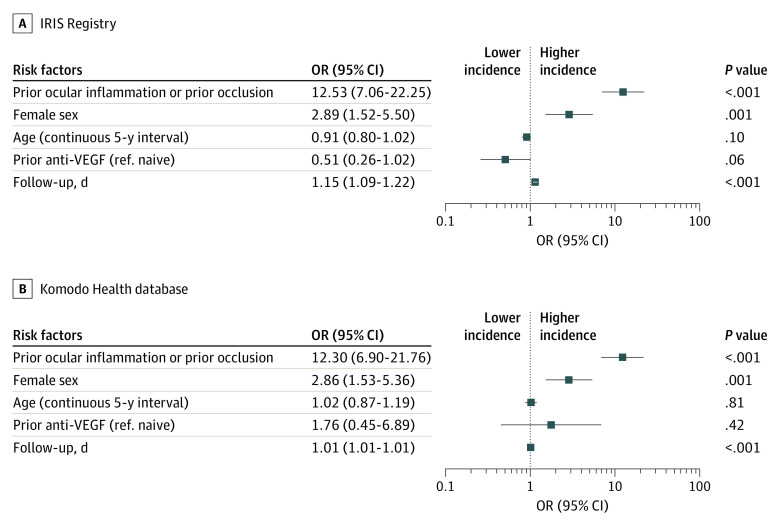
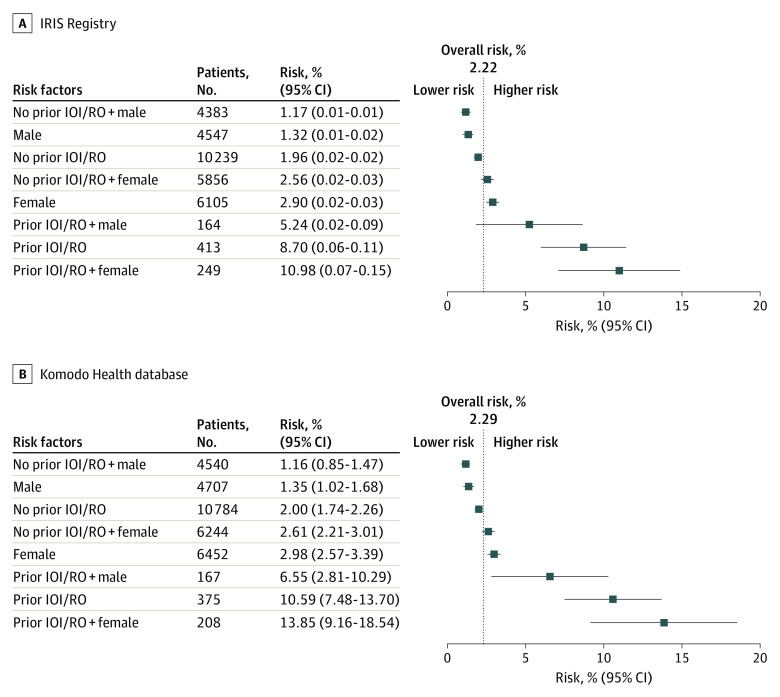
Of 10 654 and 11 161 included eyes (from the IRIS Registry and Komodo Health database, respectively), the median follow-up times were 97 and 95 days. Most eyes switched from another anti-vascular endothelial growth factor agent (9686 of 10 654 [90.9%] and 10 487 of 11 161 [94.0%], respectively), most commonly aflibercept (7160 of 9686 [73.9%] and 7156 of 10 487 [68.2%]), and most were from women (6105 of 10 654 [57.3%] and 6452 of 11 161 [57.8%]). The overall incidence of IOI and/or RO was 2.4% (255 of 10 654 eyes) and 2.4% (268 of 11 161 eyes) for the IRIS and Komodo groups, respectively, and RV and/or RO, 0.6% (59 of 10 654 eyes and 63 of 11 161 eyes), respectively. Patients with a history of IOI and/or RO in the 12 months before brolucizumab initiation had an increased observed risk rate (8.7% [95% CI, 6.0%-11.4%] and 10.6% [95% CI, 7.5%-13.7%]) for an IOI and/or RO event in the 6 months following the first brolucizumab treatment compared with patients without prior IOI and/or RO (2.0% in both data sets). There was an increased estimated incidence rate in women (2.9% [95% CI, 2.5%-3.3%] and 3.0% [95% CI, 2.6%-3.4%]) compared with men (1.3% [95% CI, 1.0%-1.7%] and 1.4% [95% CI, 1.0%-1.7%]), but this risk was not as large as that of a prior IOI and/or RO. Similar findings were observed for patients with RV and/or RO events.
The incidence rate of IOI and/or RO was approximately 2.4%. Patient eyes with IOI and/or RO in the 12 months prior to first brolucizumab injection had the highest observed risk rate for IOI and/or RO in the early months after the first brolucizumab treatment. However, given study limitations, the identified risk factors cannot be used as predictors of IOI and/or RO events, and causality with brolucizumab cannot be assessed.
目前关于接受 brolucizumab(Beovu)治疗的新生血管性年龄相关性黄斑变性患者的真实世界安全性结果的数据有限。
确定新生血管性年龄相关性黄斑变性患者接受 brolucizumab 治疗后发生眼内炎症(IOI),包括视网膜血管炎(RV)和/或视网膜血管阻塞(RO)的真实世界发生率。此外,还评估了与这些不良事件相关的潜在风险因素。
设计、设置和参与者:本队列研究纳入了 Intelligent Research in Sight(IRIS)注册中心和 Komodo Healthcare Map 中的新生血管性年龄相关性黄斑变性患者。纳入了自 2019 年 10 月 8 日至 2020 年 6 月 5 日开始并接受 1 次或多次 brolucizumab 注射治疗且随访时间达 6 个月的患者。
brolucizumab 注射。
IOI(包括 RV)和/或 RO 以及 RV 和/或 RO 的发生率,以及对确定的风险因素进行风险分层。
在 10654 只和 11161 只眼中(分别来自 IRIS 注册中心和 Komodo 健康数据库),中位随访时间分别为 97 天和 95 天。大多数眼睛从其他抗血管内皮生长因子药物(分别为 10654 只眼中的 9686 只[90.9%]和 11161 只眼中的 10487 只[94.0%])转换而来,最常见的是 aflibercept(9686 只眼中的 7160 只[73.9%]和 10487 只眼中的 7156 只[68.2%]),并且大多数是女性(10654 只眼中的 6105 只[57.3%]和 11161 只眼中的 6452 只[57.8%])。IRIS 组和 Komodo 组的 IOI 和/或 RO 总发生率分别为 2.4%(10654 只眼中的 255 只)和 2.4%(11161 只眼中的 268 只),RV 和/或 RO 分别为 0.6%(10654 只眼中的 59 只和 11161 只眼中的 63 只)。在接受 brolucizumab 治疗前 12 个月内有 IOI 和/或 RO 病史的患者,在首次接受 brolucizumab 治疗后的 6 个月内发生 IOI 和/或 RO 事件的观察风险率更高(8.7%[95%CI,6.0%-11.4%]和 10.6%[95%CI,7.5%-13.7%]),与无既往 IOI 和/或 RO 的患者相比(两组数据均为 2.0%)。与男性(1.3%[95%CI,1.0%-1.7%]和 1.4%[95%CI,1.0%-1.7%])相比,女性的估计发病率更高(2.9%[95%CI,2.5%-3.3%]和 3.0%[95%CI,2.6%-3.4%]),但这一风险并不像既往 IOI 和/或 RO 那么大。对于发生 RV 和/或 RO 事件的患者也观察到了类似的发现。
IOI 和/或 RO 的发生率约为 2.4%。在首次接受 brolucizumab 注射前 12 个月内有 IOI 和/或 RO 的患者,在首次接受 brolucizumab 治疗后的早期,其发生 IOI 和/或 RO 的观察风险率最高。然而,由于研究的局限性,所确定的风险因素不能用作 IOI 和/或 RO 事件的预测因素,也不能评估与 brolucizumab 的因果关系。