Zubricky Ryan, McCoy Jasmyne, Donkor Richard, Miller David G, Sonbolian Nina, Heaney Andrew, Bilano Ver, Karcher Helene, Coney Joseph M
Geisinger Eye Institute, Danville, PA, USA.
Retina Associates of Cleveland Inc, 24075 Commerce Park, Beachwood, OH, 44122, USA.
Ophthalmol Ther. 2023 Oct;12(5):2397-2408. doi: 10.1007/s40123-023-00741-w. Epub 2023 Jun 13.
Intraocular inflammation (IOI)-related adverse events (AEs) that may result in severe vision loss have been associated with the anti-vascular endothelial growth factor brolucizumab. In this study, we investigate the timing, management and resolution of IOI-related AEs in a large cohort of patients treated with at least one injection of brolucizumab in routine clinical practice.
Retrospective review of medical records from patients with neovascular age-related macular degeneration treated with ≥ 1 brolucizumab injection between October 2019 and November 2021 at the Retina Associates of Cleveland, Inc. clinics.
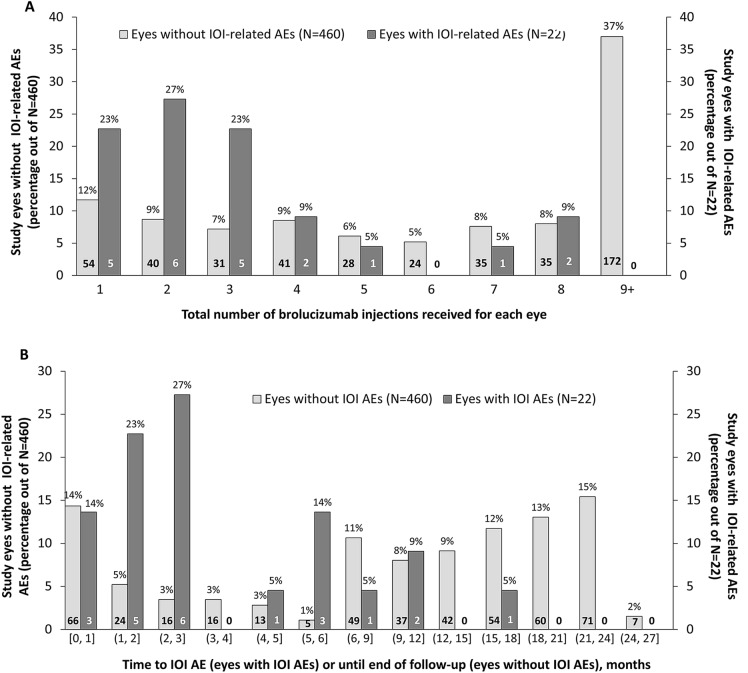
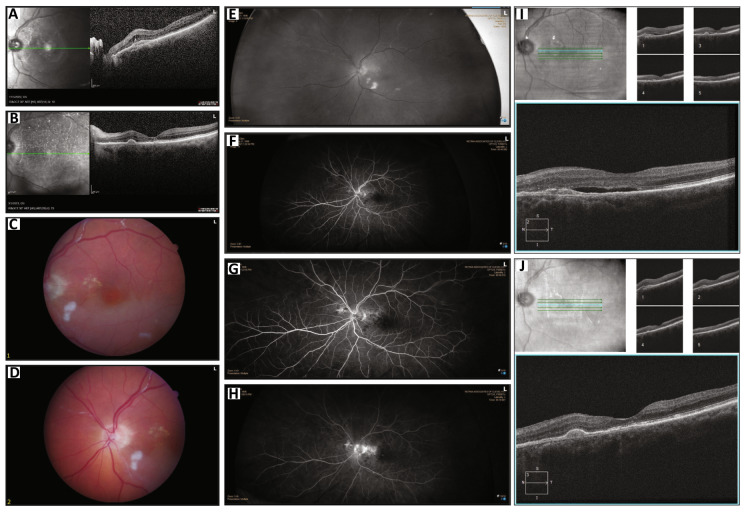
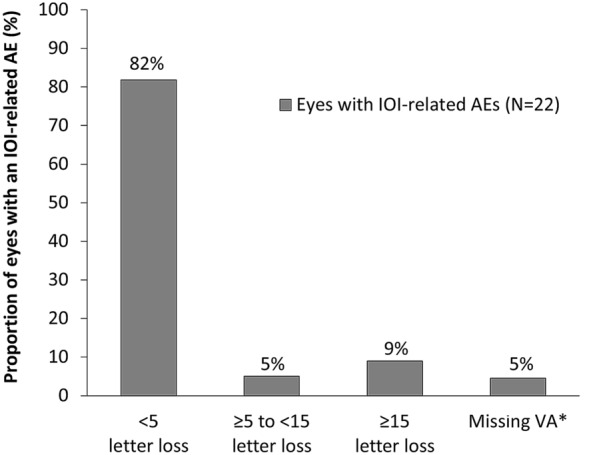
Of the 482 eyes included in the study, IOI-related AEs occurred in 22 (4.6%) eyes. Four (0.8%) eyes developed retinal vasculitis (RV) and of these, 2 (0.4%) had concomitant retinal vascular occlusion (RO). Most eyes [14/22 (64%)] developed the AE within 3 months and 4/22 (18%) within 3-6 months of the first brolucizumab injection. The median [interquartile range (IQR)] time from the last brolucizumab injection to development of the IOI-related AE was 13 (4-34) days. At the time of event, 3 (0.6%) eyes with IOI (no RV/RO) developed severe vision loss of ≥ 30 ETDRS letters, and a further 5 (1.0%) eyes (1 with IOI + RV, 1 with IOI + RV + RO) developed moderate vision loss of ≥ 15 letters compared with their last visual acuity (VA) prior to the AE. The median (IQR) vision loss was -6.8 (-19.9, -0.0) letters. Taking the best VA at either 3 or 6 months after AE resolution (or stability for occlusive events), VA decreased by ≥ 5 letters compared with prior to the AE in 3 (14%) of the 22 affected eyes, and was preserved (< 5-letter loss) in 18 (82%) eyes.
In this real-world study, most IOI-related AEs occurred early after brolucizumab treatment initiation. With appropriate monitoring and management of IOI-related AEs, vision loss associated with brolucizumab may be limited.
抗血管内皮生长因子布罗珠单抗可能会引发与眼内炎症(IOI)相关的不良事件(AE),这些事件可能导致严重的视力丧失。在本研究中,我们调查了在常规临床实践中接受至少一次布罗珠单抗注射的大量患者中,与IOI相关不良事件的发生时间、管理及缓解情况。
回顾性分析2019年10月至2021年11月期间在克利夫兰视网膜协会诊所接受≥1次布罗珠单抗注射治疗的新生血管性年龄相关性黄斑变性患者的病历。
在纳入研究的482只眼中,22只眼(4.6%)发生了与IOI相关的不良事件。4只眼(0.8%)发生了视网膜血管炎(RV),其中2只眼(0.4%)同时伴有视网膜血管阻塞(RO)。大多数眼[22只中的14只(64%)]在首次注射布罗珠单抗后的3个月内发生不良事件,4只眼(18%)在3至6个月内发生。从最后一次注射布罗珠单抗到发生与IOI相关不良事件的中位时间[四分位间距(IQR)]为13(4 - 34)天。在事件发生时,3只眼(0.6%)发生IOI(无RV/RO),视力严重下降≥30个早期糖尿病性视网膜病变研究(ETDRS)字母,另外5只眼(1.0%)(1只眼为IOI + RV,1只眼为IOI + RV + RO)与不良事件发生前的最后视力相比,视力中度下降≥15个字母。中位(IQR)视力下降为-6.8(-19.9,-0.0)个字母。以不良事件缓解后3个月或6个月(或闭塞性事件稳定时)的最佳视力为准,22只受影响眼中有3只眼(14%)的视力与不良事件发生前相比下降≥5个字母,18只眼(82%)的视力得以保留(下降<5个字母)。
在这项真实世界研究中,大多数与IOI相关的不良事件在开始使用布罗珠单抗治疗后早期发生。通过对与IOI相关不良事件进行适当监测和管理,与布罗珠单抗相关的视力丧失可能会受到限制。