Llorente-Cantarero Francisco Jesus, Jurado-Castro Jose Manuel, Leis Rosaura, Vázquez-Cobela Rocío, González-Gil Esther M, Aguilera Concepción María, Bueno Gloria, Moreno Luis A, Gil Angel, Gil-Campos Mercedes
Department of Specific Didactics, Faculty of Education, University of Córdoba, Córdoba, Spain.
CIBEROBN, (Physiopathology of Obesity and Nutrition), Institute of Health Carlos III (ISCIII), Madrid, Spain.
Sports Med Open. 2021 Nov 24;7(1):86. doi: 10.1186/s40798-021-00365-z.
Physical activity (PA) has acquired a significant relevance due to the health benefits associated with its practice. Accelerometers are an effective tool to assess PA; however, the diversity of cut-off points used to define different PA intensities through accelerometry could interfere in the interpretation of the findings among studies.
The present study aimed to examine the sedentary behavior (SB) and physical activity (PA) levels in children using six selected accelerometry protocols based on diverse cut-off points.
Clinical examination, anthropometric measurements, and PA evaluation by accelerometry were assessed in 543 selected children (10 ± 2.4 years old) from the Spanish GENOBOX study. The ActiLife data scoring program was used to determine daily min spent in SB, and light, moderate, vigorous and moderate-vigorous PA using six validated accelerometry protocols differing in their cut-off points.
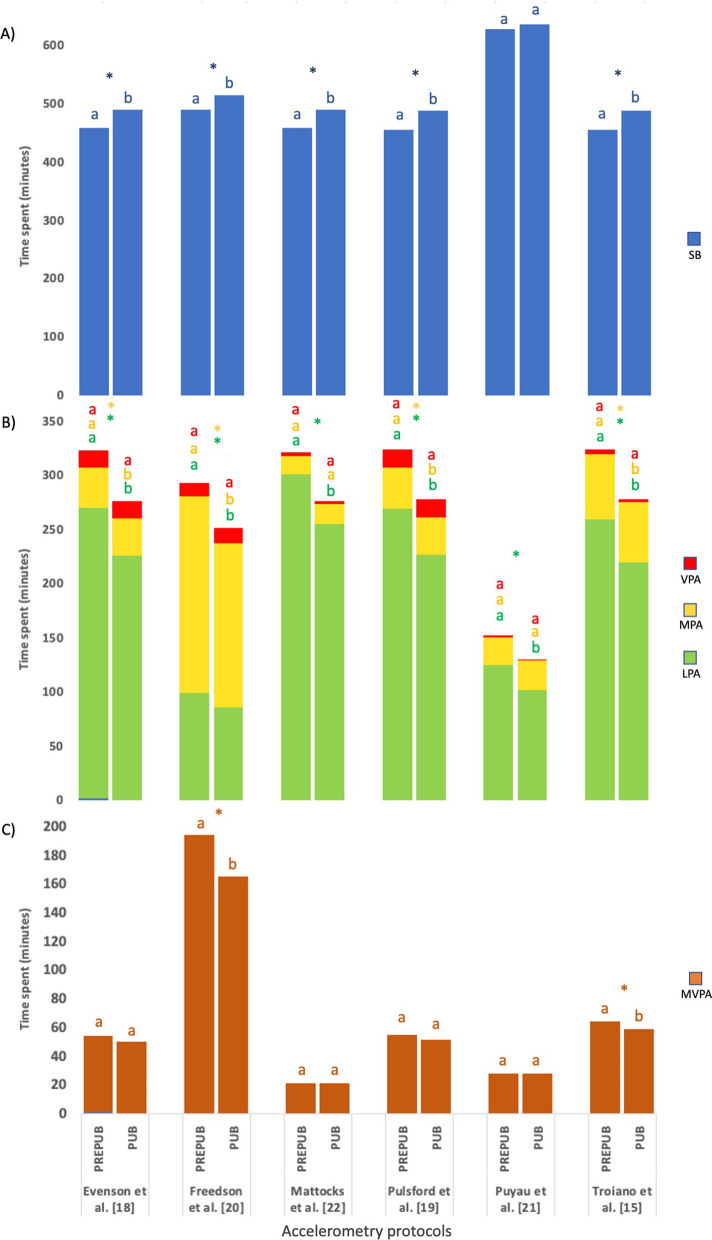
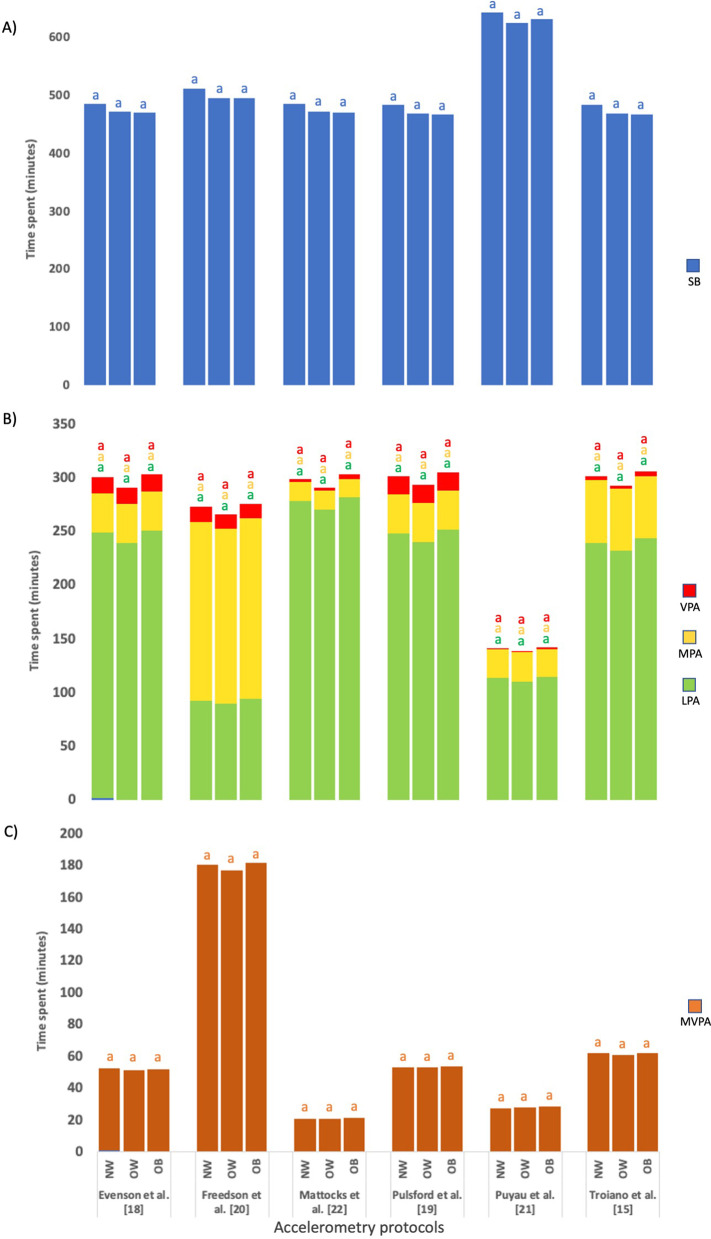
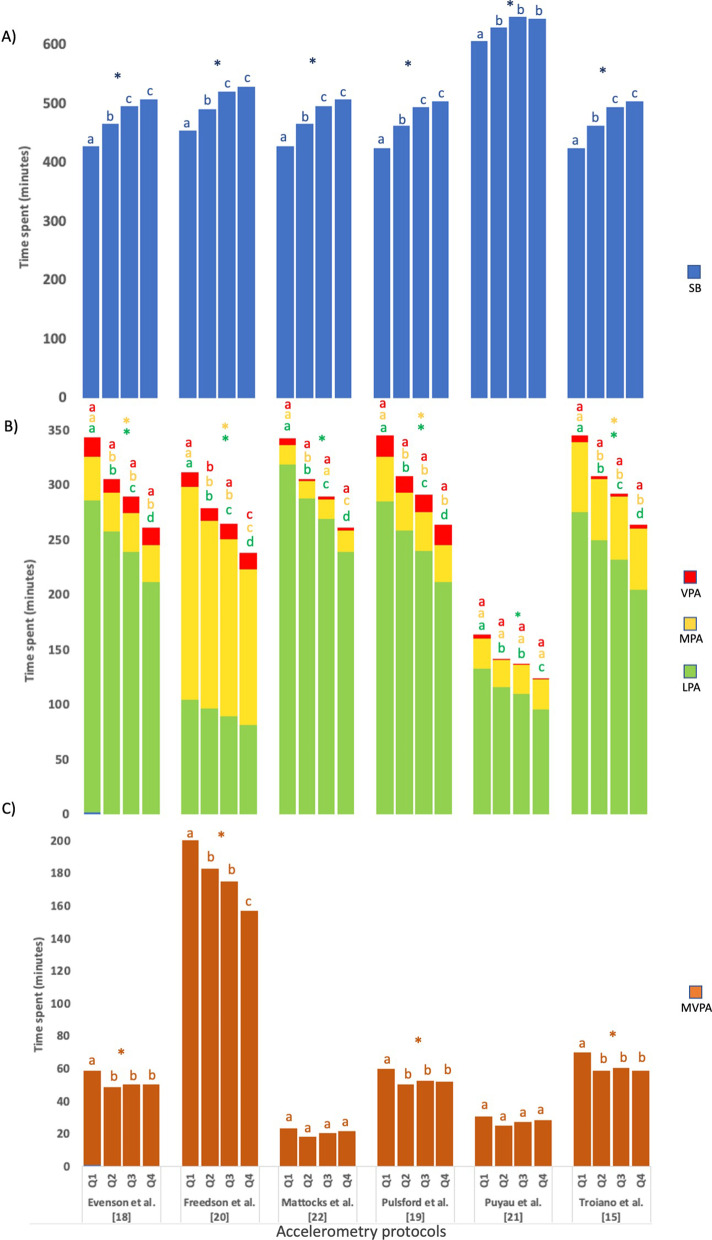
Very different estimations for SB and PA intensity levels were found in children, independently of the non-wear-time algorithm selected, and considering puberty stages, age and body mass index. The time spent in daily SB varied from 471 to 663.7 min, PA ranged from 141 to 301.6 min, and the moderate-vigorous PA was reported between 20.7 and 180.2 min.
The choice of a particular accelerometry protocol considering these factors is important to evaluate SB or PA intensities to suit the characteristics of the sample researched. It seems necessary to establish future lines of research that include different analytical approaches to measure SB and PA by accelerometry based on standardized and validated methodology.
由于体育活动(PA)对健康有益,其重要性日益凸显。加速度计是评估PA的有效工具;然而,通过加速度计定义不同PA强度时所使用的截断点的多样性可能会干扰各研究结果的解读。
本研究旨在使用基于不同截断点的六种选定加速度计方案,检查儿童的久坐行为(SB)和体育活动(PA)水平。
对来自西班牙GENOBOX研究的543名选定儿童(10±2.4岁)进行临床检查、人体测量,并通过加速度计评估PA。使用ActiLife数据评分程序,采用六种经过验证但截断点不同的加速度计方案,确定每日在SB、轻度、中度、剧烈和中度至剧烈PA中所花费的分钟数。
在儿童中发现,无论选择何种非佩戴时间算法,并考虑青春期阶段、年龄和体重指数,对于SB和PA强度水平的估计差异很大。每日在SB中花费的时间从471分钟到663.7分钟不等,PA从141分钟到301.6分钟不等,中度至剧烈PA报告在20.7分钟至180.2分钟之间。
考虑这些因素选择特定的加速度计方案对于评估SB或PA强度以适应所研究样本的特征很重要。似乎有必要建立未来的研究方向,包括采用基于标准化和经过验证的方法,通过加速度计测量SB和PA的不同分析方法。