Møller Niels Christian, Christensen Line B, Mølgaard Christian, Ejlerskov Katrine T, Pfeiffer Karin A, Michaelsen Kim F
Department of Sport Science and Clinical Biomechanics, Research Unit for Exercise, Epidemiology and Centre of Research in Childhood Health, University of Southern Denmark, Campusvej, 55, Odense M, Denmark.
Department of Nutrition, Exercise and Sports, Faculty of Science, University of Copenhagen, 1958, Frederiksberg, Denmark.
BMC Public Health. 2017 Jun 30;17(1):613. doi: 10.1186/s12889-017-4521-3.
Further collection of surveillance data is warranted, particularly in preschool populations, for optimizing future public health promotion strategies. This study aims to describe physical activity (PA) and sedentary behavior (SB) across different settings, including time in and out of daycare, and to determine the proportion of children complying with suggested PA recommendations in a high income country.
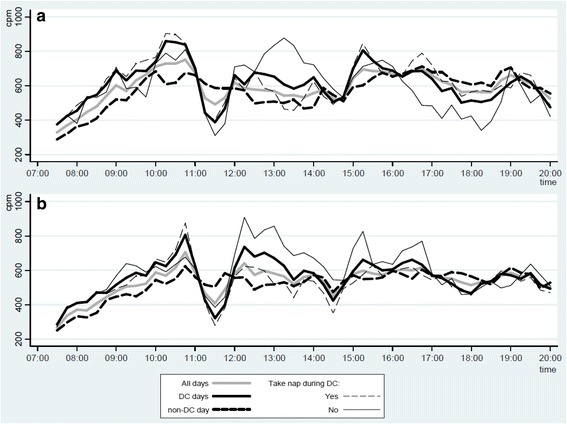
Valid PA was assessed in 231 children (36.4 ± 1.1 months) with the Actigraph GT3X accelerometer, and information regarding date and time of dropping-off/picking-up children in daycare was provided by parents. Mean total PA (i.e., counts per minute (CPM)), moderate-to-vigorous physical activity (MVPA), SB time, and non-SB time was generated and compared across settings. Post hoc, PA and SB were examined in subgroups of low-active (1st quartile) and high-active (4th quartile) children.
Overall, boys and girls spent 1.4 ± 0.3 h/day and 1.2 ± 0.4 h/day in MVPA, respectively. Likewise, boys and girls accumulated 6.7 ± 0.8 h and 6.8 ± 0.9 h of SB time per day, respectively. Higher PA levels consistently co-occurred with lower SB time in the daycare setting. Girls accumulated less SB time in daycare than before and after daycare (β = -12.2%, p < 0.001 & β = -3.8%, p < 0.001, respectively). In boys, daycare-days contained more PA and less SB than non-daycare-days (CPM: β =29, p = 0.046, %MVPA: β = 0.83, p = 0.007, %SB: β = -2.3, p < 0.001, respectively). All children fulfilled recommendations of at least 3 h of daily non-SB. Eighty-nine percent of boys and 72% of girls met the daily 1-h MVPA recommendation for 5 year-olds. Lower proportions of children, especially boys, fulfilled MVPA recommendation on days with no daycare attendance. Generally, large mean differences in MVPA and SB were observed across all settings between the most active and the least active children, and only 7% of the low-active girls and 59% of the low-active boys fulfilled MVPA recommendations.
Overall, the majority of children fulfilled MVPA guidelines for 5 year-olds, and all children complied with suggested recommendations of 180 min of daily activity. Daycare time was found to represent an important setting for PA. Substantial and consistent differences observed in the amount of time spent physically active between high- and low-active children across all settings indicate substantial variations in young children's PA levels irrespective of the context.
有必要进一步收集监测数据,尤其是在学龄前人群中,以优化未来的公共卫生促进策略。本研究旨在描述不同环境下的身体活动(PA)和久坐行为(SB),包括在日托中心内外的时间,并确定高收入国家中符合建议的PA推荐量的儿童比例。
使用Actigraph GT3X加速度计对231名儿童(36.4±1.1个月)的有效PA进行评估,家长提供有关送孩子去日托中心和接孩子的日期和时间信息。生成并比较不同环境下的平均总PA(即每分钟计数(CPM))、中度至剧烈身体活动(MVPA)、SB时间和非SB时间。事后,在低活动量(第一四分位数)和高活动量(第四四分位数)儿童亚组中检查PA和SB。
总体而言,男孩和女孩每天进行MVPA的时间分别为1.4±0.3小时和1.2±0.4小时。同样,男孩和女孩每天积累的SB时间分别为6.7±0.8小时和6.8±0.9小时。在日托环境中,较高的PA水平始终与较低的SB时间同时出现。女孩在日托中心积累的SB时间比在日托之前和之后都少(β=-12.2%,p<0.001;β=-3.8%,p<0.001)。在男孩中,日托日的PA比非日托日多,SB比非日托日少(CPM:β=29,p=0.046;%MVPA:β=0.83,p=0.007;%SB:β=-2.3,p<0.001)。所有儿童都满足每天至少3小时非SB的建议。89%的男孩和72%的女孩达到了5岁儿童每天1小时MVPA的推荐量。在没有日托的日子里,达到MVPA推荐量的儿童比例较低,尤其是男孩。一般来说,在所有环境中,最活跃和最不活跃的儿童之间在MVPA和SB方面存在很大的平均差异,只有7%的低活动量女孩和59%的低活动量男孩达到了MVPA推荐量。
总体而言,大多数儿童达到了5岁儿童的MVPA指南,所有儿童都符合每天180分钟活动的建议。日托时间被发现是PA的一个重要环境。在所有环境中,高活动量和低活动量儿童在身体活动时间上观察到的实质性和一致差异表明,无论环境如何,幼儿的PA水平存在很大差异。