Department of Industrial and Systems Engineering, University at Buffalo - The State University of New York, Buffalo, NY, United States of America.
PLoS One. 2021 Nov 24;16(11):e0258824. doi: 10.1371/journal.pone.0258824. eCollection 2021.
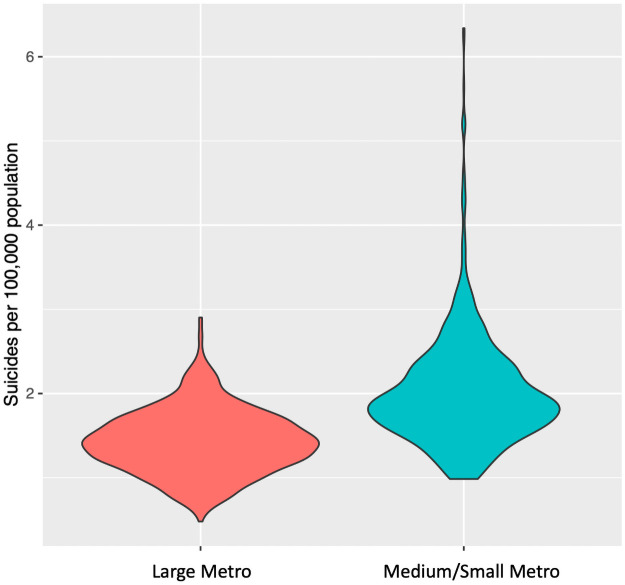
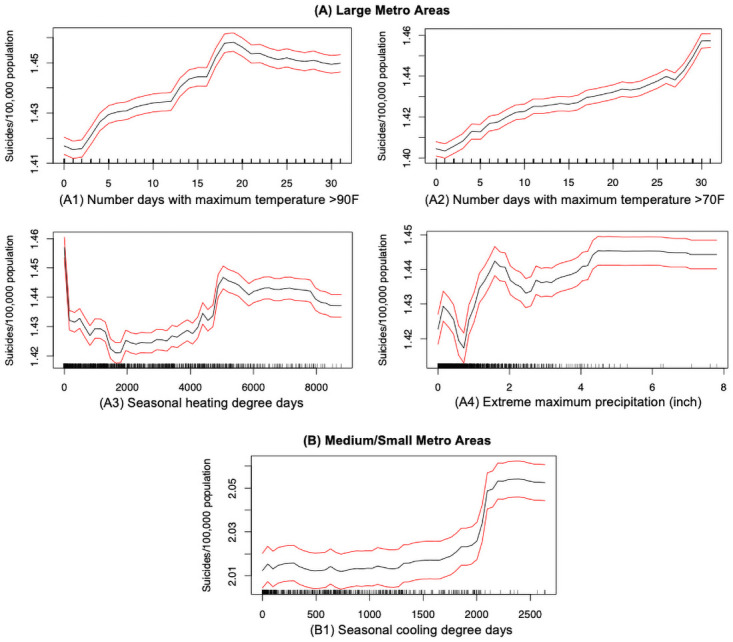
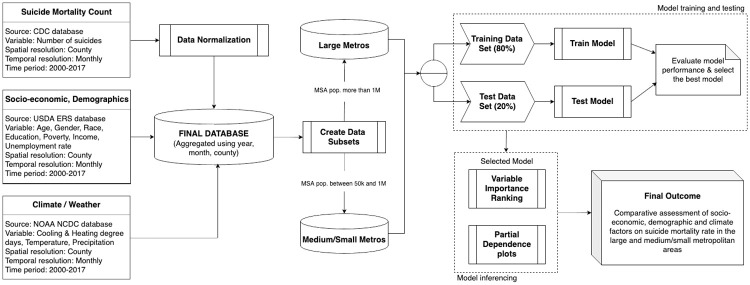
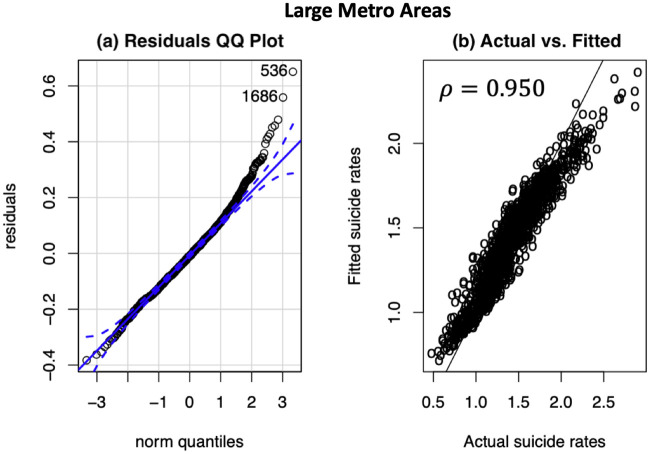
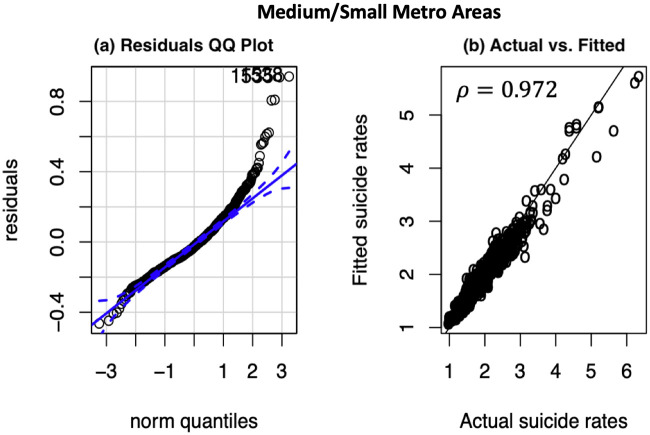
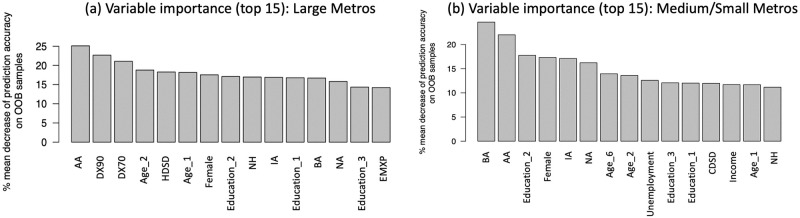
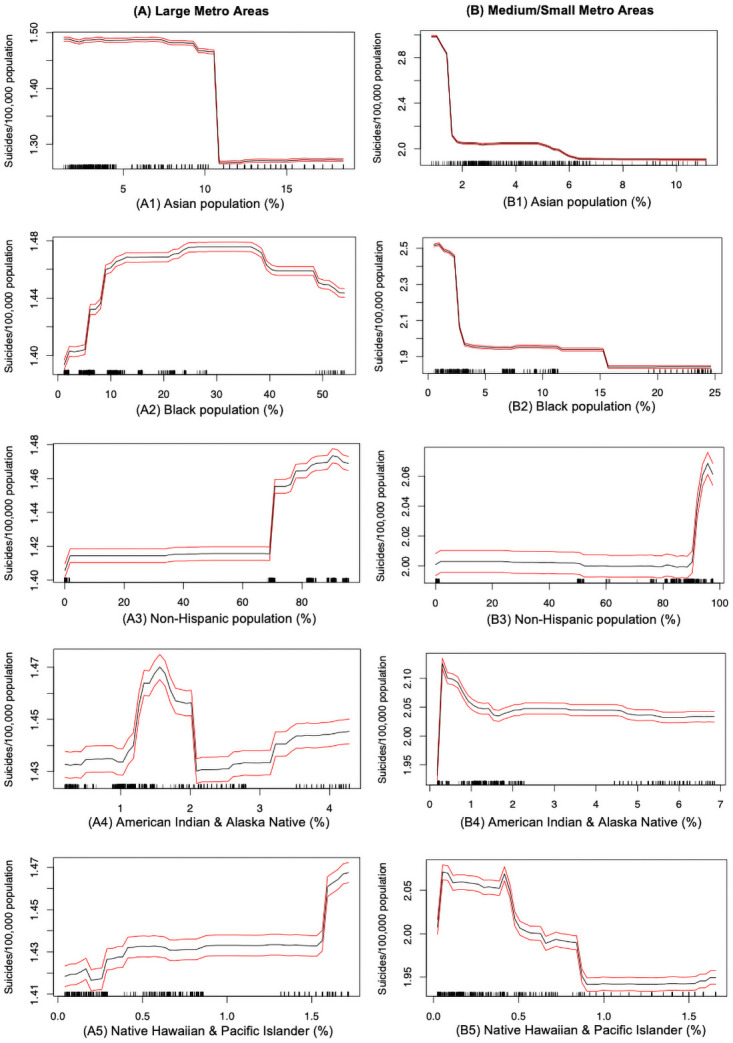
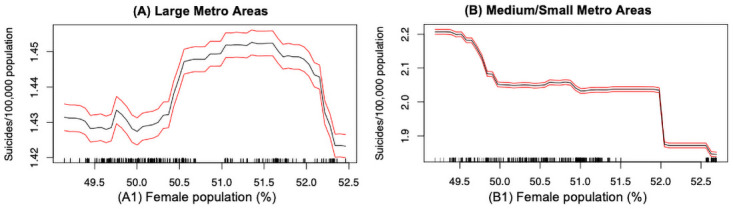
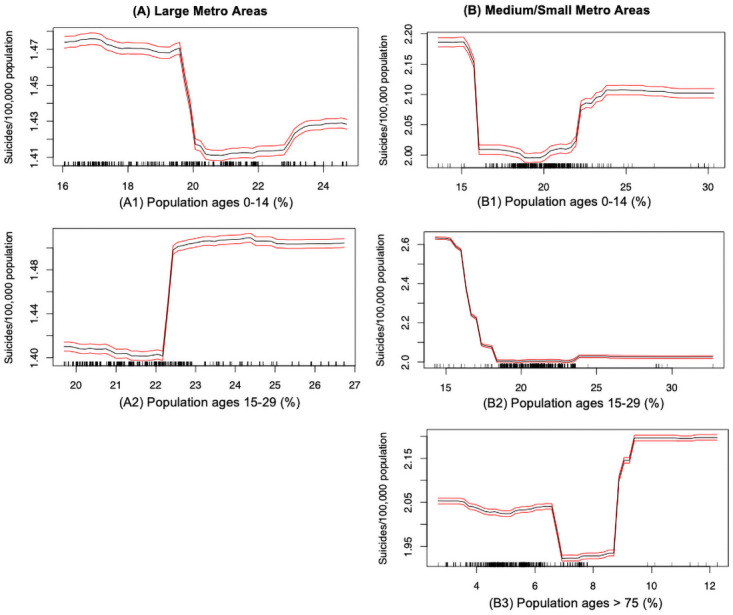
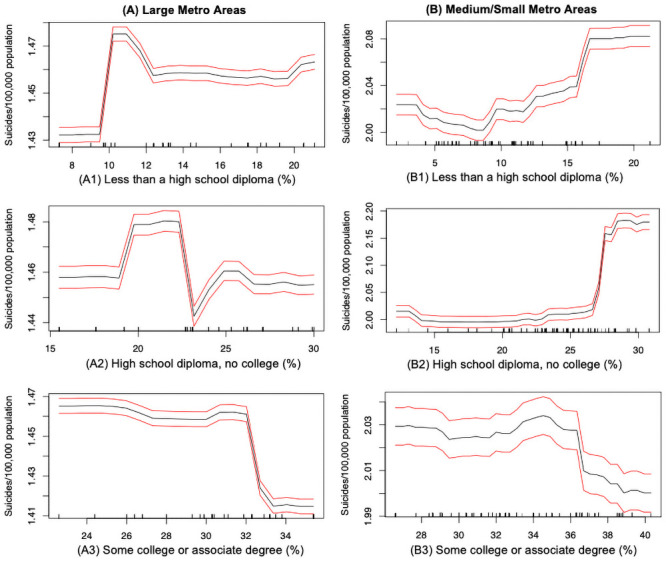
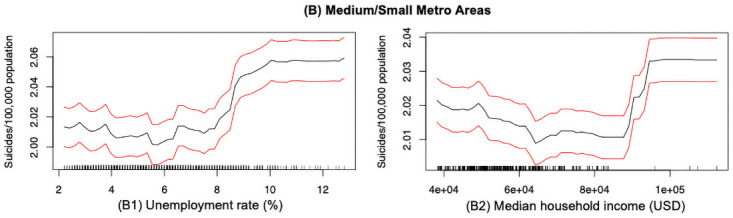
Disparity in suicide rates across various metropolitan areas in the US is growing. Besides personal genomics and pre-existing mental health conditions affecting individual-level suicidal behaviors, contextual factors are also instrumental in determining region-/community-level suicide risk. However, there is a lack of quantitative approach to model the complex associations and interplays of the socio-environmental factors with the regional suicide rates. In this paper, we propose a holistic data-driven framework to model the associations of socio-environmental factors (demographic, socio-economic, and climate) with the suicide rates, and compare the key socio-environmental determinants of suicides across the large and medium/small metros of the vulnerable US states, leveraging a suite of advanced statistical learning algorithms. We found that random forest outperforms all the other models in terms of both in-sample goodness-of-fit and out-of-sample predictive accuracy, which is then used for statistical inferencing. Overall, our findings show that there is a significant difference in the relationships of socio-environmental factors with the suicide rates across the large and medium/small metropolitan areas of the vulnerable US states. Particularly, suicides in medium/small metros are more sensitive to socio-economic and demographic factors, while that in large metros are more sensitive to climatic factors. Our results also indicate that non-Hispanics, native Hawaiian or Pacific islanders, and adolescents aged 15-29 years, residing in the large metropolitan areas, are more vulnerable to suicides compared to those living in the medium/small metropolitan areas. We also observe that higher temperatures are positively associated with higher suicide rates, with large metros being more sensitive to such association compared to that of the medium/small metros. Our proposed data-driven framework underscores the future opportunities of using big data analytics in analyzing the complex associations of socio-environmental factors and inform policy actions accordingly.
美国各大都市区的自杀率差距正在扩大。除了个人基因组和先前存在的心理健康状况影响个人自杀行为外,环境因素也在决定地区/社区自杀风险方面起着重要作用。然而,目前缺乏一种定量方法来模拟社会环境因素与区域自杀率之间的复杂关联和相互作用。在本文中,我们提出了一个整体的数据驱动框架来模拟社会环境因素(人口统计学、社会经济和气候)与自杀率之间的关联,并利用一系列先进的统计学习算法,比较脆弱的美国各州的大、中/小城市自杀的主要社会环境决定因素。我们发现,随机森林在样本内拟合优度和样本外预测准确性方面都优于所有其他模型,然后用于统计推断。总的来说,我们的研究结果表明,脆弱的美国各州的大、中/小城市的社会环境因素与自杀率之间的关系存在显著差异。特别是,中/小城市的自杀更受社会经济和人口统计学因素的影响,而大城市的自杀则更受气候因素的影响。我们的研究结果还表明,与生活在中/小城市的人相比,居住在大城市的非西班牙裔、夏威夷原住民或太平洋岛民以及 15-29 岁的青少年更容易自杀。我们还观察到,较高的温度与较高的自杀率呈正相关,与中/小城市相比,大城市对此关联更为敏感。我们提出的数据驱动框架强调了在分析社会环境因素的复杂关联方面使用大数据分析的未来机会,并相应地为政策行动提供信息。