Department of Psychiatry and Behavioral Health, The Ohio State University Wexner Medical Center, Columbus.
Rockefeller Neuroscience Institute, Behavioral Medicine and Psychiatry, West Virginia University, Morgantown.
JAMA Netw Open. 2019 Sep 4;2(9):e1910936. doi: 10.1001/jamanetworkopen.2019.10936.
Understanding geographic and community-level factors associated with suicide can inform targeted suicide prevention efforts.
To estimate suicide rates and trajectories, assess associated county-level contextual factors, and explore variation across the rural-urban continuum.
DESIGN, SETTING, AND PARTICIPANTS: This cross-sectional study included all individuals aged 25 to 64 years who died by suicide from January 1, 1999, to December 31, 2016, in the United States. Spatial analysis was used to map excess risk of suicide, and longitudinal random-effects models using negative binomial regression tested associations of contextual variables with suicide rates as well as interactions among county-level contextual variables. Data analyses were conducted between January 2019 and July 2019.
County of residence.
Three-year county suicide rates during an 18-year period stratified by rural-urban location.
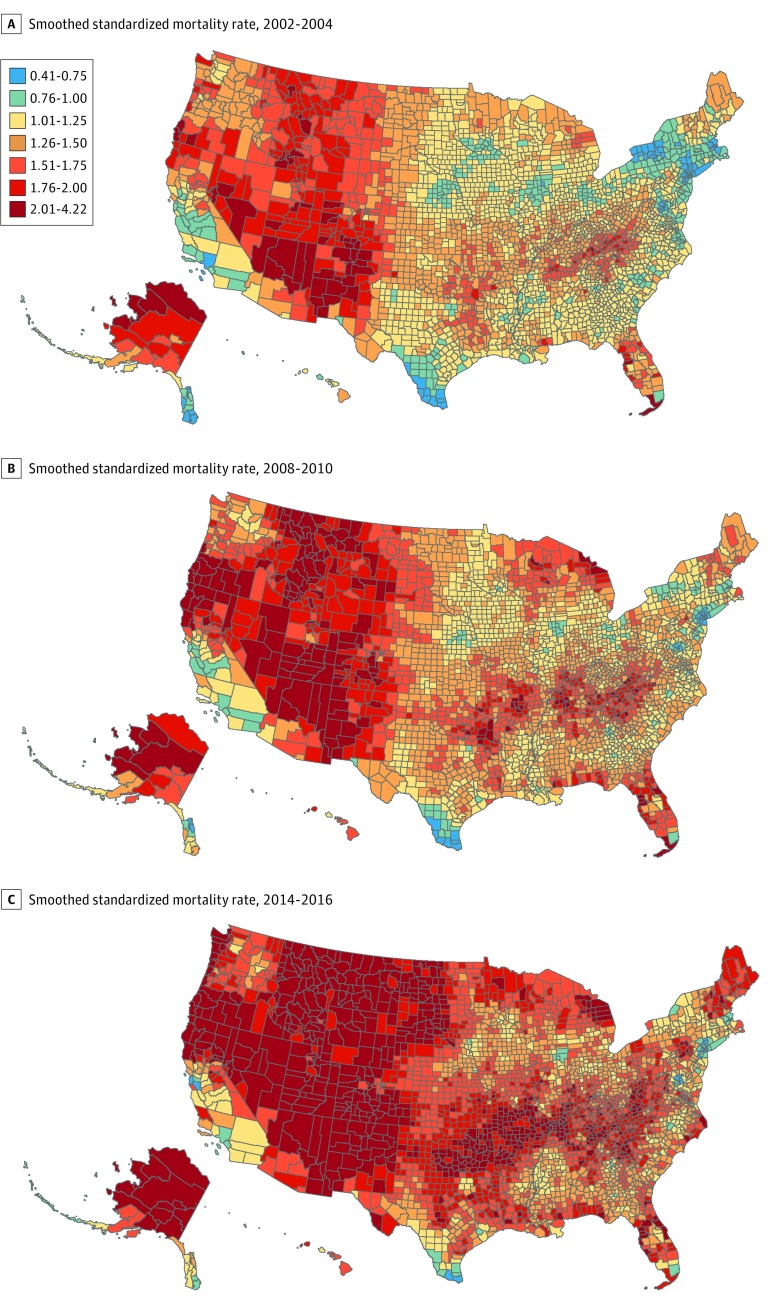
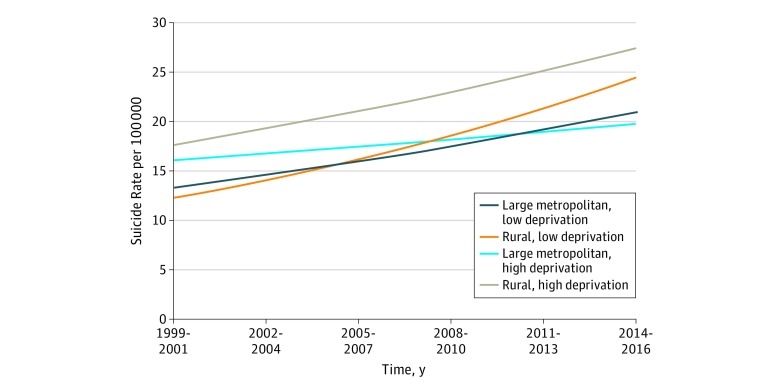
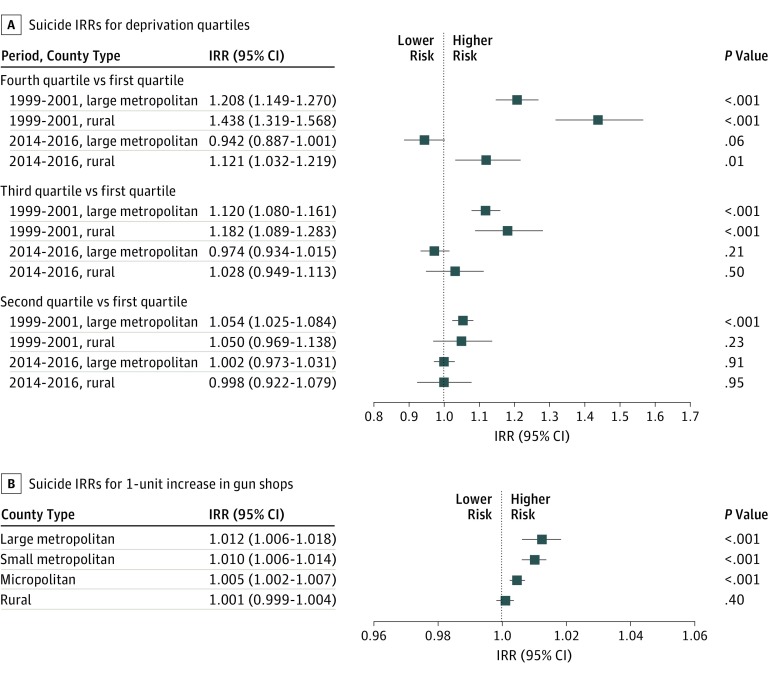
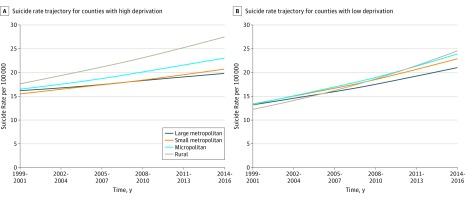
Between 1999 and 2016, 453 577 individuals aged 25 to 64 years died by suicide in the United States. Decedents were primarily male (349 082 [77.0%]) with 101 312 (22.3%) aged 25 to 34 years, 120 157 (26.5%) aged 35 to 44 years, 136 377 (30.1%) aged 45 to 54 years, and 95 771 (21.1%) aged 55 to 64 years. Suicide rates were higher and increased more rapidly in rural than in large metropolitan counties. The highest deprivation quartile was associated with higher suicide rates compared with the lowest deprivation quartile, especially in rural areas, although this association declined during the period studied (rural, 1999-2001: incidence rate ratio [IRR], 1.438; 95% CI, 1.319-1.568; P < .001; large metropolitan, 1999-2001: 1.208; 95% CI, 1.149-1.270; P < .001; rural, 2014-2016: IRR, 1.121; 95% CI, 1.032-1.219; P = .01; large metropolitan, 2014-2016: IRR, 0.942; 95% CI, 0.887-1.001; P = .06). The presence of more gun shops was associated with an increase in county-level suicide rates in all county types except the most rural (rural: IRR, 1.001; 95% CI, 0.999-1.004; P = .40; micropolitan: IRR, 1.005; 95% CI, 1.002-1.007; P < .001; small metropolitan: IRR, 1.010; 95% CI, 1.006-1.014; P < .001; large metropolitan: IRR, 1.012; 95% CI, 1.006-1.018; P < .001). High social capital was associated with lower suicide rates than low social capital (IRR, 0.917; 95% CI, 0.891-0.943; P < .001). High social fragmentation, an increasing percentage of the population without health insurance, and an increasing percentage of veterans in a county were associated with higher suicide rates (high social fragmentation: IRR, 1.077; 95% CI, 1.050-1.103; P < .001; percentage of population without health insurance: IRR, 1.005; 95% CI, 1.004-1.006; P < .001; percentage of veterans: IRR, 1.025; 95% CI, 1.021-1.028; P < .001).
This study found that suicide rates have increased across the nation and most rapidly in rural counties, which may be more sensitive to the impact of social deprivation than more metropolitan counties. Improving social connectedness, civic opportunities, and health insurance coverage as well as limiting access to lethal means have the potential to reduce suicide rates across the rural-urban continuum.
了解与自杀相关的地理和社区层面因素可以为有针对性的自杀预防工作提供信息。
估计自杀率和轨迹,评估与县一级背景因素相关的自杀率,并探索农村-城市连续体的差异。
设计、地点和参与者:本横断面研究包括 1999 年 1 月 1 日至 2016 年 12 月 31 日期间,美国所有 25 至 64 岁自杀死亡的个人。空间分析用于绘制自杀风险的超额风险,纵向随机效应模型使用负二项回归检验与自杀率相关的社区变量以及县一级背景变量之间的相互作用。数据分析于 2019 年 1 月至 7 月进行。
居住县。
18 年期间 25 至 64 岁人群的三年县自杀率,按城乡位置分层。
1999 年至 2016 年间,美国有 453577 名 25 至 64 岁的人自杀身亡。死者主要为男性(349082 人[77.0%]),其中 101312 人(22.3%)年龄在 25 至 34 岁,120157 人(26.5%)年龄在 35 至 44 岁,136377 人(30.1%)年龄在 45 至 54 岁,95771 人(21.1%)年龄在 55 至 64 岁。农村县的自杀率更高,且上升速度更快。与最低贫困程度相比,最高贫困程度的自杀率更高,尤其是在农村地区,尽管这种关联在研究期间有所下降(农村地区,1999-2001 年:发病率比[IRR],1.438;95%CI,1.319-1.568;P<0.001;大型都市县,1999-2001 年:1.208;95%CI,1.149-1.270;P<0.001;农村地区,2014-2016 年:IRR,1.121;95%CI,1.032-1.219;P=0.01;大型都市县,2014-2016 年:IRR,0.942;95%CI,0.887-1.001;P=0.06)。除了最偏远的县外,枪支商店数量的增加与所有县的县一级自杀率的增加有关(农村:IRR,1.001;95%CI,0.999-1.004;P=0.40;微都市县:IRR,1.005;95%CI,1.002-1.007;P<0.001;小型都市县:IRR,1.010;95%CI,1.006-1.014;P<0.001;大型都市县:IRR,1.012;95%CI,1.006-1.018;P<0.001)。高社会资本与低社会资本相比,自杀率较低(IRR,0.917;95%CI,0.891-0.943;P<0.001)。社会碎片化程度高、没有医疗保险的人口比例增加以及县内退伍军人比例增加与自杀率较高有关(社会碎片化程度高:IRR,1.077;95%CI,1.050-1.103;P<0.001;没有医疗保险的人口比例:IRR,1.005;95%CI,1.004-1.006;P<0.001;退伍军人比例:IRR,1.025;95%CI,1.021-1.028;P<0.001)。
本研究发现,全国的自杀率有所上升,农村县的上升速度最快,这可能比更多的大都市县更容易受到社会剥夺的影响。改善社会联系、公民机会和医疗保险覆盖范围,以及限制获得致命手段,有可能降低农村-城市连续体的自杀率。