Pontificia Universidad Católica Madre y Maestra (PUCMM), Santiago de los Caballeros, Dominican Republic.
Unidad de Investigación de la Escuela de Medicina, Universidad Autónoma de Santo Domingo (UASD), Santiago de los Caballeros, Dominican Republic.
PLoS One. 2021 Nov 24;16(11):e0259013. doi: 10.1371/journal.pone.0259013. eCollection 2021.
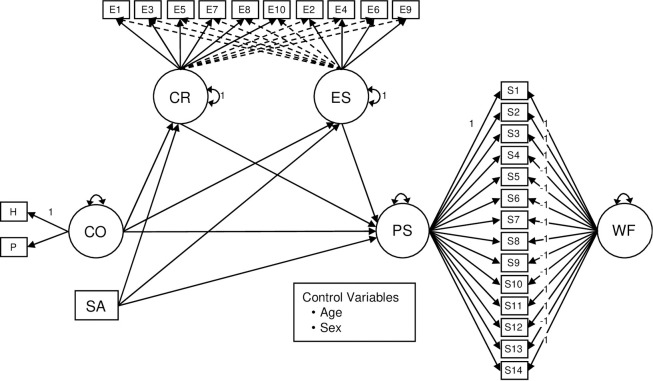
BACKGROUND/INTRODUCTION: Psychological and physical well-being of health personnel has been significantly affected by COVID-19. Work overload and continuous exposure to positive COVID-19 cases have caused them fatigue, stress, anxiety, insomnia and other detriments. This research aims: 1) to analyze whether the use of cognitive reevaluation and emotional suppression strategies decreases and increases, respectively, stress levels of health personnel; 2) to quantify the impact of contact with patients with COVID-19 on stress levels of medical staff.
Emotion regulation strategies (cognitive reevaluation and emotional expression) and stress levels were evaluated in 155 Dominican physicians who were treating people infected with COVID-19 at the moment of the study (67.9% women and 32.1% men; mean age = 34.89; SD = 9.26). In addition, a questionnaire created by the researchers quantified the impact that contact with those infected had on their stress levels.
Contact with patients with COVID-19 predicts increased use of emotion suppression strategies, although is not associated with the use of cognitive reevaluation. These findings lead to an even greater increase in stress on health care providers.
Contextual contingencies demand immediate responses and may not allow health personnel to use cognitive re-evaluation strategies, leaning more towards emotion suppression. However, findings regarding high levels of stress require the implementation of intervention programs focused on the promotion of more functional emotion regulation strategies. Such programs may reduce current stress and prevent post-traumatic symptoms.
背景/引言:COVID-19 对卫生人员的身心健康产生了重大影响。工作负荷过重和持续接触阳性 COVID-19 病例导致他们疲劳、压力、焦虑、失眠和其他损害。本研究旨在:1)分析认知重评和情绪抑制策略的使用是否分别降低和增加卫生人员的压力水平;2)量化与 COVID-19 患者接触对医务人员压力水平的影响。
在研究时正在治疗 COVID-19 感染者的 155 名多米尼加医生中评估情绪调节策略(认知重评和情绪表达)和压力水平(67.9%为女性,32.1%为男性;平均年龄=34.89;SD=9.26)。此外,研究人员创建的问卷量化了与感染者接触对他们压力水平的影响。
与 COVID-19 患者的接触预测情绪抑制策略的使用增加,尽管与认知重评无关。这些发现导致医疗保健提供者的压力更大。
情境偶然性需要立即做出反应,可能不允许卫生人员使用认知重评策略,而是更多地倾向于情绪抑制。然而,关于高压力水平的发现需要实施干预计划,重点是促进更有效的情绪调节策略。这些计划可以减轻当前的压力并预防创伤后症状。