St. Erik Eye Hospital, Eugeniavägen 12, 17164, Stockholm, Sweden.
Department of Clinical Neuroscience, Division of Eye and Vision, St. Erik Eye Hospital, Karolinska Institutet, Stockholm, Sweden.
BMC Cancer. 2021 Nov 24;21(1):1270. doi: 10.1186/s12885-021-09002-0.
To assess the long-term prognosis for patients with iris melanomas and compare it with the prognosis for small choroidal melanomas.
Retrospective observational case series.
All patients treated for iris melanomas at a single referral institution between January 1st 1986 and January 1st 2016 were included. Patients treated for small choroidal melanomas during the same period were included for comparison. The cumulative incidence of melanoma-related mortality was calculated. Patient and tumor characteristics and size-adjusted hazard ratio (HR) for melanoma-related mortality were compared between iris and small choroidal melanomas.
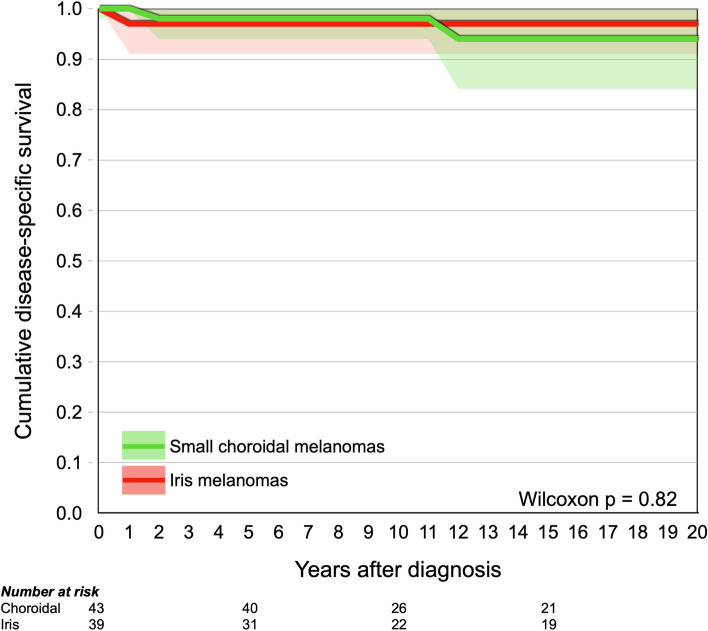
Forty-five iris melanomas and 268 small choroidal melanomas were included. Twenty-four iris melanomas (53%) had been treated with local resection, 12 (27%) with Ruthenium-106 brachytherapy, 7 (16%) with enucleation and 2 (4%) with proton beam irradiation. Twenty-one (68%), 7 (16%) and 2 (4%) of the iris melanomas were of the spindle, mixed and epithelioid cell types, respectively. Twenty-three patients had deceased before the end of follow-up. Median follow-up for the 22 survivors was 13.3 years (SD 9.4). Patients with iris melanomas were more often asymptomatic at presentation and had a trend towards significantly lower age (59 versus 63 years, Student's T-tests p = 0.057). Further, iris melanomas had significantly smaller basal diameter (5.8 versus 8.0 mm, p < 0.0001) and tumor volume (79 mm versus 93 mm mm, p < 0.0001) but greater thickness (3.0 versus 2.5 mm, p < 0.0001). The cumulative incidence of iris melanoma-related mortality was 5% at 5 years after diagnosis, and 8% at 10, 15 and 20 years. The incidence was not significantly different to small choroidal melanomas (Wilcoxon p = 0.46). In multivariate Cox regression with tumor diameter and thickness as covariates, patients with choroidal melanomas did not have increased HR for melanoma-related mortality (HR 2.2, 95% CI 0.5-9.6, p = 0.29). Similarly, there were no significant survival differences in matched subgroups (Wilcoxon p = 0.82).
There are no survival differences between iris and choroidal melanomas when adjusting for tumor size. The reason for the relatively favorable prognosis of iris melanomas compared to melanomas of the choroid and ciliary body is likely that they are diagnosed at a smaller size.
评估虹膜黑色素瘤患者的长期预后,并与小脉络膜黑色素瘤的预后进行比较。
回顾性观察性病例系列。
纳入 1986 年 1 月 1 日至 2016 年 1 月 1 日期间在一家转诊机构接受治疗的所有虹膜黑色素瘤患者。纳入同期接受小脉络膜黑色素瘤治疗的患者进行比较。计算黑色素瘤相关死亡率的累积发生率。比较虹膜和小脉络膜黑色素瘤之间的患者和肿瘤特征以及大小调整后的黑色素瘤相关死亡率的危险比(HR)。
纳入 45 例虹膜黑色素瘤和 268 例小脉络膜黑色素瘤。24 例(53%)虹膜黑色素瘤采用局部切除术治疗,12 例(27%)采用钌-106 近距离放射治疗,7 例(16%)行眼球摘除术,2 例(4%)行质子束照射。21 例(68%)、7 例(16%)和 2 例(4%)虹膜黑色素瘤分别为梭形、混合和上皮样细胞类型。23 例患者在随访结束前死亡。22 例幸存者的中位随访时间为 13.3 年(SD 9.4)。就诊时,虹膜黑色素瘤患者多为无症状,且年龄明显较低(59 岁与 63 岁,Student's T 检验,p=0.057)。此外,虹膜黑色素瘤的基底直径(5.8 毫米与 8.0 毫米,p<0.0001)和肿瘤体积(79 毫米与 93 毫米,p<0.0001)明显较小,但厚度较大(3.0 毫米与 2.5 毫米,p<0.0001)。诊断后 5 年虹膜黑色素瘤相关死亡率为 5%,10、15 和 20 年时分别为 8%。与小脉络膜黑色素瘤相比,其发生率无显著差异(Wilcoxon 检验,p=0.46)。多变量 Cox 回归分析中,以肿瘤直径和厚度为协变量,脉络膜黑色素瘤患者黑色素瘤相关死亡率的 HR 无显著升高(HR 2.2,95%CI 0.5-9.6,p=0.29)。同样,在匹配的亚组中,生存差异无统计学意义(Wilcoxon 检验,p=0.82)。
在调整肿瘤大小后,虹膜黑色素瘤和脉络膜黑色素瘤之间无生存差异。与脉络膜和睫状体黑色素瘤相比,虹膜黑色素瘤预后相对较好的原因可能是其在较小的肿瘤体积时就被诊断出来。