Nuffield Department of Orthopaedics, Rheumatology and Musculoskeletal Sciences, University of Oxford, Oxford, UK
INSERM, Institut Pierre Louis d'Epidémiologie et de Santé Publique, Sorbonne Universite, Paris, France.
Ann Rheum Dis. 2022 Mar;81(3):359-369. doi: 10.1136/annrheumdis-2021-220991. Epub 2021 Nov 24.
To evaluate efficacy and safety of guselkumab, an anti-interleukin-23p19-subunit antibody, in patients with psoriatic arthritis (PsA) with prior inadequate response (IR) to tumour necrosis factor inhibitors (TNFi).
Adults with active PsA (≥3 swollen and ≥3 tender joints) who discontinued ≤2 TNFi due to IR (lack of efficacy or intolerance) were randomised (2:1) to subcutaneous guselkumab 100 mg or placebo at week 0, week 4, then every 8 weeks (Q8W) through week 44. Patients receiving placebo crossed over to guselkumab at week 24. The primary (ACR20) and key secondary (change in HAQ-DI, ACR50, change in SF-36 PCS and PASI100) endpoints, at week 24, underwent fixed-sequence testing (two-sided α=0.05). Adverse events (AEs) were assessed through week 56.
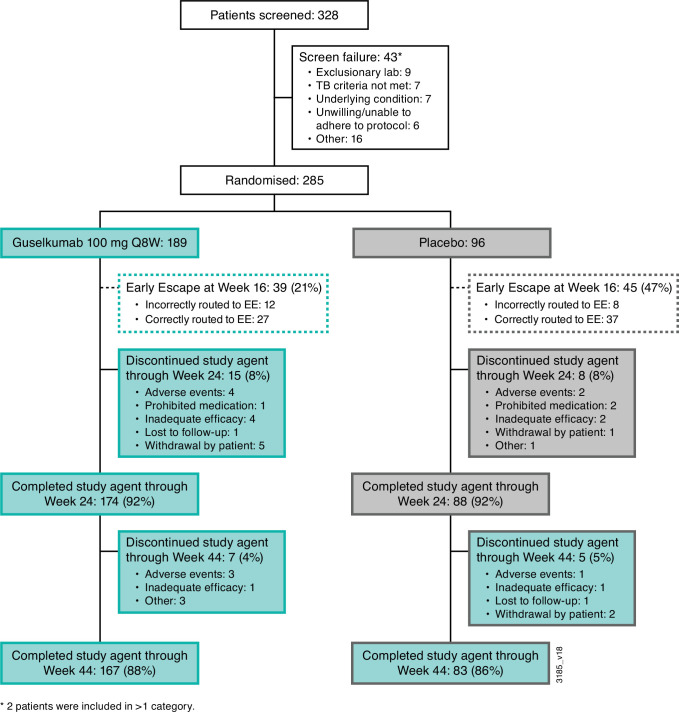
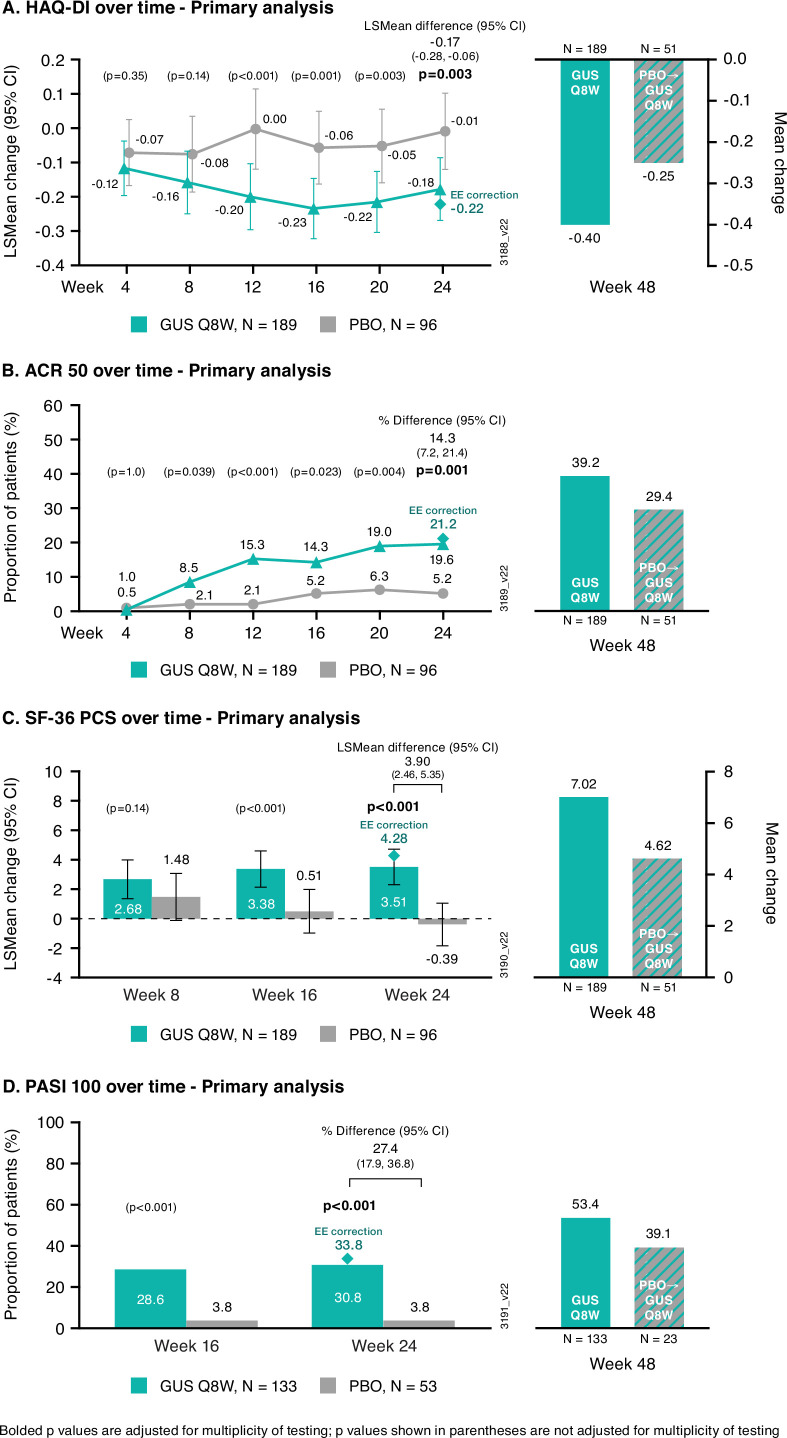
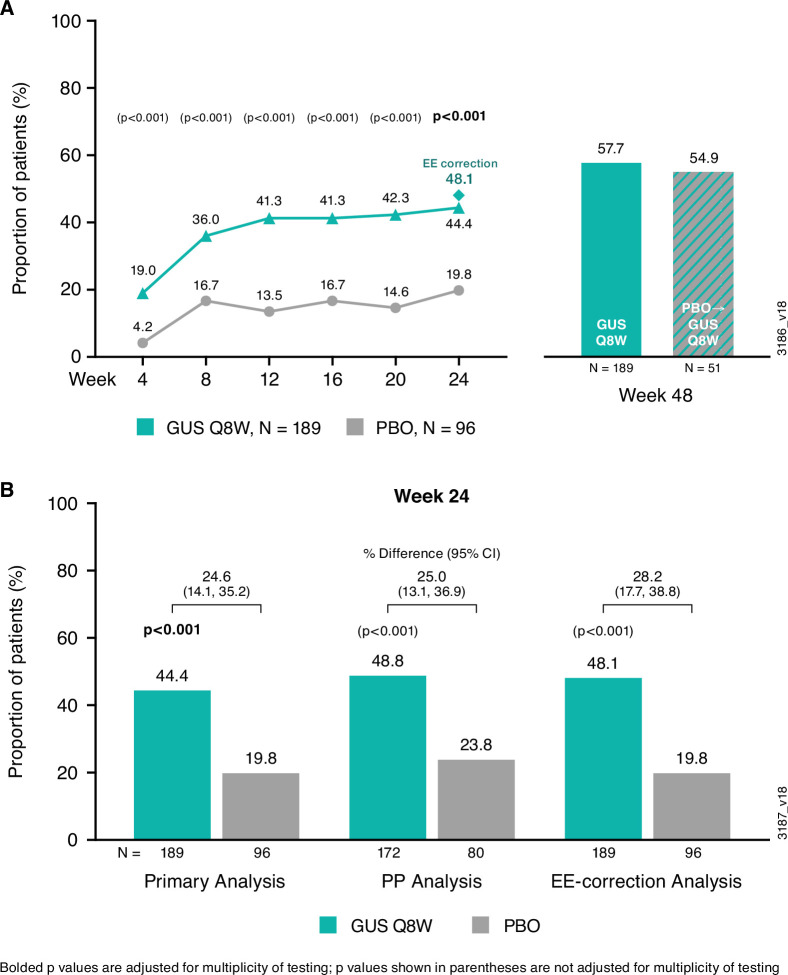
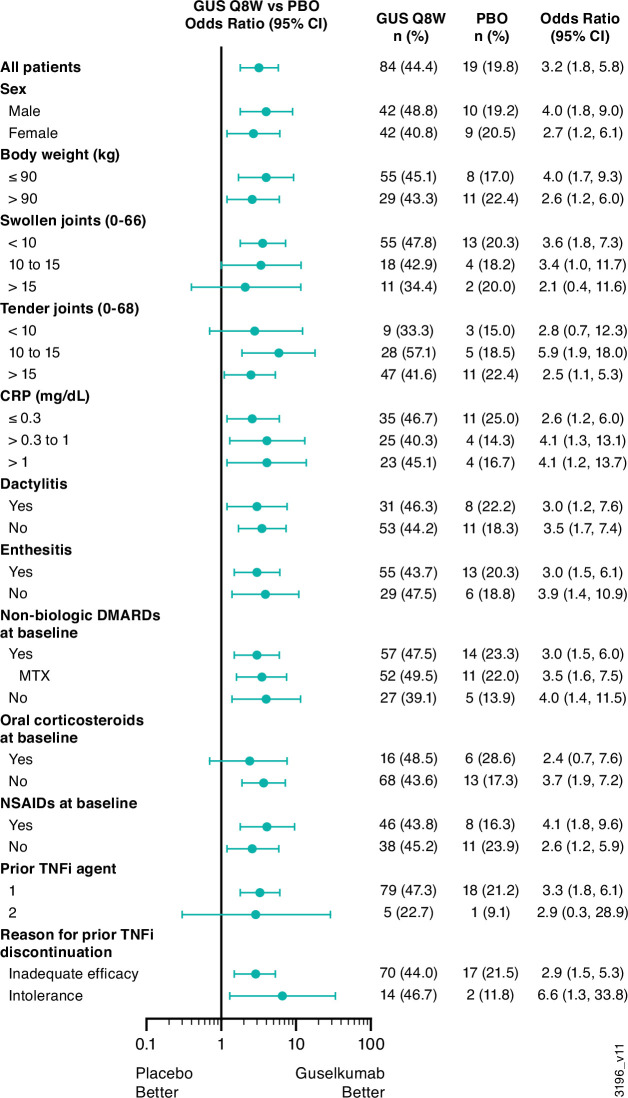
Among 285 participants (female (52%), one (88%) or two (12%) prior TNFi), 88% of 189 guselkumab and 86% of 96 placebo→guselkumab patients completed study agent through week 44. A statistically significantly higher proportion of patients receiving guselkumab (44.4%) than placebo (19.8%) achieved ACR20 (%difference (95% CI): 24.6 (14.1 to 35.2); multiplicity-adjusted p<0.001) at week 24. Guselkumab was superior to placebo for each key secondary endpoint (multiplicity-adjusted p<0.01). ACR20 response (non-responder imputation) in the guselkumab group was 58% at week 48; >80% of week 24 responders maintained response at week 48. Through week 24, serious AEs/serious infections occurred in 3.7%/0.5% of 189 guselkumab-randomised and 3.1%/0% of 96 placebo-randomised patients; the guselkumab safety profile was similar through week 56, with no deaths or opportunistic infections.
Guselkumab significantly improved joint and skin manifestations and physical function in patients with TNFi-IR PsA. A favourable benefit-risk profile was demonstrated through 1 year.
NCT03796858.
评估 Guselkumab(一种抗白细胞介素-23p19 亚单位抗体)在先前对肿瘤坏死因子抑制剂(TNFi)反应不足(IR)的银屑病关节炎(PsA)患者中的疗效和安全性。
患有活动性 PsA(≥3 个肿胀关节和≥3 个压痛关节)的成年人因 IR(缺乏疗效或不耐受)而停止使用≤2 种 TNFi,随机(2:1)接受皮下 Guselkumab 100mg 或安慰剂,在第 0 周、第 4 周,然后每 8 周(Q8W)至第 44 周。接受安慰剂的患者在第 24 周交叉至 Guselkumab。第 24 周主要(ACR20)和关键次要(HAQ-DI 变化、ACR50、SF-36 PCS 和 PASI100 变化)终点进行固定序列检验(双侧 α=0.05)。通过第 56 周评估不良事件(AE)。
在 285 名参与者(女性(52%),一种(88%)或两种(12%)先前的 TNFi)中,189 名 Guselkumab 治疗和 96 名安慰剂→Guselkumab 治疗的患者中,分别有 88%和 86%的患者通过第 44 周完成了研究药物治疗。接受 Guselkumab 的患者比例(44.4%)显著高于接受安慰剂的患者(19.8%),达到 ACR20(%差异(95%CI):24.6(14.1 至 35.2);多重调整后 p<0.001)在第 24 周。与安慰剂相比,Guselkumab 在每个关键次要终点均有优势(多重调整后 p<0.01)。第 48 周时,Guselkumab 组的 ACR20 应答(无应答者推断)为 58%;在第 24 周有应答的患者中,>80%在第 48 周时仍有应答。在第 24 周时,189 名 Guselkumab 随机分组患者中有 3.7%发生严重不良事件/严重感染,96 名安慰剂随机分组患者中分别有 0.5%和 0%;通过第 24 周,Guselkumab 的安全性与安慰剂相似,没有死亡或机会性感染。
Guselkumab 显著改善了 TNFi-IR PsA 患者的关节和皮肤表现以及身体功能。通过 1 年的研究,证实了其有利的风险效益比。
NCT03796858。