Institut Pierre Louis d'Epidémiologie et de Santé Publique, INSERM, Sorbonne Universite, Paris, France
APHP.Sorbonne Universite, Rheumatology Department, Hopital Universitaire Pitie Salpetriere, Paris, France.
Ann Rheum Dis. 2020 Jun;79(6):700-712. doi: 10.1136/annrheumdis-2020-217159.
To update the European League Against Rheumatism (EULAR) recommendations for the pharmacological treatment of psoriatic arthritis (PsA).
According to the EULAR standardised operating procedures, a systematic literature review was followed by a consensus meeting to develop this update involving 28 international taskforce members in May 2019. Levels of evidence and strengths of recommendations were determined.
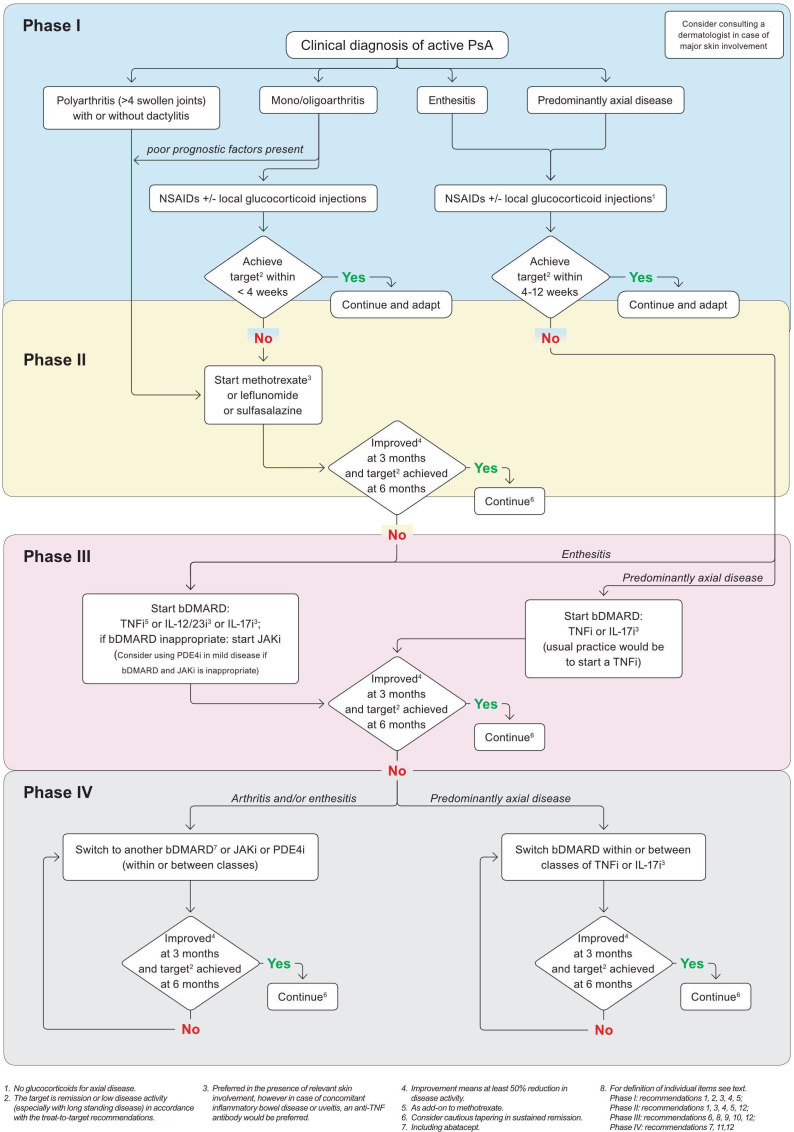
The updated recommendations comprise 6 overarching principles and 12 recommendations. The overarching principles address the nature of PsA and diversity of both musculoskeletal and non-musculoskeletal manifestations; the need for collaborative management and shared decision-making is highlighted. The recommendations provide a treatment strategy for pharmacological therapies. Non-steroidal anti-inflammatory drugs and local glucocorticoid injections are proposed as initial therapy; for patients with arthritis and poor prognostic factors, such as polyarthritis or monoarthritis/oligoarthritis accompanied by factors such as dactylitis or joint damage, rapid initiation of conventional synthetic disease-modifying antirheumatic drugs is recommended. If the treatment target is not achieved with this strategy, a biological disease-modifying antirheumatic drugs (bDMARDs) targeting tumour necrosis factor (TNF), interleukin (IL)-17A or IL-12/23 should be initiated, taking into account skin involvement if relevant. If axial disease predominates, a TNF inhibitor or IL-17A inhibitor should be started as first-line disease-modifying antirheumatic drug. Use of Janus kinase inhibitors is addressed primarily after bDMARD failure. Phosphodiesterase-4 inhibition is proposed for patients in whom these other drugs are inappropriate, generally in the context of mild disease. Drug switches and tapering in sustained remission are addressed.
These recommendations provide stakeholders with an updated consensus on the pharmacological management of PsA, based on a combination of evidence and expert opinion.
更新欧洲抗风湿病联盟(EULAR)针对银屑病关节炎(PsA)的药物治疗推荐意见。
根据 EULAR 标准化操作程序,对文献进行系统回顾,然后于 2019 年 5 月召开共识会议,邀请 28 名国际专题工作组成员参与更新工作。确定证据水平和推荐强度。
更新后的推荐意见包括 6 项总体原则和 12 项建议。总体原则涉及 PsA 的性质以及肌肉骨骼和非肌肉骨骼表现的多样性;强调协作管理和共同决策的必要性。建议提供了药物治疗策略。非甾体抗炎药和局部糖皮质激素注射被提议作为初始治疗;对于关节炎和预后不良因素的患者,如多关节炎或单关节炎/寡关节炎伴有腱鞘炎或关节损伤等因素,建议快速启动常规合成疾病修饰抗风湿药物。如果该策略未达到治疗目标,应考虑皮肤受累情况,针对肿瘤坏死因子(TNF)、白细胞介素(IL)-17A 或 IL-12/23 的生物疾病修饰抗风湿药物(bDMARDs)应作为起始治疗。如果轴性疾病占主导地位,应首先使用 TNF 抑制剂或 IL-17A 抑制剂作为一线疾病修饰抗风湿药物。Janus 激酶抑制剂的使用主要是在 bDMARD 失败后提出的。磷酸二酯酶-4 抑制剂被提议用于其他药物不适用的患者,通常在疾病轻微的情况下使用。讨论了药物转换和持续缓解时的药物减量。
这些建议基于证据和专家意见,为利益相关者提供了针对 PsA 药物治疗的最新共识。