Johnston Emily A, Beasley Jeannette M, Jay Melanie
Biomedical Education, California Health Sciences University College of Osteopathic Medicine, Clovis, CA, USA.
Department of Medicine, NYU Langone Health, New York, NY, USA.
Adv Med Educ Pract. 2021 Nov 18;12:1337-1342. doi: 10.2147/AMEP.S333370. eCollection 2021.
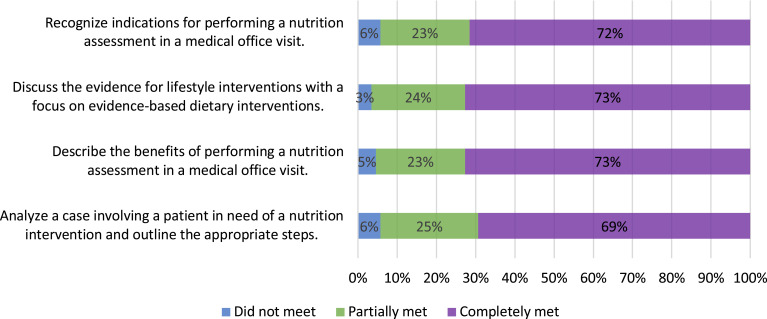
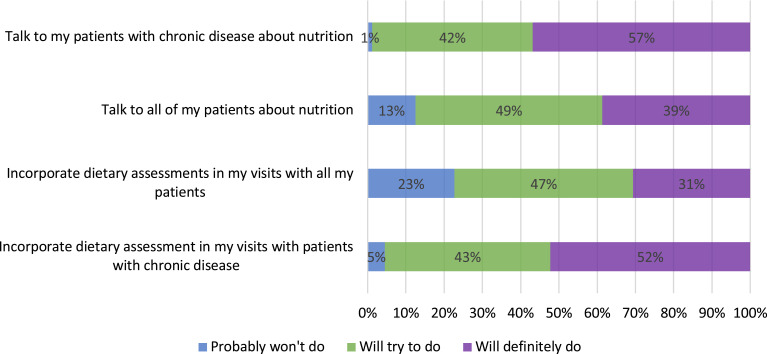
Poor dietary choices are a leading cause of chronic disease, but nutrition is rarely discussed in clinical practice. Nutrition is taught in less than a third of medical schools and physicians in practice empirically report low levels of comfort and self-efficacy in discussing nutrition with patients. A two-part presentation was created and shared with second-year medical students at a college of medicine. Students were given pre-work that included a brief (15 minutes) pre-recorded presentation and an e-resource entitled "Practical Nutrition for the Primary Care Provider" and then engaged in a live virtual session with a brief lecture and question and answer period (45 minutes). A survey was administered following the live presentation to evaluate the extent to which the presentation met the stated objectives and could impact participants' future practice. One-hundred and six students participated in the live lecture. Eighty-eight students (83%) provided survey feedback. Over two-thirds of respondents indicated that the presentation completely met the objectives, 57% indicated that they would definitely talk to patients with chronic disease about nutrition, and 52% indicated they would incorporate diet assessment in visits with patients with chronic disease. Nutrition is integral to disease prevention and management. Many students provided comments on the importance of the topic and benefit of the information. Further research is necessary to determine the optimal time and place for nutrition education in medical training. This presentation and e-resource are evidence-based, brief, and provided tools for participants to access once in practice.
不良的饮食选择是慢性病的主要成因,但在临床实践中,营养问题却很少被提及。不到三分之一的医学院校开设营养学课程,而从业医生根据经验反馈,他们在与患者讨论营养问题时,自信程度和自我效能感较低。我们制作了一个分为两部分的演示文稿,并与一所医学院的二年级医学生分享。学生们的预习作业包括一个简短的(15分钟)预录制演示文稿和一份名为《初级保健提供者实用营养学》的电子资源,然后参加了一场现场虚拟课程,课程包括简短讲座和问答环节(45分钟)。现场演示结束后进行了一项调查,以评估该演示文稿在多大程度上实现了既定目标,以及对参与者未来的实践可能产生的影响。106名学生参加了现场讲座。88名学生(83%)提供了调查反馈。超过三分之二的受访者表示该演示文稿完全达到了目标,57%的受访者表示他们肯定会与慢性病患者谈论营养问题,52%的受访者表示他们会在诊治慢性病患者时纳入饮食评估。营养对于疾病的预防和管理至关重要。许多学生对该主题的重要性和信息的实用性发表了评论。有必要进行进一步研究,以确定医学培训中营养教育的最佳时间和地点。这个演示文稿和电子资源基于证据、篇幅简短,为参与者在实际工作中提供了可随时查阅的工具。