Altalhi Faisal, Altalhi Abdulrhman, Magliah Ziad, Abushal Zaid, Althaqafi Anas, Falemban Azzam, Cheema Ejaz, Dehele Inderpal, Ali Majid
College of Pharmacy, Umm Al-Qura University, Makkah, Saudi Arabia.
School of Pharmacy, University of Management and Technology, Lahore, Pakistan.
Saudi Pharm J. 2021 Nov;29(11):1250-1257. doi: 10.1016/j.jsps.2021.10.003. Epub 2021 Oct 19.
Given the widespread use of clinical reasoning (CR) in the healthcare practice, it is essential to inculcate the CR practice in undergraduate pharmacy education which can not only facilitate their clinical education and clinical rotations but can also help them become better clinical pharmacists. There is very limited CR employed in the pharmacy curriculum and practice in the Middle East countries. This study aimed to develop and evaluate CR practice in pharmacy undergraduates in one college of pharmacy in Saudi Arabia.
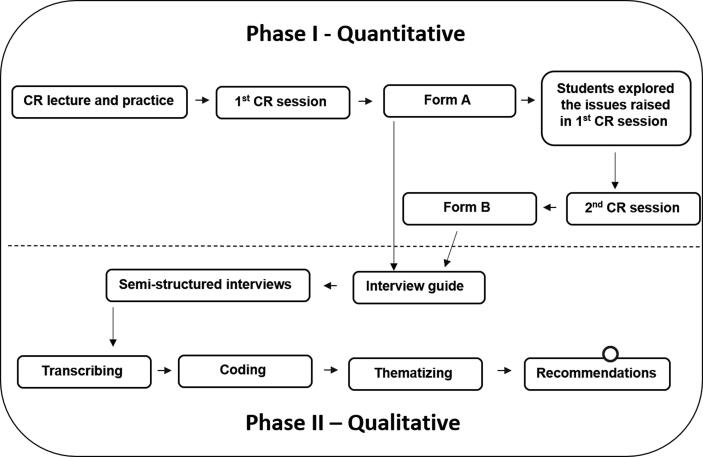
We employed a mixed-methods methodology that included two phases. In Phase I, students were introduced to CR practice ('think aloud' method) and given geriatric clinical cases which they used in two sessions together with a tutor. This was followed by the writing of SOAP notes using the tutor feedback and completion of a survey that included a self-reflection about their experience of using the CR method. Phase II included face-to-face semi-structured interviews involving selected students that were recruited via convenience sampling to further explore the issues identified in Phase I of the study.
Of the 155 students who completed the survey (response rate 94%), the majority of them agreed that CR using the 'think aloud' method was useful in gathering (92%) and interpreting (95%) relevant patient information, identifying medication-related problems (95%), exploring therapeutic options for the problem(s) (93%) and formulating a treatment plan for the patient (90%). Qualitative data analysis of the 12 interviews was consistent with these findings. Furthermore, it provided an insight into the challenges faced by the students in applying this CR method.
Students found the practice of CR using the 'think aloud' method helpful in working through given cases and taking clinical decisions. This method can be widely employed in pharmacy education and practice.
鉴于临床推理(CR)在医疗实践中的广泛应用,在本科药学教育中灌输CR实践至关重要,这不仅有助于他们的临床教育和临床轮转,还能帮助他们成为更优秀的临床药剂师。中东国家药学课程和实践中采用的CR非常有限。本研究旨在开发和评估沙特阿拉伯一所药学院本科药学专业学生的CR实践。
我们采用了一种混合方法,包括两个阶段。在第一阶段,向学生介绍CR实践(“大声思考”方法),并提供老年临床病例,他们与导师一起在两个环节中使用这些病例。随后,根据导师的反馈撰写SOAP笔记,并完成一项调查,其中包括对他们使用CR方法的经验进行自我反思。第二阶段包括对通过便利抽样招募的部分学生进行面对面的半结构化访谈,以进一步探讨研究第一阶段发现的问题。
在完成调查的155名学生中(回复率94%),大多数人同意使用“大声思考”方法进行CR有助于收集(92%)和解释(95%)相关患者信息、识别与药物相关的问题(95%)、探索问题的治疗选择(93%)以及为患者制定治疗计划(90%)。对12次访谈的定性数据分析与这些结果一致。此外,它还深入了解了学生在应用这种CR方法时面临的挑战。
学生们发现使用“大声思考”方法进行CR实践有助于处理给定病例并做出临床决策。这种方法可广泛应用于药学教育和实践。