Joerg Lukas, Hasler Susann, Gschwend Anna, Meincke Cordula, Nordmann Thierry M, Glatz Martin, Heilig Michelle, Schnyder Benno, Helbling Arthur, Schmid-Grendelmeier Peter
Allergy Unit, Department of Dermatology, University Hospital of Zurich, Zurich, Switzerland.
Division of Allergology and Clinical Immunology, Department of Pneumology, Inselspital, Bern University Hospital, University of Bern, Bern, Switzerland.
World Allergy Organ J. 2021 Nov 5;14(11):100602. doi: 10.1016/j.waojou.2021.100602. eCollection 2021 Nov.
The diagnostic approach for beta-lactam (BL) drug hypersensitivity reactions (DHR) is based on the history, clinical signs, skin tests (ST), tests, and drug provocation tests (DPT). The aim of this study was to assess the performance of an allergy workup with ST in a real-world use.
In this cross-sectional study the rate of positive ST in subjects with suspected DHR to penicillins and cephalosporins was investigated. Of special interest were correlations of ST positivity: 1) to the time intervals between index reaction and the allergic work-up, 2) time interval from drug exposure to the onset of signs, 3) pattern of manifestation in delayed DHR and involvement of test area in the index reaction, and 4) potential advantage of patch testing in delayed DHR.
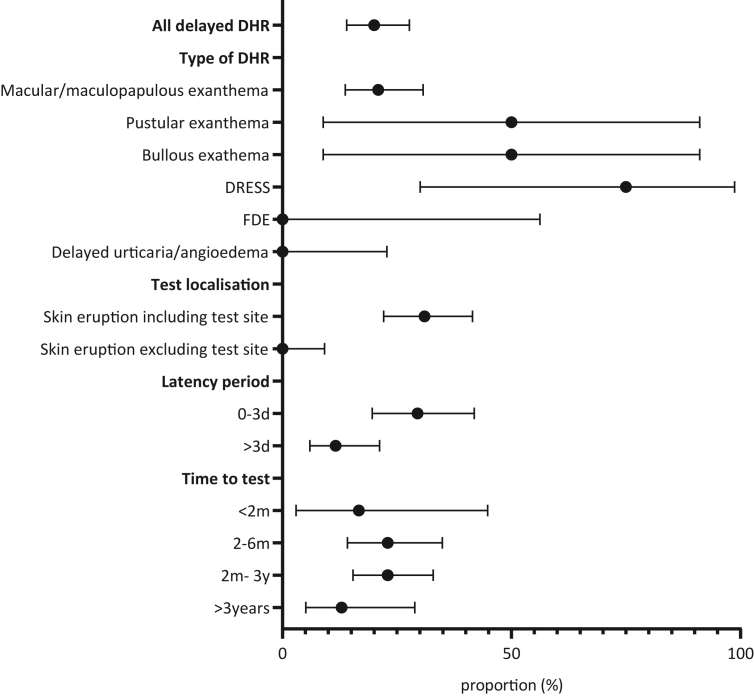
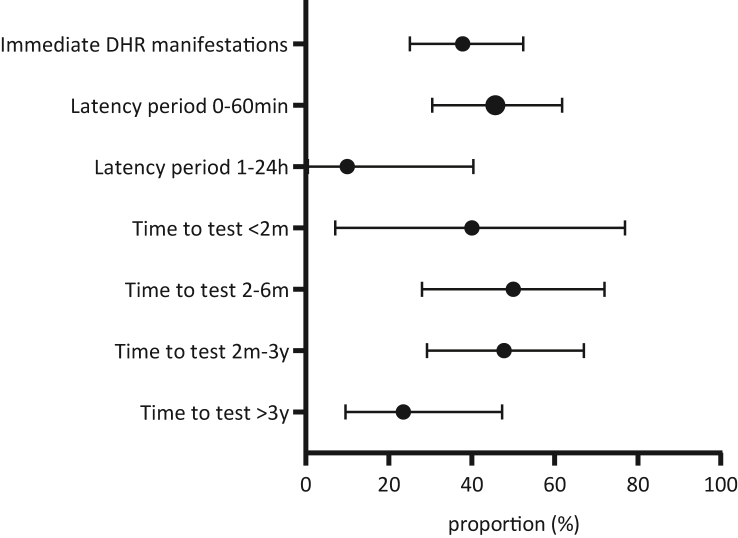
175 patients were included between January 2018 and April 2019 (63.4% female), 45 (25.7%) with immediate DHR manifestation and 130 with delayed DHR manifestation (74.3%). A total of 44 patients (25.1%) had a positive ST (immediate DHR 37.8% versus 20.0% in delayed DHR). ST positivity decreased in both groups after 3 years from 47.8% [95%CI 29.2-67] to 23.5% [95%CI 9.6-47.3] in immediate DHR and 23.0% [95%CI 15-4-32.9] to 12.9% [95%CI 5.1-28.9] in delayed DHR. The proportion of positive ST was higher in patients with more severe forms of delayed DHR, and in subjects with a shorter latency period of onset of symptoms after drug exposure: 0-3d: 29.5% [95%CI 19.6-41.9] vs. >3d: 11.6% [95%CI 6.0-21.2]). No sensitization was shown in delayed urticaria or angioedema. ST done outside the skin area involved during the index reaction were negative in all cases (0/38 vs. 26/84 in cases with involved area). The combination of patch test and intradermal test (IDT) revealed an additional positive result in 2/77 cases. Additional testing reduced the proportion of negative test results to 72%.
In most patients with negative test results, we could not clarify the cause of the BL-associated adverse events even with further investigations (including DPT). How to prevent new drug-induced adverse events in such patients has hardly been investigated yet. Corresponding cohort studies could improve the data situation.
β-内酰胺(BL)类药物过敏反应(DHR)的诊断方法基于病史、临床体征、皮肤试验(ST)、检测以及药物激发试验(DPT)。本研究的目的是评估在实际应用中进行ST过敏检查的性能。
在这项横断面研究中,调查了对青霉素和头孢菌素疑似DHR患者的ST阳性率。特别感兴趣的是ST阳性的相关性:1)与首次反应和过敏检查之间的时间间隔;2)从药物暴露到体征出现的时间间隔;3)迟发性DHR的表现模式以及首次反应中试验部位的受累情况;4)斑贴试验在迟发性DHR中的潜在优势。
2018年1月至2019年4月共纳入175例患者(女性占63.4%),其中45例(25.7%)有速发型DHR表现,130例有迟发型DHR表现(74.3%)。共有44例患者(25.1%)ST阳性(速发型DHR为37.8%,迟发型DHR为20.0%)。两组在3年后ST阳性率均下降,速发型DHR从47.8%[95%CI 29.2 - 67]降至23.5%[95%CI 9.6 - 47.3],迟发型DHR从23.0%[95%CI 15.4 - 32.9]降至12.9%[95%CI 5.1 - 28.9]。迟发型DHR更严重形式的患者以及药物暴露后症状发作潜伏期较短的患者中ST阳性比例更高:0 - 3天:29.5%[95%CI 19.6 - 41.9] 对比 >3天:11.6%[95%CI 6.0 - 21.2])。迟发性荨麻疹或血管性水肿未显示致敏。在首次反应中未受累皮肤区域进行的ST在所有病例中均为阴性(0/38对比受累区域病例中的26/84)。斑贴试验和皮内试验(IDT)联合在77例中有2例显示额外阳性结果。额外检测将阴性检测结果比例降至72%。
在大多数检测结果为阴性的患者中,即使进行进一步调查(包括DPT),我们也无法明确BL相关不良事件的原因。对于如何预防此类患者中新的药物诱导不良事件,目前几乎尚未进行研究。相应的队列研究可能会改善数据状况。