Royal Sussex County Hospital, Brighton and Sussex University Hospitals NHS Trust, Brighton, UK.
Division of Neurosurgery, Chiari/EDS Neurosurgical Center, Mount Sinai South Nassau, Oceanside, NY, USA.
Acta Neurochir (Wien). 2022 Mar;164(3):903-911. doi: 10.1007/s00701-021-05039-z. Epub 2021 Nov 25.
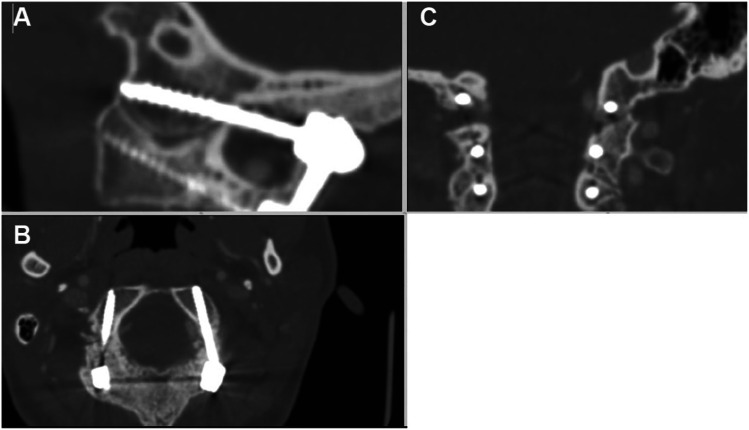
Condylar screw fixation is a rescue technique and an alternative to the conventional configuration of occipitocervical fusion. Condylar screws are utilized when previous surgical bone removal along the supraocciput has occurred which makes anchoring of a traditional barplate technically difficult or impossible. However, the challenging dissection of C0-1 necessary for condylar screw fixation and the concerns about possible complications have, thus far, prevented the acquisition of large surgical series utilizing occipital condylar screws. In the largest case series to date, this paper aims to evaluate the safety profile and complications of condylar screw fixation for occipitocervical fusion.
A retrospective safety and complication-based analysis of occipitocervical fusion via condylar screws fixation was performed.
A total of 250 patients underwent occipitocervical fusions using 500 condylar screws between September 2012 and September 2018. No condylar screw pullouts, or vertebral artery impingements were observed in this series. The sacrifice of condylar veins during the dissection at C0-1 did not cause any venous stroke. Hypotrophic condyles were found in 36.4% (91 of the 250) cases and did not prevent the insertion of condylar screws. Two transient hypoglossal deficits occurred at the beginning of this surgical series and were followed by recovery a few months later. Corrective strategies were effective in preventing further hypoglossal injuries.
This surgical series suggests that the use of condylar screws fixation is a relatively safe and reliable option for OC fusion in both adult and pediatric patients. Methodical dissection of anatomical landmarks, intraoperative imaging, and neurophysiologic monitoring allowed the safe execution of the largest series of condylar screws reported to date. Separate contributions will follow in the future to provide details about the long-term clinical outcome of this series.
髁螺钉固定是一种抢救技术,也是传统枕颈融合术式的替代方法。当颅顶上方的先前手术骨切除导致传统的杆板难以或不可能固定时,使用髁螺钉。然而,为了进行髁螺钉固定,需要对 C0-1 进行具有挑战性的解剖,并且担心可能出现并发症,因此迄今为止,还没有使用枕髁螺钉获得大量的手术系列。在迄今为止最大的病例系列中,本文旨在评估髁螺钉固定用于枕颈融合的安全性概况和并发症。
对通过髁螺钉固定行枕颈融合的安全性和并发症进行回顾性分析。
2012 年 9 月至 2018 年 9 月,共有 250 例患者接受了枕颈融合术,共使用了 500 枚髁螺钉。在本系列中,未观察到髁螺钉拔出或椎动脉撞击。在 C0-1 处的解剖过程中牺牲了髁静脉,但并未引起任何静脉性中风。在 36.4%(250 例中的 91 例)的病例中发现了发育不良的髁突,但不影响髁螺钉的插入。在该手术系列的开始时发生了 2 例短暂的舌下神经功能障碍,几个月后恢复。纠正策略在防止进一步的舌下神经损伤方面是有效的。
本手术系列表明,髁螺钉固定在成人和儿童患者的 OC 融合中是一种相对安全可靠的选择。对解剖标志、术中成像和神经生理监测的系统解剖,使能够安全地进行迄今为止报道的最大系列髁螺钉固定。未来将有单独的研究来提供有关该系列长期临床结果的详细信息。