Armitage James M, Sangion Alessandro, Parmar Rohan, Looky Alexandra B, Arnot Jon A
AES Armitage Environmental Sciences, Inc., Ottawa, ON K1L 8C3, Canada.
ARC Arnot Research and Consulting, Inc., Toronto, ON M4M 1W4, Canada.
Toxics. 2021 Nov 20;9(11):315. doi: 10.3390/toxics9110315.
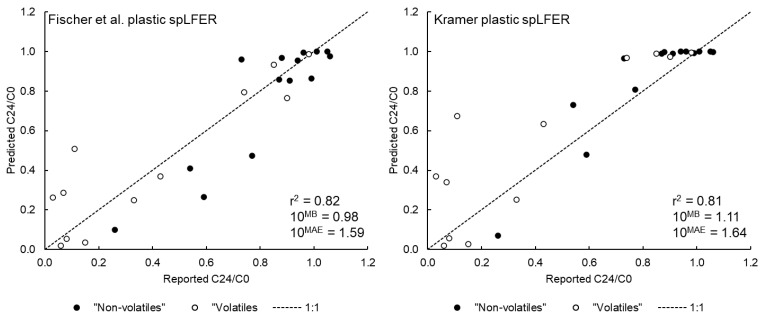
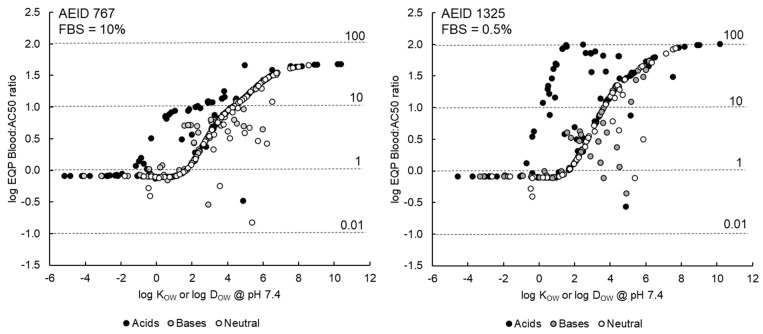
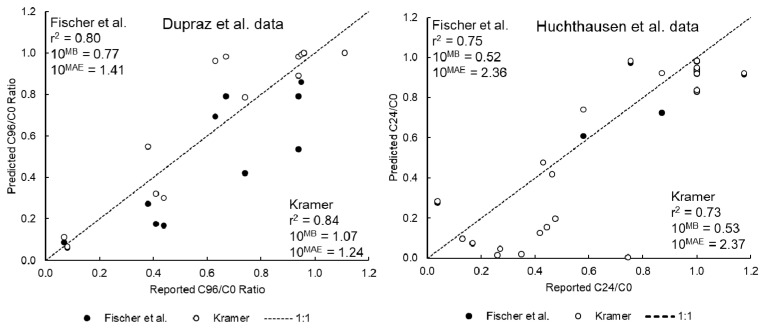
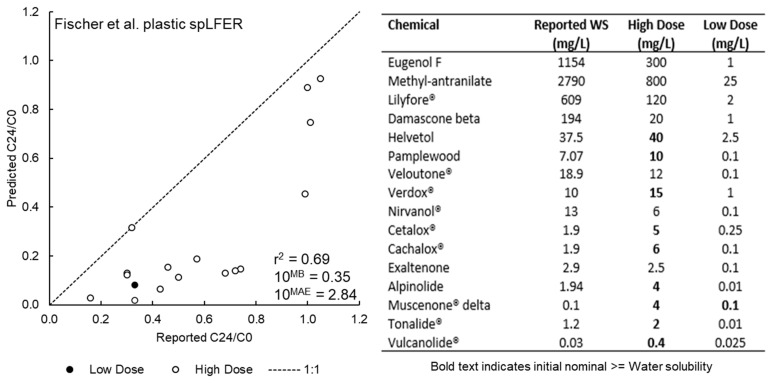
This study demonstrates the utility of an updated mass balance model for predicting the distribution of organic chemicals in in vitro test systems (IV-MBM EQP v2.0) and evaluates its performance with empirical data. The IV-MBM EQP v2.0 tool was parameterized and applied to four independent data sets with measured ratios of bulk medium or freely-dissolved to initial nominal concentrations (e.g., C24/C0 where C24 is the measured concentration after 24 h of exposure and C0 is the initial nominal concentration). Model performance varied depending on the data set, chemical properties (e.g., "volatiles" vs. "non-volatiles", neutral vs. ionizable organics), and model assumptions but overall is deemed acceptable. For example, the r was greater than 0.8 and the mean absolute error () in the predictions was less than a factor of two for most neutral organics included. Model performance was not as good for the ionizable organic chemicals included but the r was still greater than 0.7 and the less than a factor of three. The IV-MBM EQP v2.0 model was subsequently applied to several hundred chemicals on Canada's Domestic Substances List (DSL) with nominal effects data (50s) reported for two in vitro assays. We report the frequency of chemicals with 50s corresponding to predicted cell membrane concentrations in the baseline toxicity range (i.e., >20-60 mM) and tabulate the number of chemicals with "volatility issues" (majority of chemical in headspace) and "solubility issues" (freely-dissolved concentration greater than water solubility after distribution). In addition, the predicted "equivalent EQP blood concentrations" (i.e., blood concentration at equilibrium with predicted cellular concentration) were compared to the 50s as a function of hydrophobicity (log octanol-water partition or distribution ratio). The predicted equivalent EQP blood concentrations exceed the 50 by up to a factor of 100 depending on hydrophobicity and assay conditions. The implications of using 50s as direct surrogates for human blood concentrations when estimating the oral equivalent doses using a toxicokinetic model (i.e., reverse dosimetry) are then briefly discussed.
本研究展示了一种更新的质量平衡模型(体外试验系统中有机化学品分布预测模型,IV-MBM EQP v2.0)的实用性,并通过实证数据评估了其性能。IV-MBM EQP v2.0工具进行了参数化处理,并应用于四个独立数据集,这些数据集包含实测的大量介质或自由溶解浓度与初始标称浓度的比值(例如,C24/C0,其中C24是暴露24小时后的实测浓度,C0是初始标称浓度)。模型性能因数据集、化学性质(例如,“挥发性物质”与“非挥发性物质”、中性与可离子化有机物)以及模型假设而异,但总体上被认为是可接受的。例如,对于大多数纳入的中性有机物,r大于0.8,预测的平均绝对误差()小于两倍。对于纳入的可离子化有机化学品,模型性能没那么好,但r仍大于0.7,且小于三倍。随后,IV-MBM EQP v2.0模型应用于加拿大国内物质清单(DSL)上的数百种化学品,并给出了两种体外试验报告的标称效应数据(50s)。我们报告了50s对应于基线毒性范围内预测细胞膜浓度的化学品频率(即,>20 - 60 mM),并列出了存在“挥发性问题”(顶空中大部分化学品)和“溶解性问题”(分布后自由溶解浓度大于水溶性)的化学品数量。此外,将预测的“等效EQP血液浓度”(即与预测细胞浓度平衡时的血液浓度)作为疏水性(log辛醇 - 水分配系数或分布比)的函数与50s进行比较。根据疏水性和试验条件,预测的等效EQP血液浓度比50s高出多达100倍。然后简要讨论了在使用毒物动力学模型(即反向剂量测定法)估算口服等效剂量时,将50s直接用作人体血液浓度替代指标的影响。