Gommers Jessie Jj, Voogd Adri C, Broeders Mireille Jm, van Breest Smallenburg Vivian, Strobbe Luc Ja, Donkers-van Rossum Astrid B, van Beek Hermen C, Mann Ritse M, Duijm Lucien Em
Department of Medical Imaging, Radboud University Medical Center, Geert Grooteplein 10, 6525, GA, Nijmegen, the Netherlands.
Department of Epidemiology, Maastricht University Medical Center, Universiteitssingel 60, 6229, ER, Maastricht, the Netherlands; Department of Research and Development, Netherlands Comprehensive Cancer Organization, Godebaldkwartier 419, 3511, DT, Utrecht, the Netherlands.
Breast. 2021 Dec;60:279-286. doi: 10.1016/j.breast.2021.11.014. Epub 2021 Nov 20.
Problem solving magnetic resonance imaging (MRI) is used to exclude malignancy in women with equivocal findings on conventional imaging. However, recommendations on its use for women recalled after screening are lacking. This study evaluates the impact of problem solving MRI on diagnostic workup among women recalled from the Dutch screening program, as well as time trends and inter-hospital variation in its use.
Women who were recalled at screening mammography in the South of the Netherlands (2008-2017) were included. Two-year follow-up data were collected. Diagnostic-workup and accuracy of problem solving MRI were evaluated and time trends and inter-hospital variation in its use were examined.
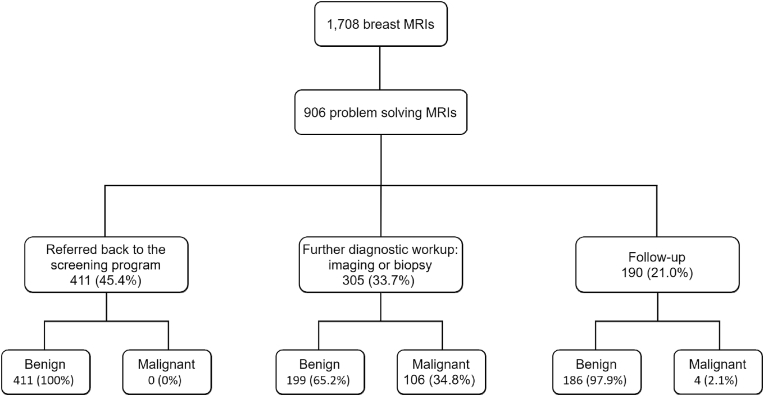
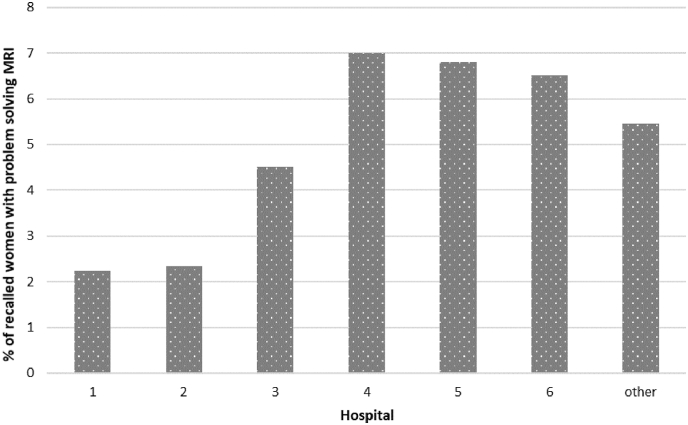
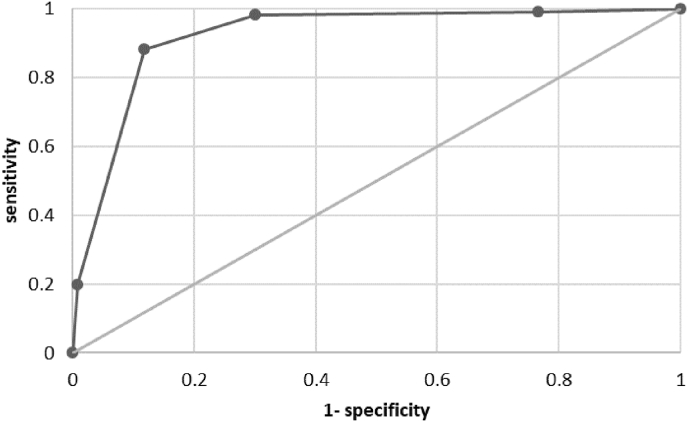
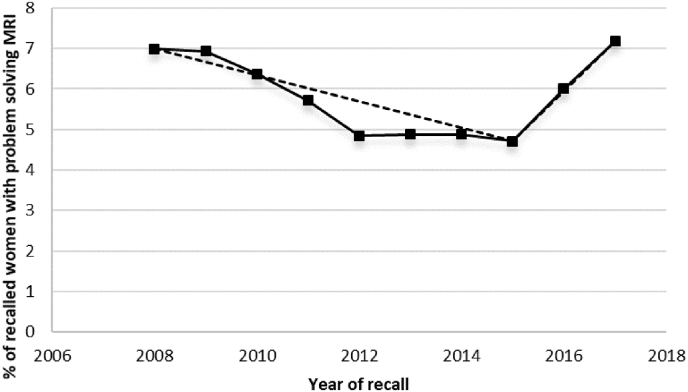
In the study period 16,175 women were recalled, of whom 906 underwent problem solving MRI. Almost half of the women (45.4%) who underwent problem solving MRI were referred back to the screening program without further workup. The sensitivity, specificity, and positive and negative predictive values of problem solving MRI were 98.2%, 70.0%, 31.1%, and 99.6%, respectively. The percentage of recalled women receiving problem solving MRI fluctuated over time (4.7%-7.2%) and significantly varied among hospitals (2.2%-7.0%).
The use of problem solving MRI may exclude malignancy in recalled women. The use of problem solving MRI varied over time and among hospitals, which indicates the need for guidelines on problem solving MRI.
问题解决型磁共振成像(MRI)用于排除在传统成像检查中发现结果不明确的女性患者的恶性肿瘤。然而,对于其在筛查后被召回的女性患者中的应用缺乏相关建议。本研究评估了问题解决型MRI对荷兰筛查项目中被召回女性患者诊断检查的影响,以及其使用的时间趋势和医院间差异。
纳入在荷兰南部进行乳腺钼靶筛查时被召回的女性患者(2008 - 2017年)。收集了两年的随访数据。评估了问题解决型MRI的诊断检查及准确性,并检查了其使用的时间趋势和医院间差异。
在研究期间,16175名女性被召回,其中906名接受了问题解决型MRI检查。接受问题解决型MRI检查的女性中,近一半(45.4%)在未进行进一步检查的情况下被转回筛查项目。问题解决型MRI的敏感性、特异性、阳性预测值和阴性预测值分别为98.2%、70.0%、31.1%和99.6%。接受问题解决型MRI检查的被召回女性的比例随时间波动(4.7% - 7.2%),且在不同医院间差异显著(2.2% - 7.0%)。
使用问题解决型MRI可能排除被召回女性患者中的恶性肿瘤。问题解决型MRI的使用随时间和医院而有所不同,这表明需要制定关于问题解决型MRI的指南。