Department of Internal Medicine, Inha University Hospital, Inha University School of Medicine, Incheon, Korea.
Department of Radiology, Inha University Hospital, Inha University School of Medicine, Incheon, Korea.
Clin Mol Hepatol. 2022 Jul;28(3):351-361. doi: 10.3350/cmh.2021.0281. Epub 2021 Nov 26.
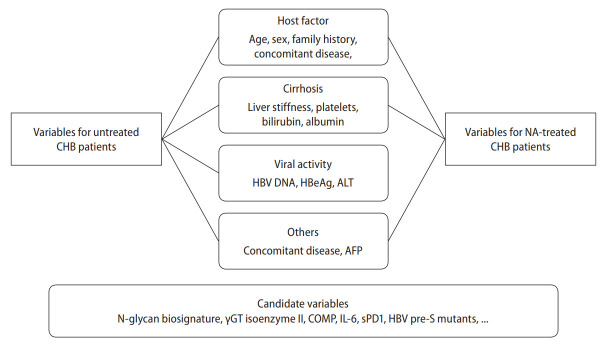
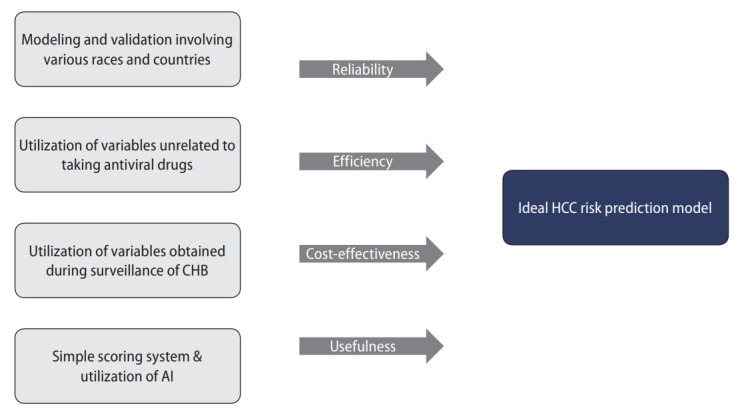
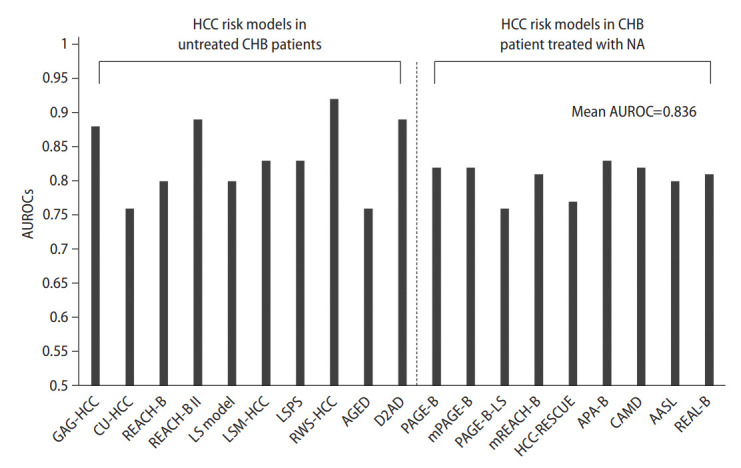
Chronic hepatitis B (CHB) seriously threatens human health. About 820,000 deaths annually are due to related complications such as hepatitis B and hepatocellular carcinoma (HCC). Recently, the use of oral antiviral agents has significantly improved the prognosis of patients with CHB infection and reduced the risk of HCC. However, hepatitis B virus still remains a major factor in the development of HCC, raising many concerns. Therefore, numerous studies have been conducted to assess the risk of HCC in patients with CHB infection and many models have been proposed to predict the risk of developing HCC. However, as each study has different models for predicting HCC development that can be applied depending on the use of antiviral agents or the type of antiviral agents, it is necessary to properly understand characteristics of each model when using it for the evaluation of HCC in patients with CHB infection. In addition, because different variables such as host factor, viral activity, and cirrhosis are used to evaluate the risk of HCC development, it is necessary to assess the risk by carefully verifying which variables are used. Recently, studies have also evaluated the risk of HCC using risk prediction models through transient elastography and artificial intelligence (AI) system. These HCC risk predication models are also noteworthy. In this review, we aimed to compare HCC risk prediction models in patients with CHB infection reported to date to confirm variables used and specificity between each model to determine an appropriate HCC risk prediction method.
慢性乙型肝炎(CHB)严重威胁人类健康。每年约有 82 万人死于乙型肝炎和肝细胞癌(HCC)等相关并发症。最近,口服抗病毒药物的使用显著改善了 CHB 感染患者的预后,降低了 HCC 的风险。然而,乙型肝炎病毒仍然是 HCC 发展的主要因素,引起了许多关注。因此,许多研究评估了 CHB 感染患者 HCC 的风险,并提出了许多模型来预测 HCC 的发病风险。然而,由于每个研究都有不同的预测 HCC 发展的模型,这些模型可以根据抗病毒药物的使用或抗病毒药物的类型进行应用,因此在评估 CHB 感染患者的 HCC 时,有必要正确理解每个模型的特点。此外,由于宿主因素、病毒活性和肝硬化等不同变量用于评估 HCC 发展的风险,有必要仔细验证使用哪些变量进行评估。最近,研究还通过瞬时弹性成像和人工智能(AI)系统评估了 HCC 风险预测模型。这些 HCC 风险预测模型也值得关注。在这篇综述中,我们旨在比较迄今为止报道的 CHB 感染患者的 HCC 风险预测模型,以确认每个模型之间使用的变量和特异性,从而确定合适的 HCC 风险预测方法。